
18 min read
By Dustin Thompson, Franchise Marketing and Development at Jack in the Box
Last updated: October 2, 2026
Key Takeaways
|
If you already run restaurants, you know how a franchise works. The harder question is whether this brand, in this market, on these terms, is a deal you'd still be glad you signed five years from now. Think about it, franchise terms can be five, ten, fifteen and twenty years long which means you really should do your homework before signing your development agreement.
I'm Dustin Thompson, and I work in Franchise Marketing and Development at Jack in the Box. Most of the people I talk with are trying to answer that exact question. Some run restaurants for other brands. Some own hotels or coffee shops and want to add a restaurant to their portfolio. Others are investors looking at our active development markets in Florida, Georgia, Illinois, Kentucky, Ohio, and Tennessee among others.
Since I work for the franchisor, I'm going to use our own 2026 Franchise Disclosure Document (FDD), issued March 13, 2026, as the example throughout this guide. I'll cover the parts that aren't sales copy, too. Any brand you're looking at should be willing to walk you through its FDD the same way.
In this guide:
- What a QSR franchise investment evaluation covers
- What federal law requires before you sign
- Which legal terms matter most to multi-unit operators
- How to figure out the full cost
- How to read Item 19
- What running the business takes day to day
- How to check the market
- Warning signs that should slow a deal down
- A step-by-step due diligence process
- Frequently asked questions
What Is a QSR Franchise Investment Evaluation?
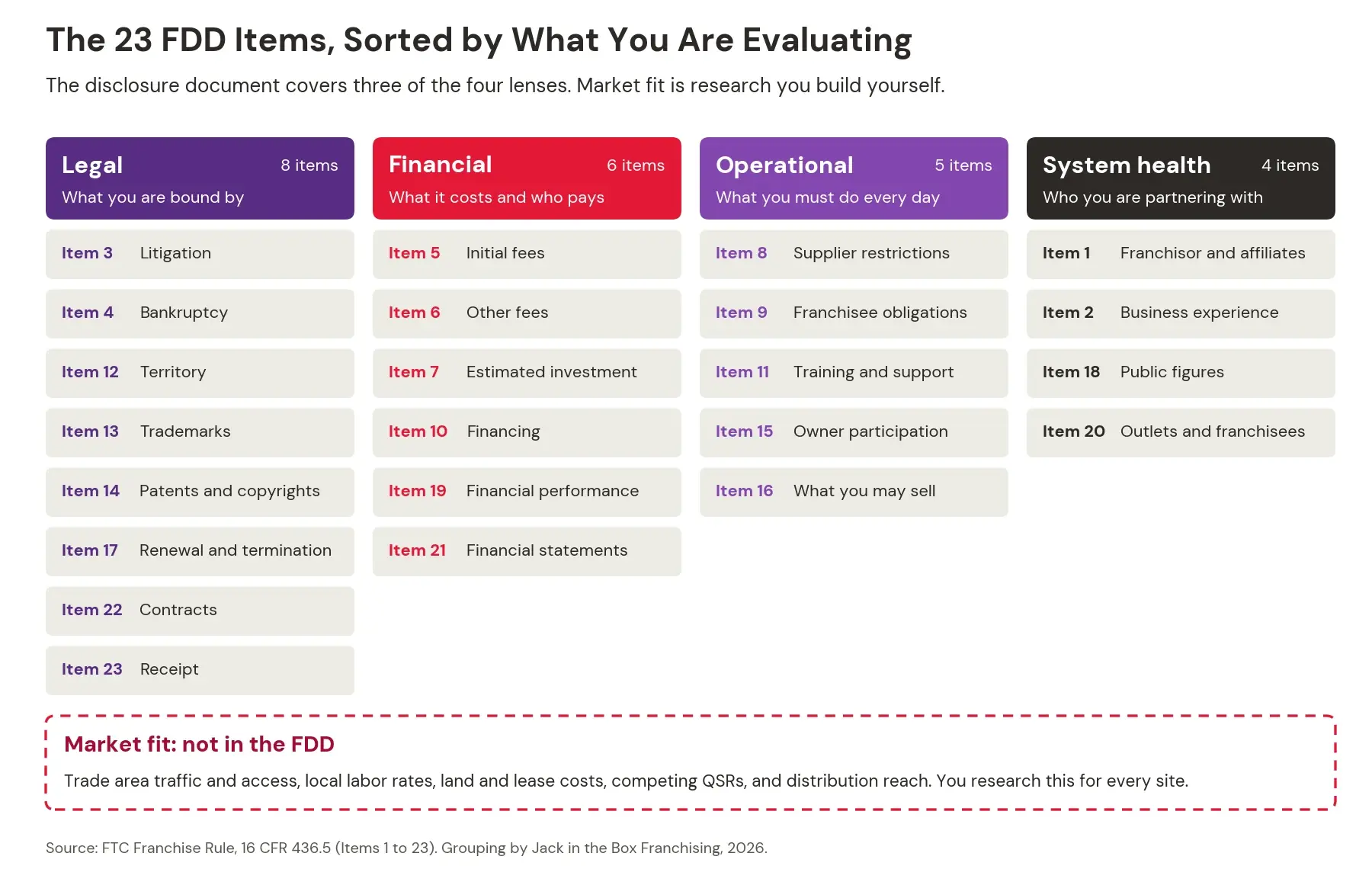
A QSR franchise investment evaluation is a close review of a quick-service restaurant franchise that you do before you sign anything. It covers the legal terms you'd agree to and the full cost to open and run the restaurant. It looks at the rules you'd follow every day, too, and whether your market can support another location.
Most of that work starts with the FDD. The FTC Franchise Rule sets the same 23-item format for every FDD, so once you've read one closely, comparing brands gets much easier.
The FDD can't tell you whether your trade area needs another drive-thru, though. You'll have to research that yourself, and I'll cover how later in this guide.
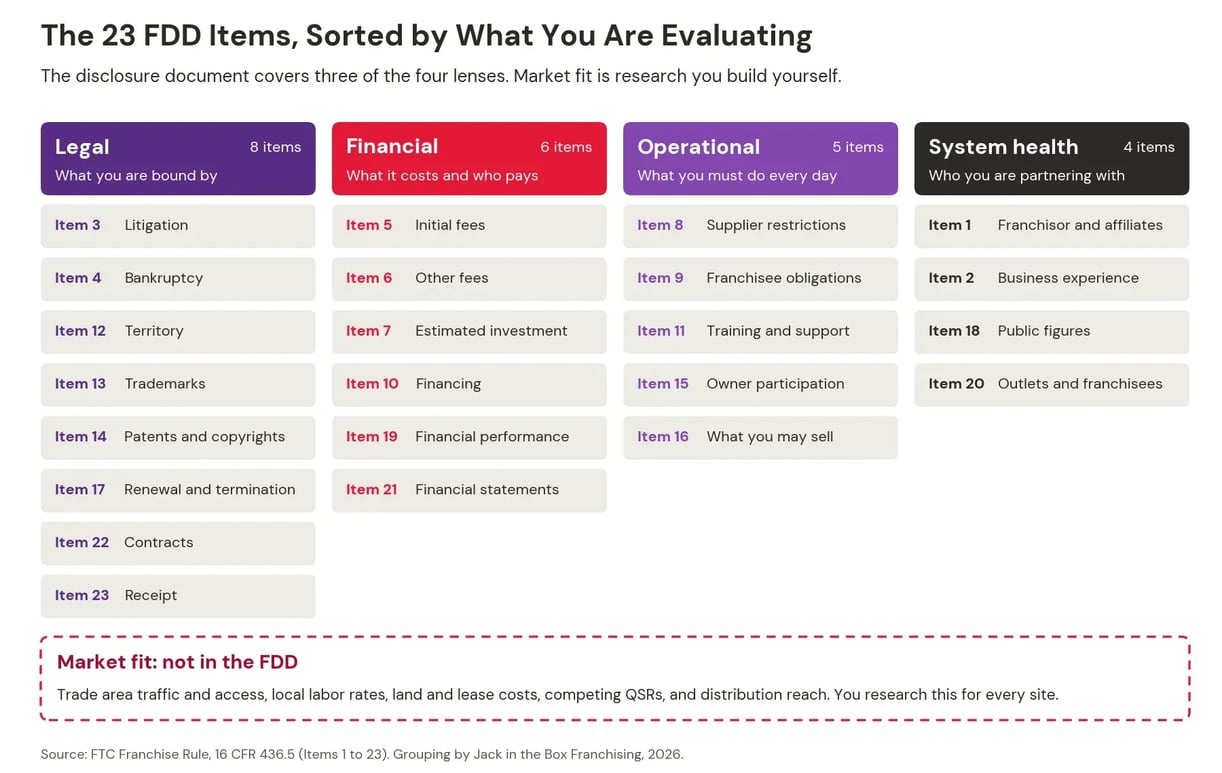
The FDD covers three of the four areas. You research market fit on your own. Source: FTC Franchise Rule, 16 CFR 436.5.
Why does a QSR franchise take more homework than other franchises?
A lot of the money in a quick-service restaurant goes into real estate and construction. In our 2026 FDD, the two biggest costs in Item 7 are building improvements, at $626,000 to $1,250,400, and on-site improvements, at $337,000 to $825,000. The cost of land isn't included in the total which can easily be one of the largest, if not THE largest expenses in owning a QSR franchise.
Restaurants need a big staff and a tight schedule to run. When you sign, you agree to set hours, staffing standards, food safety rules, and approved suppliers. A development agreement adds one more promise on top of that, which is to open each restaurant by a certain date. With that many pieces involved, plan on reading the FDD more than once.
What Does Federal Law Require Before You Sign a Franchise Agreement?
Under the FTC Franchise Rule, 16 CFR 436.2, a franchisor has to give you its current FDD at least 14 calendar days before you sign a binding agreement or pay any money. If the franchisor makes important changes to the agreement on its own, it has to give you the new version at least seven calendar days before you sign it.
No government agency checks the FDD for accuracy. Our own cover page says this in plain words. The FDD is information the franchisor has to share with you, and no agency has signed off on it.
Some states have their own franchise laws on top of the federal rule. A state-by-state overview from the law firm Wiley lists the states that require franchisors to register or file before they sell there. They include California, Illinois, Maryland, Minnesota, New York, Virginia, and Washington. Registration doesn't mean the state recommends the franchise. If your state has an addendum in the FDD, read it.
The FTC offers a free guide called A Consumer's Guide to Buying a Franchise. It's a good read before your first call with any brand.
Where can you find a brand's FDD before you talk to sales?
Some states post franchise filings online, and anyone can look them up. The Wisconsin Department of Financial Institutions franchise search is one of the easiest to use because you can search by the company's legal name or its brand name.
If the brand name doesn't turn anything up, try the legal name. A lot of brands sell franchises through a separate company. For Jack in the Box, that company is Different Rules, LLC, which is based in San Diego, California.
Some brands may choose not to register in registration states or, it might mean they aren't growing in those areas and there's no reason to register their FDD there. So if a brand doesn't turn up in the search above, ask the brand why.
What should you read first in an FDD?
I'd start with the page near the front called Special Risks to Consider About This Franchise. Some states require franchisors to list certain risks there. Ours, for example, says disputes have to be settled in court where our main office is, which is currently San Diego. If your restaurants are in Kentucky or Florida, that could make a dispute more expensive for you.
After that, read the page called How to Use This Franchise Disclosure Document. It lists common questions, like "How much will I need to invest?" and "Will my business be the only one in my area?" Then it tells you which Item answers each one. It works like a study guide for the rest of the FDD.
Which Legal Terms Matter Most to Multi-Unit Operators?
If you plan to own several restaurants, read four parts of the legal terms word for word. They cover how long the agreement lasts, what territory you get(if any), who has to run and guarantee the business, and how trouble at one restaurant can spread to the others. You'll find them in Items 12, 15, and 17 and in the agreements attached at the back of the FDD.
I find every brand has a different view and strategy for things like territory. It's important to understand what is offered and what isn't so there's no confusion down the road.
How long is the term, and can you renew?
Item 17 gives a summary of the rules for the term, renewal, ending the agreement, and selling the business. Read that summary first, and then read the section of the agreement it points to.
Our franchise agreement lasts 20 years, and it doesn't include a right to renew. When the term ends, we may offer you a new franchise agreement, but that choice is at our sole discretion. We look at things like how the restaurant has performed, your payment history, and the condition of the building. A new agreement can come with conditions, such as updating the building to current standards, signing a general release, and paying a new franchise fee. The new terms may be quite different from the original ones.
Whatever brand you look at, ask what it would take to keep operating after year 20.
What territory rights do you actually get?
Territory is one of the easiest terms to misunderstand, so read Item 12 closely.
Under our franchise agreement, you get the right to a specific site. You don't get an exclusive territory. Our development agreements can include protected development rights, such as a one-mile radius around agreed market points, and Item 12 explains the limits on those rights. It says we can sell through other channels, like the internet, food trucks, or grocery stores.
Before you sign, put every site you plan to build and every restaurant you already own, for any brand, on one map. Then go back and read Item 12 again with that map in front of you.
Who has to run the restaurant, and who signs the guarantee?
Item 15 explains who has to be involved in running the business. At Jack in the Box, each restaurant needs an approved Operator who owns at least 25% of the franchised business and is highly experienced in quick-service restaurants. Each restaurant also needs a manager who has finished our Certified Restaurant Manager training. Once you have 15 or more restaurants, you need at least one employee whose job is to help you oversee operations across your restaurants.
If you own the business through a company, every owner signs a guarantee. Talk this through with your partners early.
How can a problem at one restaurant affect the others?
When you own several restaurants, your agreements are often tied together. That means a default under one agreement can lead to defaults under others. Our Item 10 gives an example. If you default on the note for a Development Incentive loan, one possible result is a cross default under your related franchise and lease agreements.
Ask your attorney to find every cross-default clause in your franchise agreements, development agreement, leases, and loan notes. It's much easier to deal with these before you sign the first one.
How Do You Analyze the Full Cost of a QSR Franchise?
From my experience, I would go in this order. Start with Item 7, then add the costs Item 7 leaves out, and then add the ongoing fees from Item 6. If you work through it that way, the big number at the top of Item 7 is less likely to shape your whole budget.
Our 2026 FDD estimates the total investment for a Jack in the Box restaurant you build at $1,909,500 to $4,041,500. The initial franchise fee is $50,000. After you open, you pay a royalty of 5% of gross sales and a marketing fee of 5% of gross sales. Our franchise costs page has the full breakdown.
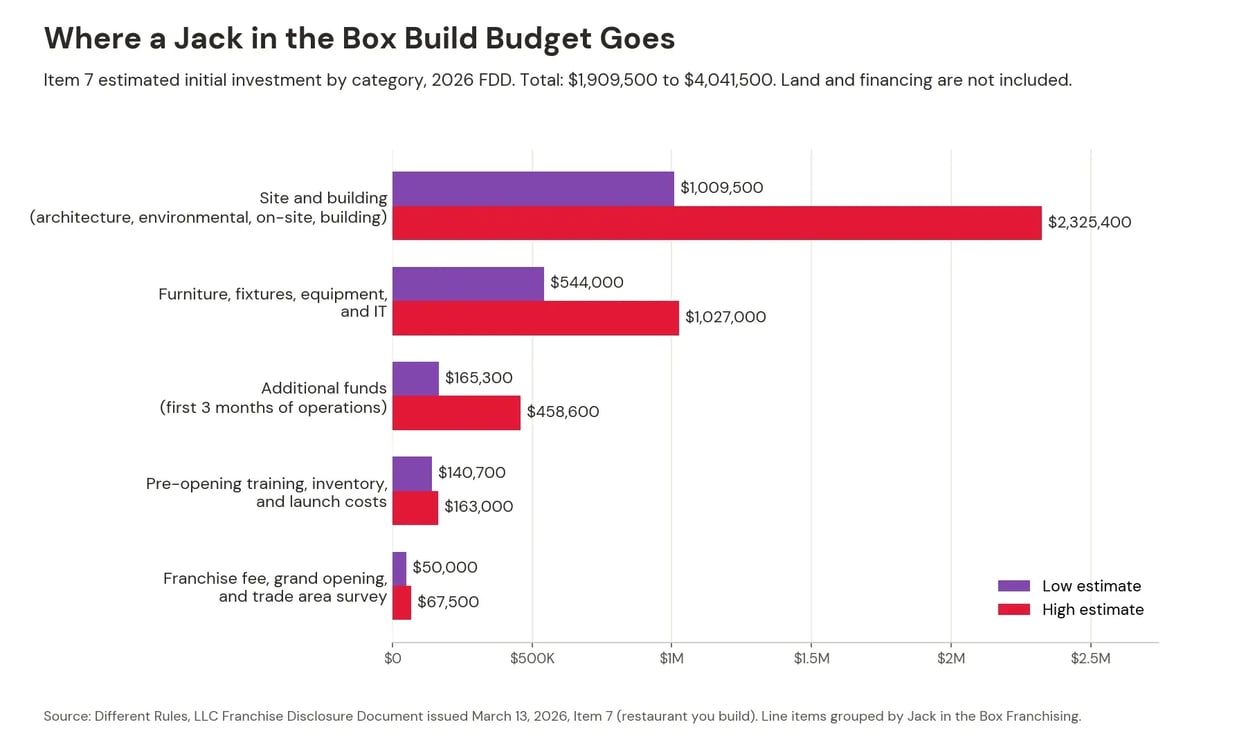
Item 7 costs grouped into five categories. Source: Different Rules, LLC Franchise Disclosure Document issued March 13, 2026, Item 7.
What does the Item 7 total leave out?
The notes under the Item 7 table tell you what the total includes and what it doesn't. Our notes include these points.
- Land isn't included.
- Financing costs aren't included, so your interest rate, loan fees, and down payment will change the total.
- The "additional funds" line covers your first three months of operating costs, such as wages, food and supplies, utilities, repairs, and insurance. It doesn't cover royalties, marketing fees, rent, officer pay, and several other costs.
- The IT line suggests setting aside another $2,000 to $6,000 for hardware your site might need. You'll also pay a point-of-sale software fee of $280 to $369 a month to the vendor.
- The estimates are based on our prototype buildings, which range from 1,386 to 2,440 square feet, and a 1,317-square-foot modular option. You can see them on our prototype page.
Every brand writes these notes a little differently. Build a spreadsheet that starts with the Item 7 numbers and adds a line for each cost the notes leave out.
Which ongoing fees should you plan for?
Item 6 lists every fee you'll pay after you open. For a traditional Jack in the Box restaurant, the two biggest are the 5% royalty and the 5% marketing fee, and both are figured on gross sales.
It helps to know how those rates could change. Our marketing fee can go up if a majority of the restaurants paying the standard fee vote for it. Any increase is capped at 0.5% of gross sales in a 24-month period. The same Item shows that royalty rates across our system range from 0% to 12.5%, based on things like nontraditional sites, new markets, incentive programs, and legal settlements.
While you're in Item 6, look at technology fees, transfer fees, and rent if you lease from the franchisor. Check what a new agreement would cost at the end of the term, too.
| Term | 2026 FDD figure | Where to find it |
|---|---|---|
| Estimated initial investment, one restaurant you build | $1,909,500 to $4,041,500 | Item 7 |
| Estimated initial investment, two-restaurant development agreement | $3,820,000 to $8,088,000 | Item 7 |
| Initial franchise fee, traditional restaurant | $50,000 | Item 5 |
| Development fee, new developers | $50,000 for the first restaurant, $10,000 for each one after that | Item 5 |
| Royalty | 5% of gross sales | Item 6 |
| Marketing fee | 5% of gross sales | Item 6 |
| Franchise term | 20 years, no right to renew | Item 17 |
| Operator training | About 10 to 14 weeks (560 hours) | Item 11 |
| Operator ownership | At least 25% | Item 15 |
| Minimum liquid assets and net worth | $750,000 liquid, $1,500,000 net worth | Franchise costs page |
How do development agreements change the math for multi-unit buyers?
When you plan to open more than one restaurant, the development agreement has its own costs, and you should budget for them separately.
Our 2026 FDD estimates the total initial investment for a two-restaurant development agreement at $3,820,000 to $8,088,000. New developers pay a development fee of $50,000 for the first restaurant and $10,000 for each one after that. Existing franchisees pay $10,000 per restaurant. The fee isn't refundable, but if you follow the agreement, each restaurant's share counts toward its initial franchise fee.
Building a restaurant depends on permits, contractors, and landlords, and any of them can slow you down. That's why the extension terms matter. Ours let you extend each deadline once, for 12 months, if you give us six months' written notice. You pay $5,000 for each deadline you extend, and you sign an amendment that includes a general release.
Multi-unit developers may qualify for two incentive programs. Both have eligibility requirements, both are offered at our sole discretion, and we may change or discontinue either one at any time.
- Development Incentive. If you're a qualified developer who signs for at least three restaurants and opens on schedule, we may loan you $150,000 at 0% interest. The loan goes toward the development costs of a qualifying restaurant. You repay it through that restaurant's royalty payments until it's paid off. The loan doesn't require a security interest, and you can pay it off early with no penalty (Items 5 and 10).
- Select Market Incentive. This program is for developers who commit to at least three restaurants in a market we name as a Select Market. For qualifying restaurants, the royalty may drop from 5% to 2% of gross sales for the first five years (Item 5).
You'll find more on our multi-unit development page. Before you count on any incentive, make sure it's written into your agreement or an amendment.
How Should You Read Item 19?
Franchisors don't have to include Item 19. When they do, it shows what a certain group of existing restaurants reported over a certain period, and the franchisor has to explain how that group was chosen. It isn't meant to predict how your restaurant will do.
In our 2026 FDD, the system average gross sales for franchised traditional Jack in the Box restaurants in the continental U.S. was $1,913,335 for the 12 months that ended September 30, 2025. That number is gross sales only. It isn't profit or income, and it doesn't subtract royalties, rent, labor, or any other cost.
The group behind that number leaves out restaurants in convenience stores and travel plazas. It also leaves out restaurants that opened or closed during the period and restaurants without a full year of data under the same operator. Restaurants outside the continental U.S. aren't included either. Franchisees reported the data, and it hasn't been audited. Some outlets have earned these amounts. Your individual results may differ. There is no assurance you will earn as much.
When you read any brand's Item 19, look for answers to these four questions.
- Which restaurants are included, and which ones were left out? If the group is different from the kind of restaurant you'd open, the numbers won't line up with your situation.
- Is the number gross sales, or does it take costs into account? Gross sales and profit are very different numbers.
- Does it show a median and results by tier, or only an average?
There's one more line in Item 19 you should know about. Our FDD says we don't allow our employees or representatives to share financial performance information outside of Item 19, and that includes me. If anyone gives you projections that aren't in Item 19, the FDD asks you to report it to the franchisor's management, the FTC, and your state regulator.
What Does QSR Business Ownership Take Day to Day?
When you own a QSR franchise, you run the business using the brand's system and meet the brand's standards. Items 8, 9, 11, and 16 explain where you have to buy supplies, what you're required to do, what help the franchisor gives you, and what you're allowed to sell.
How much training do you need before you open?
At Jack in the Box, the Franchise Operator training program takes about 10 to 14 weeks, or roughly 560 hours. It's held in San Diego, Dallas, or Los Angeles. The cost of training is included in the initial franchise fee, but you pay for your own travel and living expenses. Our training and support page has more detail.
If you run other restaurants, that's a big block of time to plan around. Decide early who on your team will go through the training and when they'll do it.
What rules apply to suppliers and the marketing fund?
Most QSR brands make you buy from approved suppliers. Every FDD has a general risk page that warns those items may cost more than similar ones you could buy on your own. Item 8 tells you whether the franchisor keeps any rebates from suppliers. Under ours, rebates from certain approved suppliers go back to franchisees based on what each one actually bought.
Ask who runs the marketing fund, how the money is spent, and whether the fund is audited. Our Item 11 says the company runs the fund and it isn't audited. Our franchisee Leadership Advisory Council can ask for quarterly reports on it. Every brand handles this a little differently, so it's a fair question to ask on every call.
What should you ask current and former franchisees?
Item 20 and the exhibits that go with it list current franchisees and people who have left the system. The FDD's own guide page suggests calling them. Our Item 20 notes that some current and former franchisees have signed agreements that limit what they can talk about. It lists the independent franchisee associations the company knows about, and I'd call them too.
If I were in your seat, I'd ask these questions.
- How close did your actual building costs come to the Item 7 range?
- How long did it take to go from signing to opening day?
- What was hiring and staffing like during your first year?
- When something goes wrong, how does the franchisor respond?
- For former owners, why did you leave, and what do you wish you had checked before you signed?
How Do You Check the Market Before You Commit to Opening Dates?
The FDD tells you about the brand, but it can't tell you whether your area can support another restaurant. You'll need to build that case yourself before you agree to a development schedule. Look into these five things for every market.
- Traffic and access. Find out how many cars pass each day, how easy it is to turn in, and whether there's room for a drive-thru line.
- Labor. Look at local wage rules and how many people are available to hire. The U.S. Department of Labor keeps a table of state minimum wages, and several states adjust their rates every year.
- Real estate. Price out land and leases, since Item 7 may not include land.
- Competition. Count every quick-service restaurant in the area, including brands that don't sell burgers.
- Supply chain. Ask how well food distributors reach the market, since that can affect your food costs.
Some of this ties into our program terms. For the Select Market Incentive, a Select Market is a place where we decide food or other operating costs are higher than average because of supply chain conditions. Also, if you want to build within 15 miles of an existing Jack in the Box, we may require a trade area survey. Item 7 lists that at $0 to $7,500 plus expenses.
Our active development markets are Florida, Georgia, Illinois, Ohio, Michigan, Kentucky, North Carolina, South Carolina, and Tennessee, and you can find them on our available markets page. Illinois is also a franchise registration state, so if you build there, its state addendum will be part of your FDD review.
What does national restaurant data show for 2026?
The National Restaurant Association's 2026 State of the Restaurant Industry report projects $1.55 trillion in total restaurant and foodservice sales this year, with real growth of 1.3% after inflation. The report projects the industry will employ 15.8 million people, with operators adding about 100,000 jobs. The report notes that costs are still rising and customer traffic has been uneven. These are national numbers, so check how your own trade area compares.
What Warning Signs Should Slow Down a QSR Franchise Deal?
A lot of franchise due diligence comes down to comparing what you were told with what the documents say. The table below lists common warning signs, where to look for them, and what to do next.
| Warning sign | Where to check | What to do |
|---|---|---|
| Pressure to sign or pay before 14 calendar days have passed | Item 23 receipt and 16 CFR 436.2 | Wait. Federal law gives you the full 14 days. |
| Sales or profit numbers that aren't in Item 19 | Item 19 | Ask for them in writing, and report them the way the FDD says to. |
| Unclear answers about territory | Item 12 and the agreements | Get the exact wording from the agreement and a map. |
| Financial statements you can't make sense of | Item 21 and Exhibit A | Have your accountant go through them. |
| Lots of transfers or closures in the outlet tables | Item 20 | Call former franchisees and ask why they left. |
| Incentives that are only promised out loud | Items 5, 6, and 10 | Get them written into the agreement or an amendment. |
| A broker who won't say how they get paid | The broker's disclosure | Ask before you share your financial information. |
California has passed new rules for franchise brokers. Its SB 919 requires brokers to register with the state and give buyers a disclosure document. You can see more on that bill here.
What Does a Step-by-Step Franchise Due Diligence Process Look Like?
This is the order I'd follow for any QSR brand, since each step gives you information you'll use in the next one.
- Ask for the FDD and sign the receipt. The 14-day clock starts when you get it.
- Read the front pages and Items 1 through 4. These cover risks, the franchisor's background, lawsuits, and bankruptcy.
- Build your cost model. Use Items 5, 6, 7, and 10, and add a line for each cost Item 7 leaves out.
- Read Item 19 closely. Note what it includes and what it leaves out, and ask for the written substantiation.
- Call current and former franchisees. Use the lists in Item 20 and its exhibits.
- Research your market. Look at sites, traffic, labor, real estate, and competition.
- Get a professional review. Have a franchise attorney review the agreements and an accountant review your cost model and Item 21.
- Meet the franchisor's leadership and operations team. Bring the questions your research turned up.
- Sign only after every open question has a written answer. Wait at least 14 calendar days after you got the FDD.
Our own steps are on our franchise process page. If you want more detail on building the numbers, read our guide to QSR franchise investment evaluation.
Where Should You Start?
Start with the FDD itself. Read the front pages, then turn Item 7 into a spreadsheet with a line for every note under the table. After that, call franchisees. When you meet with a franchisor's leadership team, you'll be able to ask about specific Items, and you'll get a lot more out of the meeting.
If you're considering a Jack in the Box franchise the please visit our overview of the Jack in the Box franchise is a good place to begin. When you're ready to talk, contact our franchise development team. We'll send you the current FDD and go through any Item you have questions about.
Frequently Asked Questions About Buying a QSR Franchise
How long do you have to review an FDD before signing?
At least 14 calendar days. Under the FTC Franchise Rule, the franchisor has to give you its current FDD at least 14 calendar days before you sign a binding agreement or pay any money. If the franchisor makes important changes to the agreement on its own, you have to get the new version at least seven calendar days before you sign. You can always take more time than the rule requires.
What should I read first in a Franchise Disclosure Document?
Start with two pages at the front. The Special Risks to Consider page lists risks that some states require the franchisor to point out. The How to Use This Franchise Disclosure Document page tells you which Item answers common questions. After that, read Items 1 through 4 for the franchisor's background, lawsuits, and bankruptcy history, and then move on to fees and costs in Items 5 through 7.
Does Item 19 tell me how much my restaurant will make?
No. Item 19 shows past results for a certain group of existing restaurants, and the franchisor has to explain how that group was chosen. It doesn't predict your results. In the 2026 Jack in the Box FDD, the FY2025 system average gross sales for franchised traditional restaurants in the continental U.S. was $1,913,335. That number is gross sales only, not profit, and it comes from a specific group of restaurants that may not match yours. Some outlets have earned these amounts. Your individual results may differ. There is no assurance you will earn as much.
How much does it cost to open a Jack in the Box franchise?
The 2026 FDD estimates the total initial investment for a Jack in the Box restaurant you build at $1,909,500 to $4,041,500. That range doesn't include land or financing, but it does include the $50,000 initial franchise fee. After you open, you pay a 5% royalty and a 5% marketing fee, both based on gross sales. Candidates need at least $750,000 in liquid assets and a net worth of at least $1,500,000.
Do I need restaurant experience to buy a QSR franchise?
It depends on the brand, so check Item 15 in each FDD. At Jack in the Box, every restaurant needs an approved Operator who owns at least 25% of the franchised business and is highly experienced in quick-service restaurants. Each restaurant also needs a manager who has finished the Certified Restaurant Manager program.
Can I use an SBA loan to buy a QSR franchise?
Possibly. The SBA brought back its Franchise Directory under SOP 50 10 8, which took effect June 1, 2025. In general, a brand has to be listed there before a lender can make an SBA 7(a) or 504 loan to its franchisees. Look up each brand you're considering in the directory, and ask an SBA lender whether you qualify.
Does Jack in the Box offer incentives for multi-unit developers?
Two programs may apply. Each one has eligibility requirements, is offered at the company's sole discretion, and may be changed or discontinued at any time. The Development Incentive may provide a $150,000 loan at 0% interest toward development costs for qualified developers who sign for at least three restaurants and open on schedule. The Select Market Incentive may lower the royalty from 5% to 2% of gross sales for five years on qualifying restaurants in markets the company chooses. Items 5 and 10 of the 2026 FDD have the details.
Keep Reading
- How Much Does a Jack in the Box Franchise Cost?
- Does Jack in the Box Offer Franchise Incentives?
- Owning vs Leasing Real Estate: Pros and Cons
|
About the author Dustin Thompson works in Franchise Marketing and Development at Jack in the Box. The brand's franchises are offered by Different Rules, LLC, which is based in San Diego, California. He works with multi-unit operators and others considering a franchise in the brand's active markets of Florida, Georgia, Illinois, Kentucky, and Tennessee. He also writes the franchise education content on jackintheboxfranchising.com. Dustin is not authorized to make, and this article does not make, any financial performance representation beyond what appears in Item 19 of the current Jack in the Box Franchise Disclosure Document. |
This article is for general information only and is not legal, tax, or financial advice. It is not an offer to sell, or a solicitation of an offer to buy, a franchise. Any offer is made only by means of a Franchise Disclosure Document, and in states that regulate franchise sales, only after any required registration. Figures are from the Different Rules, LLC Franchise Disclosure Document issued March 13, 2026, unless another source is linked. Review the current FDD and all agreements with your own attorney and accountant.