
When was Jack in the Box founded, and who founded it?
Jack in the Box was founded in 1951 in San Diego, California, by Robert O. Peterson. He did not build a new restaurant to do it. He converted an existing carhop drive-in he already owned on El Cajon Boulevard into a drive-thru hamburger stand, equipped it with a two-way intercom, and put a large jack-in-the-box clown on the roof so drivers could spot it from down the road.
Hamburgers were 18 cents.
.webp?width=1000&height=563&name=jack-in-the-box-brand-timeline-1951-2022%20(1).webp)
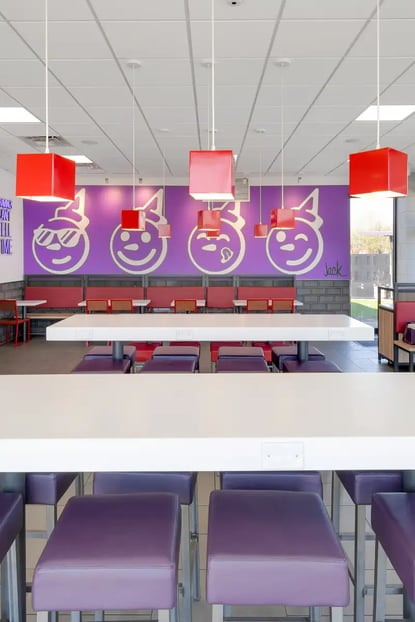
What is Jack in the Box?
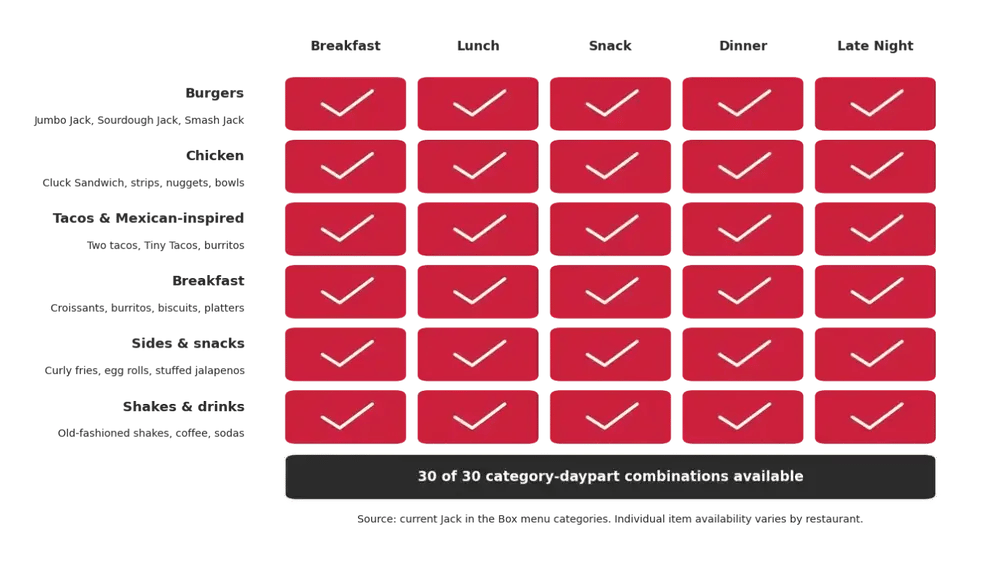
Jack in the Box is a quick-service burger brand that runs on a 24-hour clock and sells across five dayparts. Burgers are the anchor. Tacos, a full breakfast menu, chicken sandwiches, curly fries and shakes sit next to them on the same menu board, available at the same hours.
That combination is the short answer to why the brand does not read like its competitors. Most burger chains built a burger menu and then bolted on a breakfast window. This one was built as what the founder called a modern food machine, and the menu grew outward from convenience rather than from a single hero product.
I have spent my career on the development side of restaurant franchising, and here is the part that surprises people who only know the brand from a drive-thru at midnight: the personality is not a marketing layer added later. It is the operating model showing through.
What did Jack in the Box actually do first?
It made the drive-thru the point of the restaurant rather than a side door. Other operators had drive-up windows before 1951. What the first Jack in the Box did was pair that window with a two-way intercom so one car could order while another was being served, and then design the entire building around that flow.
You do not have to take a franchise marketing page's word for it. Jack in the Box Inc. put the claim in writing in its annual report filed with the U.S. Securities and Exchange Commission, where the company described itself as the first chain to develop and expand the drive-thru-only restaurant concept, and noted that most of its restaurants at the time ran between 18 and 24 hours a day. That filing is public on EDGAR.
I point candidates to that document more than any other piece of brand history, because a statement in an SEC filing carries a different weight than a statement on a website. Ours included.
Why is it called Jack in the Box?
The name came from the roof. When the first restaurant opened in 1951, a large jack-in-the-box clown sprang from a box above the building, and a smaller clown head sat on top of the ordering speaker in the drive-thru lane.
There is a detail there that I like more than the clown itself. Ordering food by talking into a box was so unfamiliar in 1951 that the speaker panel needed instructions printed on it. The Smithsonian's National Museum of American History holds one of those original panels in its collection. The lettering told drivers to pull forward, because Jack would speak to them.
A brand that had to explain the concept of a speaker box now takes orders through a mobile app. The through line is the same one either way, which is removing steps between a hungry customer and their food.
.webp?width=1060&height=1134&name=old-time%20jack%20in%20the%20box%20WebP%20(1).webp)
How does the 24-hour clock change the restaurant?
It gives the restaurant five demand bands instead of two or three, and it moves the operating challenge from menu management to labor and prep design.
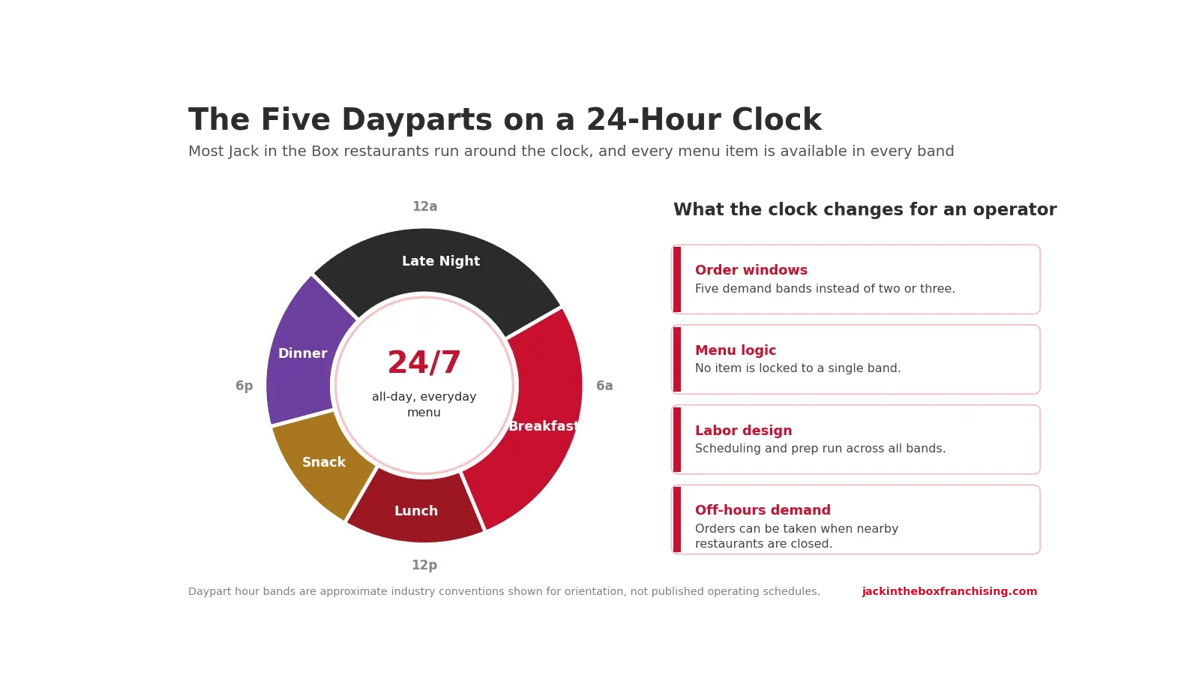
Hour bands are approximate QSR industry conventions shown for orientation, not published operating schedules.
Most Jack in the Box restaurants run 24 hours a day, with some exceptions by location and market. That is an operational commitment rather than a slogan, and it cuts in both directions. Staffing an overnight shift is real work. Being open when nearby restaurants are not means the restaurant can take orders in hours that are simply unavailable to a competitor who locked the door at 10 p.m.
Industry data has been moving toward that shape, not away from it. Datassential's 2026 foodservice outlook found that snacking, late-night eating and nontraditional dayparts continue to rise as consumers spend more deliberately. Circana's eating-patterns work, reported by Nation's Restaurant News, found the line between meals and snacks blurring, with 462 snacking occasions a year now happening during traditional mealtimes. Meanwhile the National Restaurant Association's 2026 State of the Restaurant Industry report forecasts modest real sales growth of 1.3 percent for the year, with 60 percent of operators having reported softer customer traffic the year prior.
Read those together and the takeaway is not a promise. It is a description of terrain. Demand is spreading across the clock while overall traffic is flat, which means where you can capture an order matters as much as how many orders exist.
What that means for your specific market, your build, and your development schedule is a conversation for the available markets and multi-unit opportunity pages. I am not going to hand-wave it here.