
Burger Franchise Startup Costs 2026 | Brand Comparison
Compare 2026 startup costs for McDonald's, Wendy's, Burger King, and Jack in the Box: franchise fees, FDD investment ranges, and liquidity...
8 min read
By Dustin Thompson, Franchise Marketing & Development at Jack in the Box
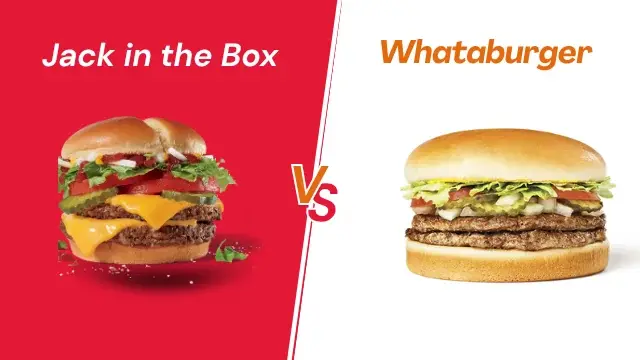
If you have landed here, you are probably weighing two burger brands and trying to figure out which one you can actually buy into. I get that question a lot. I work on the franchise marketing and development team at Jack in the Box, and "how do you stack up against Whataburger?" comes up in calls almost every week.
So let me give you a straight, side-by-side look. I last wrote a version of this comparison in 2022, and a fair amount has changed since then, on both sides. I pulled the Jack in the Box numbers from our current Franchise Disclosure Document, and I sourced the Whataburger figures from its published franchising materials and recent reporting. Where Whataburger keeps something private, I will say so rather than guess.
Why you can trust this comparison. My job at Jack in the Box is franchise development, so I read our FDD, walk candidates through the numbers, and help operators figure out where they can build. I am not a neutral party, and I will not pretend to be. What I can do is show you the published figures from both brands, link to the sources, and be honest about the parts where Whataburger does not share its data.
Two things shifted. First, Whataburger has been on a long expansion run since the Dobson family sold its majority stake to a Chicago investment firm, now known as BDT & MSD Partners, back in 2019. The brand has pushed well past its Texas roots into new states across the South and Midwest.
Second, Jack in the Box kept growing its own map. In February 2026, we opened our first restaurant in Florida, in Longwood, which marked a new region for the brand. If you were looking at either company a few years ago, the picture today is different enough that the old article needed a rewrite.
Scale matters when you are picking a market, because a crowded category leaves you fewer good corners to build on. For context, McDonald's operates more than 13,800 restaurants in the United States as of mid 2026. That is the saturation benchmark everyone measures against.
Whataburger is far smaller. The chain has grown to more than 1,100 restaurants across 17 states, with most of those locations company owned rather than franchised. Jack in the Box operates across more than 20 states and, as noted above, just entered Florida.
Here is the practical read: both burger brands are a fraction of McDonald's size, which means the category is nowhere near full. The difference is who gets to plant a flag. Jack in the Box franchises broadly to qualified operators. Whataburger keeps tight control and opens franchise doors selectively.
This is usually the first filter, and it is the biggest gap between the two brands. To be considered for a Jack in the Box franchise, we look for a minimum net worth of $1.5 million and liquidity that starts around $750,000 and ranges up to $750,000 depending on the deal.
Whataburger sits in a different tier. Its published requirements call for a minimum net worth of $12.5 million and $5 million in liquid capital, according to the company's franchising information and third-party summaries of it. That is a multimillionaire-only door.
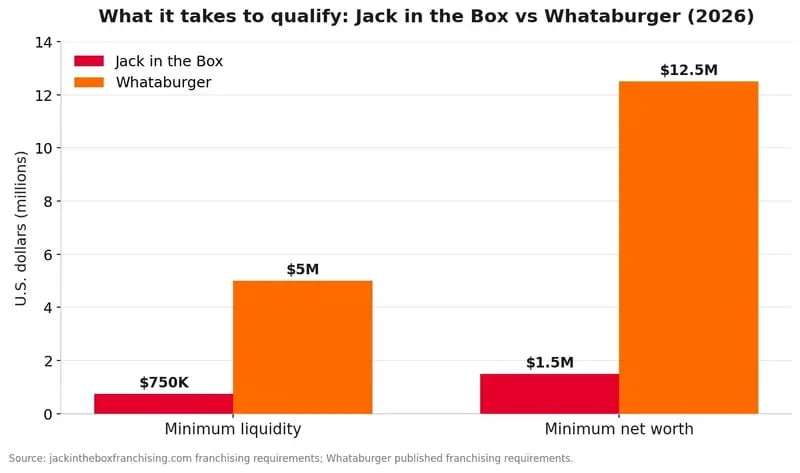
Figure 1. Minimum financial qualifications to franchise, Jack in the Box vs Whataburger (2026). Jack in the Box liquidity shown at the low end of its published $750K range.
One more detail that often gets missed: if you cannot hit those numbers on your own, the path is not closed at Jack in the Box. We allow business partners, and many candidates pull together resources through partnerships, stocks, or a 401(k) rollover. I will come back to that.
Qualifying is one thing. Building is another. The estimated initial investment for a Jack in the Box restaurant is $1,909,500 to $4,041,500 per location, excluding land and financing, per Item 7 of our 2026 FDD. That covers building improvements, equipment, inventory, training, and operating cash. You can see the full breakdown on our franchise cost and fees page.
Whataburger does not publish an Item 7 to the public the way we do, so the figures floating around come from outside estimates. Reporting and franchise data sources put a Whataburger build somewhere in the $1.2 million to $3 million range or higher per restaurant, with cost driven heavily by real estate and the state you build in. Treat those as estimates, not official numbers.
Jack in the Box charges a $50,000 initial franchise fee per restaurant, with a 25% discount for qualifying veterans that brings it to $37,500. On top of that, franchisees pay a 5% royalty and a 5% marketing fee on gross sales. Those fees are spelled out in the FDD, and you can read more on our cost breakdown.
Whataburger does not publicly disclose its initial franchise fee or its royalty structure. I am not going to put a number on it, because I do not have a verified one to share. If a third-party site quotes you a precise Whataburger royalty, ask them where it came from.
Yes, and this is where the math gets interesting for multi-unit operators. We run a development incentive program with two options. One reduces your royalty on a tiered schedule in the early years before it returns to the standard 5%. The other is a $150,000 interest-free loan toward development. The exact terms live in the FDD and on our site, and they change, so confirm the current version with our team before you plan around them. Visit our incentive calculator here to see how it will impact your numbers.
At Jack in the Box, you can have business partners help you meet the investment requirements. In practice, a lot of our operators come in as groups, and I would rather see a well-capitalized partnership than a single buyer who is stretched thin.
Whataburger's model points a different direction. Rather than emphasizing partner flexibility, it asks franchisees to commit to opening at least five restaurants over a five-year window. That is a development obligation, not a single-store entry. It fits experienced, deep-pocketed operators and screens out almost everyone else by design.
Both brands let franchisees control the property, but they lean different ways. At Jack in the Box, you can buy or lease the site, and we have an in-house real estate and leasing team that helps you find locations and work through lease negotiations.
Whataburger has historically preferred ground leases in most situations, where the operator controls the land under the building. Same end goal, real estate ownership, with a different default starting point.
Menu is not just a customer question. It shapes your dayparts, your labor, and your sales windows. Both brands sell burgers, fries, and shakes, and both run long hours.
Where Jack in the Box differs is breadth. We run a 24/7 menu built around five dayparts, so a guest can order most of the menu at any hour. Alongside the burgers, we carry items you will not find at a traditional burger chain, including tacos and egg rolls, which have a genuine following of their own. For an operator, more dayparts means more chances to capture a sale across the day and overnight.
Here is the whole picture in one view. The image below is a clean reference you can save, and the same numbers are in the table underneath for quick reading.
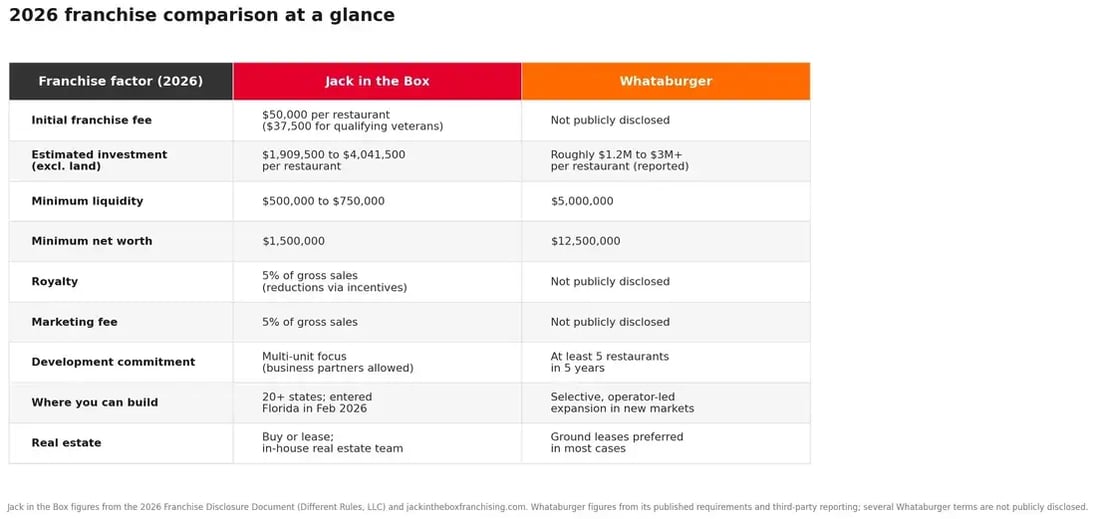
Caption: Figure 2. Side-by-side franchise comparison, 2026. Jack in the Box figures from the 2026 FDD and jackintheboxfranchising.com; Whataburger figures from its published requirements and third-party reporting.
| Franchise factor (2026) | Jack in the Box | Whataburger |
|---|---|---|
| Initial franchise fee | $50,000 per restaurant ($37,500 for qualifying veterans) | Not publicly disclosed |
| Estimated investment (excl. land) | $1,909,500 to $4,041,500 per restaurant | Roughly $1.2M to $3M+ per restaurant (reported estimate) |
| Minimum liquidity | $500,000 to $750,000 | $5,000,000 |
| Minimum net worth | $1,500,000 | $12,500,000 |
| Royalty | 5% of gross sales (reductions via incentives) | Not publicly disclosed |
| Marketing fee | 5% of gross sales | Not publicly disclosed |
| Development commitment | Multi-unit focus; business partners allowed | At least 5 restaurants in 5 years |
| Where you can build | 20+ states; entered Florida in Feb 2026 | Selective, operator-led expansion in new markets |
| Real estate | Buy or lease; in-house real estate team | Ground leases preferred in most cases |
Whataburger does not publish a public FDD Item 7 or fee schedule, so its figures are reported estimates. Jack in the Box figures come from the 2026 Franchise Disclosure Document (Different Rules, LLC).
There is no single winner here, and I am not going to pretend one exists. It comes down to who you are as a buyer.
If you have eight figures of net worth, $5 million in cash, and you want to develop five restaurants in a market Whataburger has chosen, Whataburger is built for you. If that is not your profile, the door is effectively closed, and that is fine to know early.
If you are a qualified operator who wants a published set of numbers, the option to bring in partners, the choice to buy or lease your real estate, and a broad map of states to build in, Jack in the Box is the more accessible path. That accessibility is the real difference in 2026, more than the burgers.
My honest advice, whichever way you lean: read the actual disclosure document before you fall in love with a brand. For us, that starts by requesting the FDD. If you want a wider view of the category first, I put together a rundown of every major burger franchise that sells in the United States, and a primer on how Jack in the Box franchising works.
The estimated initial investment is $1,909,500 to $4,041,500 per restaurant, excluding land and financing, per Item 7 of the 2026 FDD. The initial franchise fee is $50,000, or $37,500 for qualifying veterans. See our franchise requirements page for the full list.
Whataburger's published requirements call for a minimum net worth of $12.5 million and $5 million in liquid capital, plus a commitment to open at least five restaurants over five years.
Yes, but selectively. Most Whataburger restaurants are company owned. The brand opens franchise opportunities to large operators in chosen markets and asks them to develop multiple restaurants on a set schedule.
Yes. Jack in the Box allows business partners to help meet the financial requirements, which include a $1.5 million minimum net worth and liquidity of $750,000+.
Jack in the Box has the lower financial bar. It asks for $1.5 million in net worth and liquidity starting at $750,000, while Whataburger asks for $12.5 million in net worth and $5 million in liquid capital.
Dustin Thompson works in Franchise Marketing & Development at Jack in the Box, where he helps prospective franchisees understand the brand's costs, requirements, incentives, and available markets. He works directly from the company's Franchise Disclosure Document and speaks with candidates and multi-unit operators every week. Connect with Dustin on his author page or reach the Jack in the Box franchise development team to request the current FDD.