
How Much Does It Cost to Buy a Franchise?(2026 Guide)
ByDustin Thompson, Franchise Marketing & Development, Jack in the BoxLast updated: June 19, 2026
6 min read
By Dustin Thompson, Franchise Marketing & Development, Jack in the Box
Last updated: June 19, 2026
I spend my days walking prospective franchisees through this exact process, so I will give you the version I wish more people had before their first call with me. Buying a fast-food franchise is not complicated, but it is sequential. Skip a step and you stall. Follow the order and you can go from a contact form to an open restaurant faster than most people expect.
At the simplest level, buying a fast-food franchise means three things: you qualify financially, you review the legal disclosures, and you sign agreements that grant you the right to operate under an established brand. Everything else is detail.
The franchise model itself is in a strong stretch. The International Franchise Association projects the sector's economic output will rise from $907.3 billion to $921.4 billion in 2026, with roughly 845,000 establishments operating across the country, according to the IFA's 2026 Franchising Economic Outlook. The same report flags the Southeast and Southwest as the fastest-growing regions for new franchise development, which matters when you are choosing where to build.
Below is the path I use with every candidate. I built this timeline to show how the nine steps map to that 60-to-120-day window.
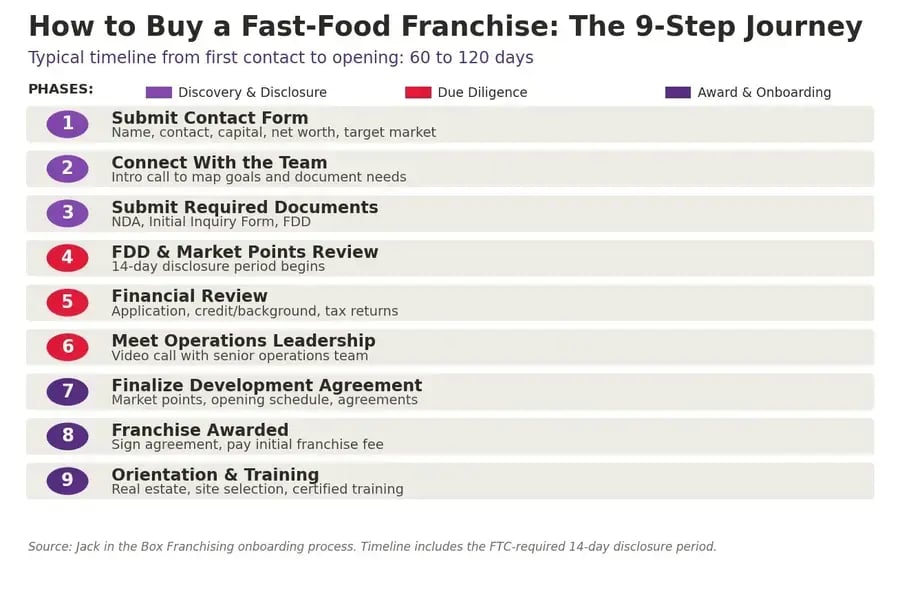
You start by submitting a contact form. That is the single action that opens the door. On the Jack in the Box franchising site, the form asks for your first and last name, email, phone number, target location, cash available, net worth, and the number of locations you are considering.
Before you fill it out, get familiar with the three financial minimums we review:
If you are not quite there on liquidity today, there are sources people often overlook, including business partners, stocks and bonds, home equity, and 401(k) rollovers. I cover this in more detail under financing below, and you can also read more about our minimum liquidity requirement.
Once your form is in, a franchise recruitment director follows up with next steps.
Next comes an introduction call. This is where we answer your questions and walk through how recruitment works and what documents you will need on your end. It is also where I get a real picture of your goals, your timeline, and the markets you care about. The better I understand what you want to build, the more useful the rest of the process is for you.
After our conversation, you receive the documents that move you forward: a Non-Disclosure Agreement, an Initial Inquiry Form, and the Franchise Disclosure Document, or FDD. These give us insight into your goals and set up the next steps. If you have never seen an FDD before, it is worth understanding what is inside it before you read 600-plus pages of it.
This is your due diligence period. You review our FDD and you get to speak with other franchisees in the system. The FDD is the legal document at the center of any U.S. franchise sale, and the Federal Trade Commission requires the franchisor to give it to you before any agreement is signed or money changes hands.
Your acknowledgement of receipt starts the 14-day disclosure period. That is a federal minimum waiting window that applies in all 50 states, and it exists to protect you. We also review the market points available in the territory you want during this stage.
Because it is where we verify everything. You submit the franchise application, credit and background check authorizations, business and personal tax returns, and other required documents so we can complete a full financial review. It is the most document-intensive part of the journey. It is also the stage where you can keep talking to current franchisees and ask them whatever you want about operating the brand.
After your documents are gathered, we schedule a video call with the Jack in the Box senior operations team. This is your chance to ask operational questions directly and build a relationship with the people who run the brand. I encourage candidates to come with real questions here. The leaders expect them.
Here we finalize your market points and your opening schedule, then send franchise agreements to sign. If you are committing to more than one restaurant, this is where the multi-unit development structure gets locked in. The minimum under a Multi-Unit Development Agreement is two restaurants.
Once we receive your signed development agreement and your initial franchise fees, you are officially a Jack in the Box franchisee. That is the milestone most people are working toward, and it is a real one.
Orientation starts with your regional real estate development manager, who helps you with site selection. Once you have a site, a regionally based construction manager provides CAD drawings of the prototype layout. Before opening, your organization designates two people to complete the full training program at a certified training restaurant. This is the stage where the abstract becomes physical: a real building, a real team, a real opening date.
The headline number is the estimated initial investment, which you find in Item 7 of the FDD. For a prototypical Jack in the Box restaurant, that range is $1,909,500 to $4,041,500 per the FDD dated March 13, 2026. That figure covers the franchise fee, building and site improvements, furniture, fixtures, equipment, inventory, training, and working capital. It excludes land and financing. For a fuller breakdown, see our guide on how much it costs to buy a franchise.
Here is the snapshot I show candidates so the qualifying numbers are clear before we go further.

One point I repeat constantly: Jack in the Box does not collect your full liquid assets upfront. At signing you pay the franchise fee and any development deposit tied to the number of locations in your agreement. The rest of your liquidity is working capital for the build and the opening months.
No. Most franchisees finance part of the cost. The common routes are:
Each option carries its own risk, so talk to a financial advisor about what fits your situation. I am in marketing and development, not financial advising, and I am careful to keep that line clear with candidates.
There are, and they are worth knowing before you sign anything:
These are offered at the company's discretion and have specific requirements, all detailed in the FDD.
We move as fast as you are willing to move. The full process typically runs 60 to 120 days. That window includes the 14-day franchise disclosure period and a separate requirement that you receive the franchise agreement at least 7 full days before signing. Those two periods can run at the same time, which is why most FDDs include a full copy of the franchise agreement.
We are focused on a set of active development markets right now, including Florida, Georgia, Illinois, Kentucky, and Tennessee. Several of those sit squarely in the Southeast growth region the IFA called out for 2026. If you are evaluating where to build a multi-unit footprint, market availability is one of the biggest differentiators between brands, and open whitespace is harder to find with many legacy names. You can also compare other fast-food brands and the best burger franchises to start.
Submitting a contact form. It triggers a follow-up from a recruitment director and starts the qualification conversation.
The minimum liquidity requirement is $750,000, alongside a $1.5 million minimum net worth.
The initial franchise fee is $50,000 per traditional restaurant, due when you sign your franchise agreement.
Typically 60 to 120 days, including the federally required 14-day disclosure period.
Yes. Multi-Unit Development Agreements start at a minimum of two restaurants, and incentive programs are designed for multi-unit developers.
If you want to talk through markets, numbers, and timeline, reach out to our franchise team. I read what comes in, and I am happy to point you in the right direction.
About the author: Dustin Thompson works in Franchise Marketing & Development at Jack in the Box, where he helps prospective franchisees understand the brand, the markets, and the path to ownership. Learn more on his author page.