
7 Best Coffee Franchises to Start in 2026
Compare the best coffee franchises to start in 2026, from 7 Brew to Dunkin', and see which brands are franchised versus company-owned.
6 min read
By Dustin Thompson, Franchise Marketing & Development, Jack in the Box
Last updated: June 19, 2026
I look at quick-service restaurant brands for a living, and the question I get most is some version of "which one is actually worth owning?" There is no single answer, because the right brand depends on your capital, your market, and whether the brand is even open to new operators. So instead of hand-waving, I pulled current 2026 location data and franchise-access details for the brands people search for most. Here is the honest comparison, with Jack in the Box included as one strong option among many.
Start with three filters before you fall in love with a logo. First, capital: brands range widely in total investment, and you should match the brand to what you can fund. Second, territory: a great brand with no open markets near you is not a real option. Third, access: some brands barely take new operators, while others are actively recruiting. If budget is your starting point, read our guide on how much it costs to buy a franchise.
The backdrop is favorable. The International Franchise Association projects franchise output rising to $921.4 billion in 2026 across roughly 845,000 establishments, with the Southeast and Southwest as the fastest-growing regions. That regional tilt matters, because it overlaps with where several brands, including ours, have open development.
To ground the comparison, here is the current U.S. footprint of the major QSR brands people ask about.
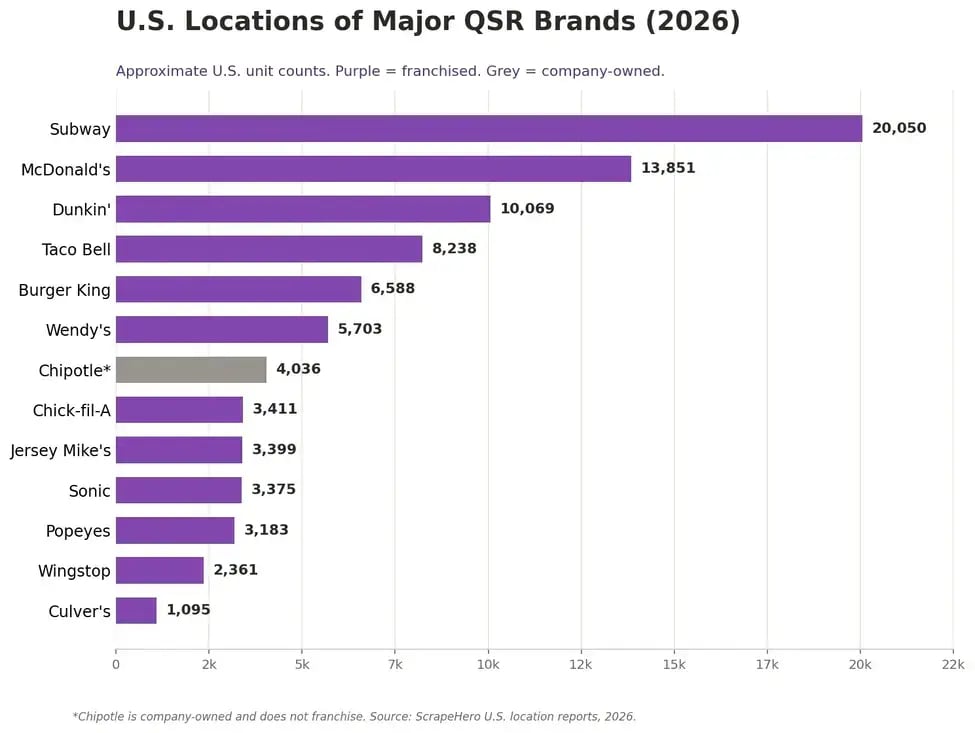
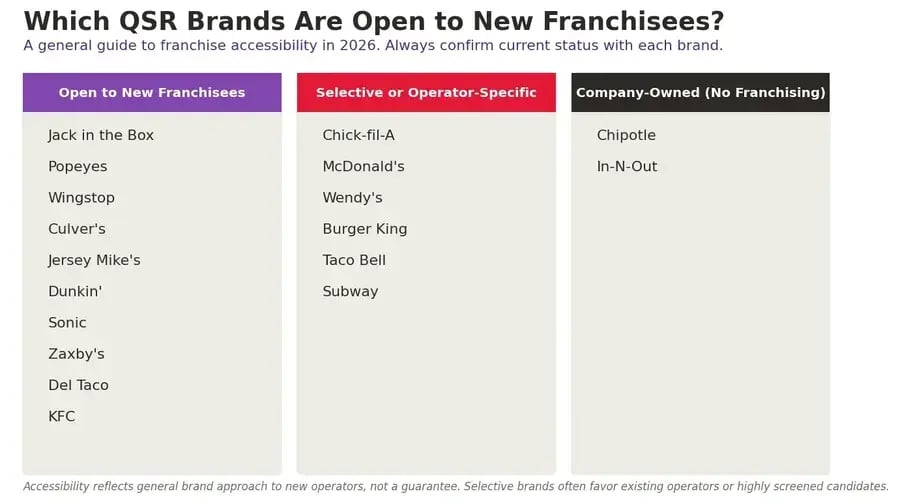
Footprint is not the same as opportunity, though. A brand with 13,000 locations may have almost no room left for a new operator, while a smaller brand could be hungry for one. So here is how the brands break down by how open they actually are to new franchisees.
Now to the brands themselves, in no particular order.
I will start with my own brand, then get out of the way. Jack in the Box runs a large 24/7 menu with five dayparts, so guests can order anything at any hour. Our newer 1,350 square foot prototype is built around dual drive-thrus for order volume plus a walk-up window for mobile pickup.
The reason Jack in the Box is worth a look is open territory. Many legacy brands you recognize have very little whitespace left, which makes building a multi-unit portfolio difficult. We are actively developing in markets including Florida, Georgia, Illinois, Kentucky, and Tennessee, several of which sit inside the Southeast growth region the IFA flagged for 2026. We have supported franchisees for more than 70 years. If you want the path, see the steps to becoming a franchisee and the minimum liquidity you will need.
McDonald's is the most recognized burger brand on earth, with about 13,851 U.S. restaurants per ScrapeHero's 2026 data. The vast majority are owned by independent operators. The catch for newcomers is access: availability in a given area is uncertain until you complete training, and you may need to relocate to where an opportunity exists. It is a selective path, not an open one.
Chick-fil-A operates around 3,411 U.S. restaurants and posts some of the highest per-store sales in the industry. But its operator model is unusual and famously selective. Operators typically run a single restaurant, the upfront franchise fee is low, and the company retains significant control. It is a fantastic brand and a tough one to enter, so set expectations accordingly.
Taco Bell is the largest Mexican-inspired QSR by U.S. count, with roughly 8,238 restaurants per ScrapeHero. It is a heavily franchised system with strong brand heat, though prime territory in established markets can be hard to find.
Wendy's runs about 5,703 U.S. restaurants and is known for square patties and the Frosty. It recruits franchisees in select markets, so availability depends heavily on where you want to build.
Burger King has around 6,588 U.S. restaurants and offers domestic and international growth paths. It is a large, established franchised system, which again means open territory tends to be the limiting factor for new operators.
Subway is still the largest QSR by U.S. count at roughly 20,050 locations, but the trend matters: the brand closed 729 U.S. units in 2025 while opening 499, and per-unit sales run lower than many sandwich competitors. The low entry cost is appealing, but study the unit economics carefully before committing.
Dunkin' operates about 10,069 U.S. locations, concentrated in the Northeast but expanding. Coffee and breakfast traffic give it a different daypart profile than burger brands, and it remains an active franchise system.
Popeyes has roughly 3,183 U.S. restaurants and is close to fully franchised, at about 98 percent per public reporting. The chicken category has been hot, and Popeyes has been a notable growth story, though some franchisees have faced pressure, so diligence on the specific market is key.
Sonic, the drive-in brand, runs about 3,375 U.S. locations, with its heaviest concentration in Texas. The carhop drive-in format is a distinct guest experience and a recognizable franchise option.
Culver's is one of the cleaner growth stories in the category. It crossed 1,000 restaurants and sits around 1,095 U.S. locations across 27 states, with plans to add dozens more in 2026, the vast majority franchisee-owned. ButterBurgers and frozen custard drive a loyal following.
Wingstop has about 2,361 U.S. restaurants and a small-footprint, delivery-friendly model that has fueled fast expansion. For operators who want a lean build and a focused menu, it is worth evaluating.
Jersey Mike's runs roughly 3,400 U.S. locations and has been expanding aggressively, now backed by Blackstone. The sub category has held up well, and the brand continues to add franchised units.
Del Taco is a Mexican QSR known for tacos, burritos, and fresh prep, including house-made guacamole and freshly grilled proteins. It competes in the same value-driven Mexican QSR space as several brands on this list and offers franchise opportunities in select markets.
KFC is one of the most heavily franchised brands in the world, with a large international footprint and a recognizable bucket. In the U.S. it has been reshaping its store base, so confirm current development availability directly with the brand.
Zaxby's, founded in Statesboro, Georgia, in 1990, has more than 850 franchise-owned locations plus a small number of company stores. It is pushing beyond its Southeastern base into the Midwest and Northeast, which can mean genuine first-mover territory for new operators.
Chipotle is worth naming because people search for it as a franchise, but you cannot own one. All of its roughly 4,036 U.S. locations are company-owned, and it does not franchise. Same goes for In-N-Out. If a brand does not franchise, it is not an option no matter your capital. For brands you can actually own, see the best burger franchises to start.
| Brand | U.S. Locations (2026) | Franchising? | Known For |
|---|---|---|---|
| Jack in the Box | Open development markets | Yes, actively | 24/7 five-daypart menu, dual drive-thru |
| McDonald's | ~13,851 | Selective | Global burger leader |
| Subway | ~20,050 | Yes | Largest U.S. footprint, low entry cost |
| Dunkin' | ~10,069 | Yes | Coffee and breakfast dayparts |
| Taco Bell | ~8,238 | Yes | Largest Mexican-inspired QSR |
| Burger King | ~6,588 | Yes | Flame-grilled burgers |
| Wendy's | ~5,703 | Select markets | Square patties, Frosty |
| Chipotle | ~4,036 | No | Company-owned |
| Chick-fil-A | ~3,411 | Highly selective | Top per-store sales |
| Jersey Mike's | ~3,400 | Yes, actively | Fast-growing sub brand |
| Sonic | ~3,375 | Yes | Drive-in carhop format |
| Popeyes | ~3,183 | Yes | Louisiana chicken |
| Wingstop | ~2,361 | Yes, actively | Lean, delivery-friendly model |
| Culver's | ~1,095 | Yes, actively | ButterBurgers, custard |
| Zaxby's | 850+ | Yes | Southern chicken, expanding north |
There is no universal best. The right brand depends on your capital, your target market, and whether the brand is accepting new franchisees. Actively growing options like Popeyes, Wingstop, Culver's, Jersey Mike's, and Jack in the Box are common starting points.
Chick-fil-A and McDonald's are among the most selective. Chick-fil-A uses a single-operator model with heavy company control, and McDonald's availability depends on completing training and possibly relocating.
No. Both are company-owned and do not offer franchises.
Brands like Popeyes, Wingstop, Culver's, and Jersey Mike's have been adding units at a steady pace in recent years.
Open development markets and a 24/7, five-daypart menu set it apart from legacy brands that have little remaining whitespace.
If you want to know where Jack in the Box has territory available near you, reach out to our franchise team.
About the author: Dustin Thompson works in Franchise Marketing & Development at Jack in the Box, where he tracks the QSR franchise landscape and helps prospective operators evaluate where to build. Learn more on his author page.