
17 Best QSR Franchises to Own in 2026 (Ranked by Data)
ByDustin Thompson, Franchise Marketing & Development, Jack in the BoxLast updated: June 19, 2026
8 min read
By Dustin Thompson, Director of Franchise Marketing & Development at Jack in the Box Last updated: June 18, 2026
I run franchise marketing and development for Jack in the Box, which means I spend most of my week talking to multi-unit operators who are deciding where to put their next dollar. Coffee comes up in many of those conversations. It is the category people ask about most after burgers, and it is also the one with the most confusion attached.
Here is the thing nobody tells you up front. Half the "best coffee franchise" lists floating around still treat Dutch Bros and Starbucks as buyable franchises. They are not. Both have shut the door on outside franchisees. If you spend a month building a business plan around a brand that will not sell you a store, that is a month you do not get back.
So this list does two things. It names the coffee brands worth a serious look in 2026, and it sorts them by whether you can buy in at all. I pulled every location count straight from the brands' 2025 and 2026 Franchise Disclosure Documents, public company filings, or official press releases, and I linked each one so you can check my work. No revenue promises, no "you'll get rich" language, just the structural facts you need before you ever fill out an inquiry form.
A quick note on the market. The National Coffee Association reported that 66% of Americans drank coffee in the past day, the highest reading in decades. The International Franchise Association's 2026 Economic Outlook projects more than 12,000 new franchised businesses opening this year. Demand is there. The job is picking the right structure.
A franchise means the brand sells you the right to open and operate a location under its name, in exchange for an upfront fee and ongoing royalties. You own the business. That is different from a company-owned chain, where every store is run by the corporation and the only way "in" is to work there or buy the stock.
That distinction is the whole point of this article, so here is the field in one picture.
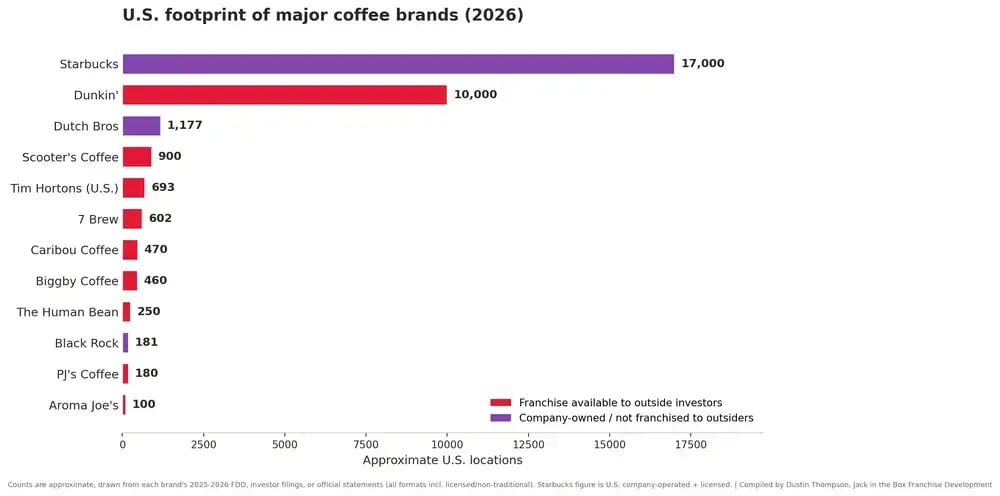
U.S. location counts compiled from each brand's 2025-2026 FDD, investor filings, and official statements. Red bars are franchises you can buy. Purple bars are company-owned.
Two things jump out. First, the two biggest footprints (Starbucks and Dunkin') sit in different camps entirely, which tells you size has nothing to do with whether a brand franchises. Second, almost every challenger brand growing quickly today is a franchise. That is where the real opportunity for an operator lives.
These nine brands were selling franchises to qualified candidates as of this writing. They are listed in no particular order.
Founded in 1950 in Quincy, Massachusetts, Dunkin' is now owned by Inspire Brands and runs one of the largest franchise systems in the category. The brand crossed 10,000 U.S. stores in October 2025 and operates more than 14,000 locations worldwide across roughly 40 markets, about 95% of them franchised. Dunkin' offers freestanding, drive-thru, endcap, and small-format builds, plus co-branded layouts with Jimmy John's. It is also returning to Canada in late 2026 through a master franchise deal. If you are weighing it against a burger concept, we wrote a full comparison here: Jack in the Box vs Dunkin'.
The Canadian icon opened its first U.S. store in 1984 in Tonawanda, New York, and is now part of Restaurant Brands International. Tim Hortons U.S. closed 2025 with 693 restaurants, 669 of them franchised, its strongest growth year in over a decade. The footprint is concentrated in New York, Michigan, and Ohio, with new development pushing into Texas, Georgia, and Florida. The brand offers freestanding drive-thru, in-line, and food-court formats, and is actively recruiting in southern markets.
Scooter's started in 1998 in Bellevue, Nebraska, and has franchised since 2002. In February 2026 it reached 900 stores across 32 states, with nearly all of them franchisee-owned. The model is built around a small drive-thru kiosk, and the brand recently signed one of its largest development deals to date with a major multi-unit operator for North Carolina and Virginia. Scooter's also offers endcap and non-traditional formats to give operators more real estate options.
This is the one operators ask me about more than any other right now. 7 Brew launched in 2017 in Rogers, Arkansas, began franchising in 2020, and is drive-thru only. According to its latest FDD reported by QSR Magazine, the chain ended 2025 with about 602 units (578 franchised, 24 corporate) after adding a net of 281 locations in a single year. Blackstone took a minority stake in the company in 2024. The double-lane stand and 20,000-plus drink combinations are the calling card, and there is still open territory across the Midwest, Southeast, and Northeast.
Caribou opened in 1992 in Edina, Minnesota, and is part of Panera Brands. It launched its first U.S. franchise program in October 2021, so it is newer to outside ownership than its age suggests. The brand reports more than 470 U.S. locations across 19 states, with roughly 800 worldwide. Caribou gives franchisees three formats: the sit-down Chalet, the drive-thru-only Cabin (about 600 square feet), and a smaller Kiosk for airports, campuses, and hospitals.
Founded in 1978 by Phyllis Jordan and owned since 2008 by Ballard Brands, PJ's brings a New Orleans angle with chicory coffee, cold brew, and beignets. The brand operates more than 185 stores, including international locations in Vietnam and Kuwait, with its heaviest concentration in Louisiana and active growth across the South and into the Northeast. PJ's leans into multi-unit ownership, with more than half of its franchisees running more than one store.
Biggby started in 1995 in East Lansing, Michigan, began franchising in 1999, and is one of the few brands in the category that is 100% franchise-owned across 460-plus locations in 13 states. It offers a small drive-thru and walk-up footprint that fits roughly eight parking spaces, which keeps build and rent costs down. The brand is concentrated in the Midwest and has been expanding into the Southeast.
Another Oregon drive-thru concept, founded in 1998, The Human Bean has grown to roughly 250 locations across 24 states. What makes it unusual is the franchise structure: the brand does not charge percentage-of-sales royalty fees, which is rare in this category and worth a hard look if ongoing fees are a sticking point for you. The menu runs from classic espresso to energy drinks and dirty sodas.
Founded in 2000 in Maine, Aroma Joe's runs drive-thru kiosks and walk-up windows and is known for its AJ's Rush energy drinks. The brand operates more than 100 locations across eight states, mostly in New England with expansion into the Mid-Atlantic. It offers a veteran discount on the franchise fee and positions itself around a smaller-investment entry point.
These three brands show up on plenty of "best coffee franchise" lists, but you cannot buy a location in any of them. They are here so you do not waste time chasing a door that is closed.
Starbucks opened its first store in 1971 at Pike Place Market in Seattle and operates more than 41,000 stores worldwide as of its early 2026 filings. It does not sell traditional franchises. Its stores are either company-operated or run under licensing agreements that go to established companies for venues like airports, grocery stores, and campuses, not to individual entrepreneurs. If you want exposure to Starbucks, the route is the stock, not a franchise agreement.
This is the brand I correct people on most. Dutch Bros, founded in 1992 in Grants Pass, Oregon, did franchise years ago, but it stopped offering franchises and now grows only through company-owned shops. The company states plainly that it no longer offers franchising, and new operator roles go to internal employees who have worked their way up. It reached 1,177 locations across 25 states as of March 31, 2026. You can invest through the public stock (NYSE: BROS), but you cannot buy a stand.
Black Rock is the newest cautionary tale on franchise status. The Oregon brand, founded in 2008, did franchise starting in 2013, then bought back all of its franchised locations in 2021 and returned to a fully company-owned model. It went public in 2025 (Nasdaq: BRCB) and entered 2026 with roughly 181 locations across seven western states. Like Dutch Bros, the only way to participate is as a shareholder.
| Brand | Founded | Headquarters | Format | Approx. U.S. locations | Franchise available? |
|---|---|---|---|---|---|
| Dunkin' | 1950 | Canton, MA | Multi-format, drive-thru | ~10,000 | Yes |
| Tim Hortons | 1964 (1984 U.S.) | Toronto / Miami | Multi-format, drive-thru | 693 | Yes |
| Scooter's Coffee | 1998 | Omaha, NE | Drive-thru kiosk | 900 | Yes |
| 7 Brew | 2017 | Rogers, AR | Drive-thru only | 602 | Yes |
| Caribou Coffee | 1992 | Brooklyn Center, MN | Chalet / Cabin / Kiosk | 470+ | Yes |
| PJ's Coffee | 1978 | New Orleans, LA | Coffeehouse / drive-thru | 185+ | Yes |
| Biggby Coffee | 1995 | East Lansing, MI | Drive-thru / walk-up | 460+ | Yes |
| The Human Bean | 1998 | Medford, OR | Drive-thru | ~250 | Yes |
| Aroma Joe's | 2000 | Scarborough, ME | Drive-thru / walk-up | 100+ | Yes |
| Starbucks | 1971 | Seattle, WA | Coffeehouse / licensed | ~17,000 | No (company + licensed) |
| Dutch Bros | 1992 | Tempe, AZ | Drive-thru | 1,177 | No (company-owned) |
| Black Rock Coffee Bar | 2008 | Scottsdale, AZ | Drive-thru / cafe | 181 | No (company-owned) |
When operators ask me how a coffee concept fits into a portfolio that already has burgers, my first question is always the same: does the brand even sell franchises? Once that is settled, the conversation usually turns to dayparts and real estate.
Coffee earns its money in the morning and mid-day. A burger franchise like ours runs strong through breakfast, lunch, dinner, and late night. Pairing the two inside one operating company can keep a team busy and a balance sheet working across more hours of the day, which is one reason multi-unit operators look at both. The small-footprint, drive-thru-focused model that powers brands like 7 Brew and Scooter's is the same model that has made drive-thru burger boxes efficient for decades, so the playbook transfers.
To be clear about what we look for at Jack in the Box: the financial qualification is a minimum of $750,000 in liquid capital and $1,500,000 in net worth. We do not publish or promise earnings, and you should be skeptical of any coffee brand that does. What we do offer is a path to add a burger concept to an existing or new QSR portfolio. If you want the numbers on cost, those live here: How Much Does a Burger Franchise Cost?
What is the best coffee franchise to start in 2026? There is no single best one. The right pick depends on your capital, your market, and your appetite for build complexity. Among brands actively franchising, the fastest unit growth is in drive-thru concepts like 7 Brew and Scooter's Coffee, while Dunkin' and Tim Hortons offer larger, more established systems.
Can you buy a Dutch Bros or Starbucks franchise? No. Neither brand sells franchises to outside investors. Starbucks runs company-operated and licensed stores, and Dutch Bros grows only through company-owned shops with operator roles reserved for internal employees.
Which coffee franchises are drive-thru only? 7 Brew and Caribou's Cabin format are drive-thru only. Scooter's Coffee, The Human Bean, Aroma Joe's, and Biggby are built primarily around drive-thru kiosks with walk-up windows.
How much does a coffee franchise cost? Costs vary widely by brand and format, from smaller walk-up kiosks to full coffeehouses. Always request the brand's Franchise Disclosure Document (Item 7) for the actual investment range, and consult an attorney and accountant before signing anything.
Is coffee a good franchise category to enter? Coffee consumption is at multi-decade highs and the category is one of the most active in franchising right now. That said, category demand is not a guarantee of individual store performance, so evaluate each brand's FDD and unit-level disclosures on their own.
We hope this breakdown helped you sort the coffee field by what you can actually buy. A few more reads if you are weighing options:
Have questions about adding a burger concept to your portfolio? Contact our franchise sales and support team.
Dustin Thompson is the Director of Franchise Marketing & Development at Jack in the Box, where he works directly with multi-unit and prospective franchisees evaluating quick-service opportunities. He has spent more than a decade in franchise development and marketing across multiple national brands. Connect with Dustin on his author page or reach the Jack in the Box franchise team at jackintheboxfranchising.com/contact-us.