
Burger Franchise vs Sub Franchise: Everything You Need to Know
See how burger and sub franchises compare on cost, fees, real estate, and menu, plus why franchising is a strong fit for veterans.
9 min read
By Dustin Thompson, Franchise Marketing and Development, Jack in the Box | Last updated: July 17, 2026
Are you looking for a list of the best sub franchises in the USA? If so, you're in the right place.
I lead franchise marketing and development at Jack in the Box, which means I spend a good part of my week inside franchise disclosure documents. Prospective owners ask me all the time how different QSR categories stack up, and subs come up in nearly every one of those conversations. So for this update, I pulled the published investment figures, franchise fees, and royalty rates for each brand directly from its own franchise website or most recent FDD. No aggregator numbers, no guesswork.
Below, we'll look at seven of the best sub franchises in the USA, in no particular order, followed by a side by side comparison of what each one costs to open and run.
Since 1956, Jersey Mike's Subs has been serving freshly sliced meats and cheeses on fresh baked rolls, and the brand's growth over the past decade has been remarkable. When Blackstone completed its acquisition of a majority stake in Jersey Mike's in January 2025, the chain had grown past 3,100 locations, and the deal was reportedly valued at around $8 billion.
According to the company's franchise investment page, the estimated initial investment ranges from $185,903 to $1,417,592, which includes a $20,000 initial franchise fee and a $10,000 development fee. The brand's FDD has reported a royalty of 6.5% of gross sales plus an advertising contribution. That combined fee load sits at the higher end of this list, which is worth weighing against the brand's momentum and name recognition.
Founded in 1965, Subway grew into the world's largest submarine sandwich chain, with restaurants in more than 100 countries. The brand was acquired by affiliates of Roark Capital in a deal completed in 2024, and it has spent recent years remodeling stores and refreshing its menu.
Per the company's official franchise FAQ, the estimated initial investment runs from $199,135 to $536,745, with a $15,000 initial franchise fee. Ongoing fees are an 8% royalty and a 4.5% advertising fee, both calculated on gross sales. That 12.5% combined rate is the highest ongoing fee structure on this list, while the entry cost is among the lowest. Both facts matter when you model a location.
Jimmy John's built its name on delivery speed and a deliberately simple menu. The brand started in 1983 in Charleston, Illinois, began franchising in 1993, and has been part of the Inspire Brands portfolio since 2019, alongside Arby's, Sonic, and Dunkin'. It operates well over 2,600 locations across the country.
Based on Items 5 through 7 of the company's 2025 FDD, the estimated initial investment runs from $366,200 to $728,200, including a $35,000 franchise fee. The royalty is 6% of gross sales, and the advertising and development fund contribution is currently 4.5%. The franchise fee is the largest on this list, though the total investment range is narrower than most.
Founded in 1994 by two former firefighters in Jacksonville, Florida, Firehouse Subs is known for hot subs, its firefighter themed restaurants, and the Firehouse Subs Public Safety Foundation. Restaurant Brands International, the parent of Burger King and Popeyes, acquired the chain in 2021, and it now has more than 1,200 locations.
The brand's franchising site breaks the investment out by format: $379,650 to $795,600 for an in line traditional restaurant, $549,650 to $1,038,100 for an end cap with a drive thru, and $705,650 to $1,396,100 for a free standing restaurant with a drive thru. The initial franchise fee is $20,000, with a 6% royalty and a 5% advertising fee. If you want a drive thru in the sub category, this is one of the few brands that publishes format level numbers for it.
Larry's Giant Subs is the regional pick on this list. The Raikes brothers opened the first shop in Jacksonville, Florida in 1982 and began franchising in 1986. Most locations sit in the Southeastern USA, and the brand has kept its focus on quality ingredients and generous portions rather than rapid national expansion.
According to the company's franchise page, the total investment ranges from $175,000 to $254,000, with a 6% royalty that the brand notes is among the lower rates in the segment. The company also states that it passes vendor rebates back to franchisees. For an owner who wants a smaller system where the founders still answer the phone, that is a different kind of opportunity than the national brands above.
Quiznos pioneered the toasted sub after its founding in Denver in 1981, and competitors across the category eventually followed. The system is far smaller than it was at its peak, and the brand, now owned by REGO Restaurant Group, has shifted toward smaller format restaurants and nontraditional venues as it rebuilds.
Per the brand's franchise FAQ, the total investment ranges from $216,100 to $500,000, with a $30,000 franchise and support fee. The FAQ lists a 5% royalty for a limited time, with conditions, plus a 2% marketing fee. Read the conditions on that royalty carefully, and ask the development team directly what rate applies to your agreement and for how long.
Charleys is the cheesesteak entry here, founded in 1986 near the Ohio State campus by Charley Shin and franchising since 1991 under parent company Gosh Enterprises. The brand describes itself as the largest Philly cheesesteak franchise in the world, with more than 800 locations across the USA and international markets, many of them in malls, airports, and Walmart stores.
The company's franchise FAQ lists a total investment of $203,736 to $984,732, a $24,500 franchise fee for the first unit and $15,000 for each additional unit, and a 6% royalty on gross sales. One detail that surprises people: Charleys requires new franchisees to buy a minimum of three licenses. That makes it a multi unit commitment from day one, not a single store trial.
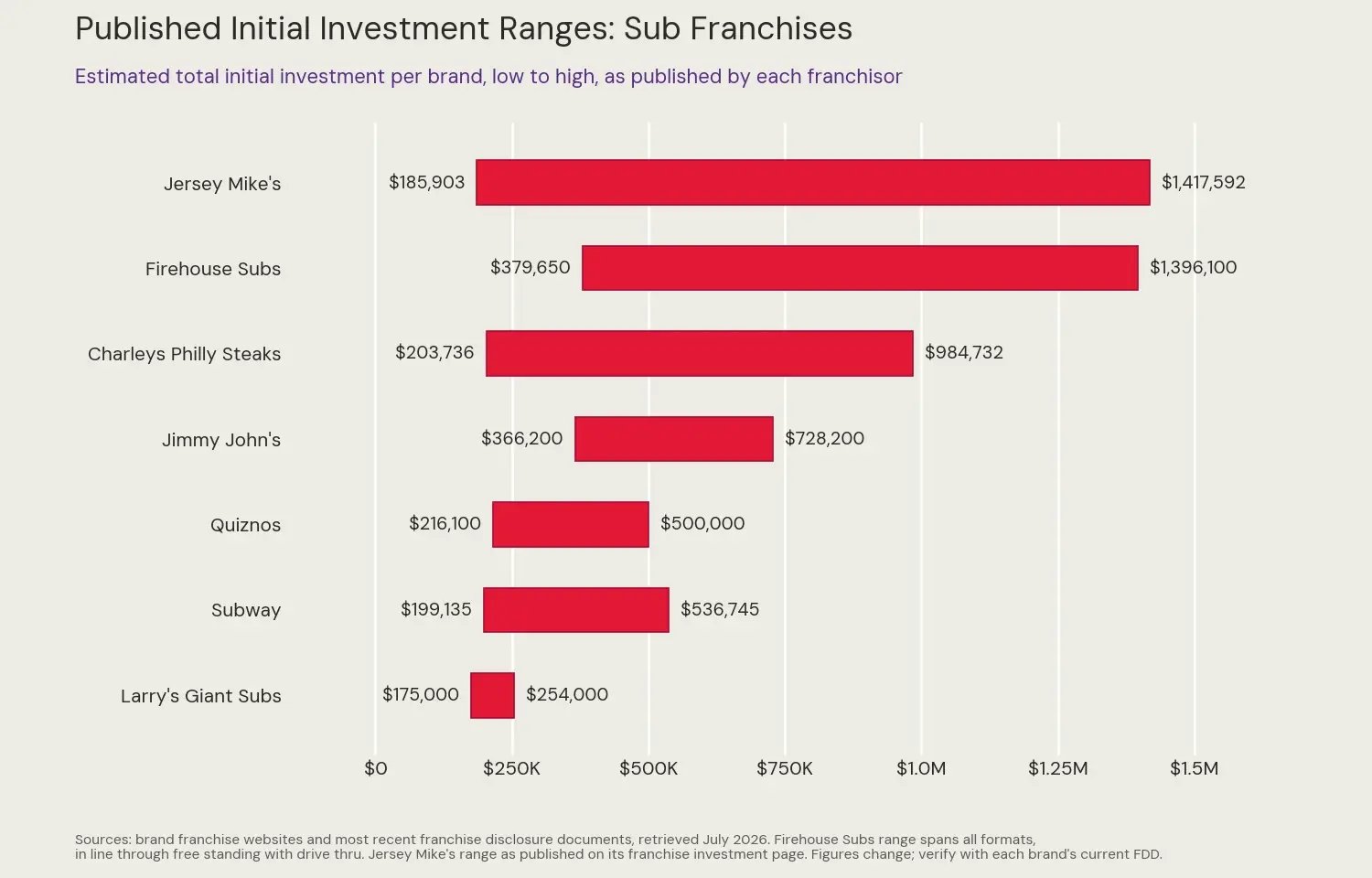
Here is every published figure in one place. I built both of the visuals below from the source data linked in each section above, so you can check any number against the brand's own materials.
| Brand | Founded | Published Investment Range | Franchise Fee | Royalty | Marketing / Ad Fee |
|---|---|---|---|---|---|
| Jersey Mike's | 1956 | $185,903 to $1,417,592 | $20,000 plus $10,000 development fee | 6.5%¹ | 5%¹ |
| Subway | 1965 | $199,135 to $536,745 | $15,000 | 8% | 4.5% |
| Jimmy John's | 1983 | $366,200 to $728,200 | $35,000 | 6% | Up to 4.5% |
| Firehouse Subs | 1994 | $379,650 to $1,396,100² | $20,000 | 6% | 5% |
| Larry's Giant Subs | 1982 | $175,000 to $254,000 | See current FDD | 6% | See current FDD |
| Quiznos | 1981 | $216,100 to $500,000 | $30,000 | 5%³ | 2% |
| Charleys Philly Steaks | 1986 | $203,736 to $984,732 | $24,500 first unit, $15,000 each additional | 6% | See current FDD |
¹ As reported in the brand's franchise disclosure document; the brand's investment page does not list ongoing fees. ² Range spans all published formats, from in line traditional through free standing with drive thru. ³ Listed by the brand as a limited time rate, with conditions. All figures retrieved July 2026 from the sources linked above. Figures change with each FDD issuance, so verify with the brand's current disclosure document before making decisions.
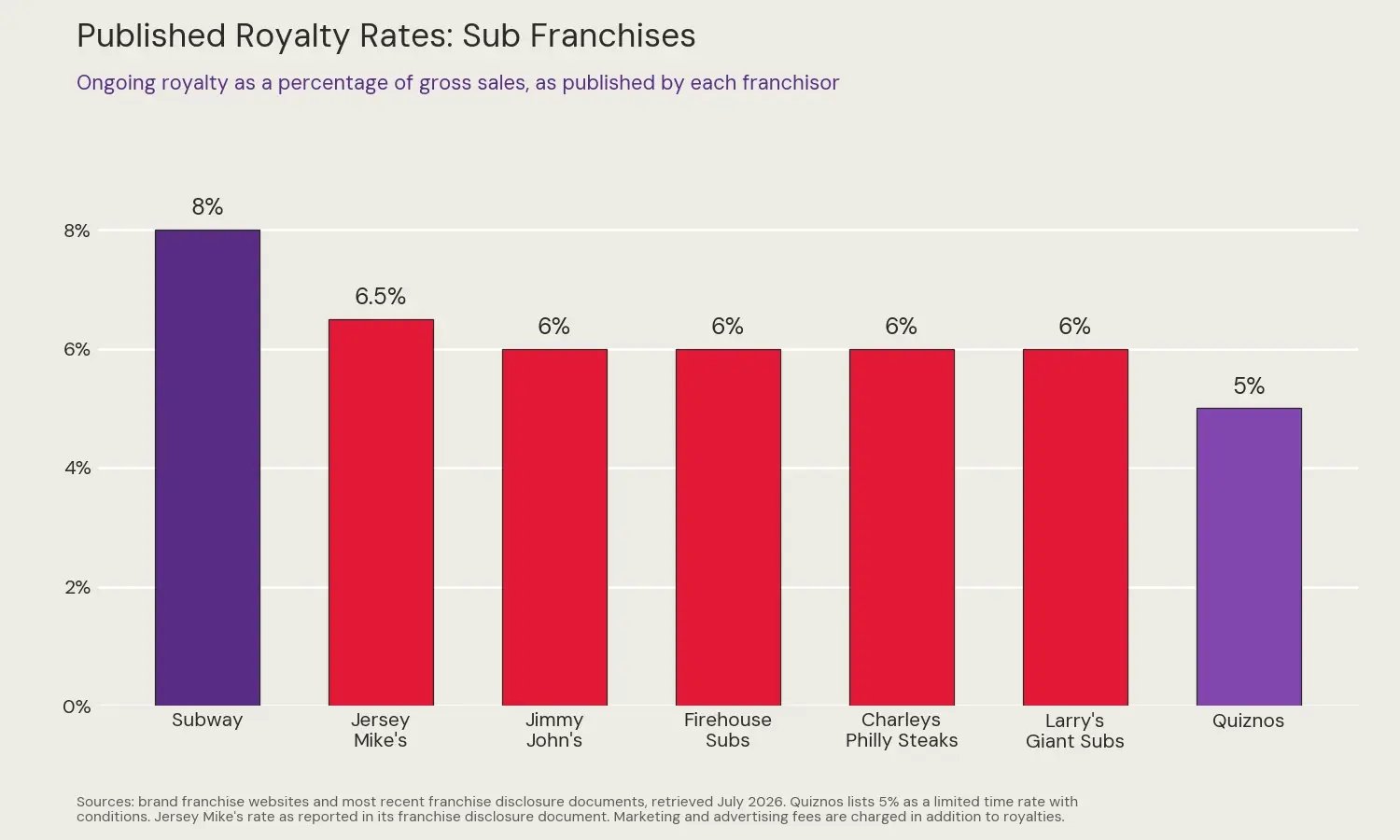
Two things stand out to me in this data. First, the low end of a published range usually describes a small, nontraditional, or landlord subsidized location, not the store most new owners actually build, so budget against the middle and top of the range. Second, the royalty is only half of the ongoing fee story. Add the marketing fee, and the combined percentage of gross sales going to the franchisor runs from roughly 7% at Quiznos to 12.5% at Subway.
Every investment range, fee, and royalty rate above came from one of two places: the brand's own franchise website or figures drawn from its most recent franchise disclosure document, with the source linked at the point where the figure appears. I skipped third party franchise directories entirely, because when I checked several of them against the brands' own pages while researching this update, the numbers were frequently years out of date or contradicted each other.
Where a brand does not publish a figure, the table says so instead of guessing. And where a brand attaches conditions to a number, like the Quiznos royalty rate, I have said that too. This is the same standard we hold ourselves to when we publish our own franchise costs.
A list like this one is a starting point, not a decision. Once a brand makes your shortlist, request its FDD and read these items closely:
The Federal Trade Commission publishes a free Consumer's Guide to Buying a Franchise that explains each item in plain language, and I recommend it to every candidate I talk to, no matter which brand they end up choosing. Also pay attention to structural requirements. Charleys' three license minimum, for example, changes the capital math entirely, and it is the kind of detail worth understanding early. If you are weighing single unit versus multi unit ownership more broadly, we wrote about how development schedules work on our multi unit development page.
Subs are one lane in QSR. Burgers are another, and the two categories behave differently on check size, daypart coverage, and drive thru volume. We compared them head to head in Burger Franchise vs Sub Franchise: Everything You Need to Know, and that piece is a good next read if you have not settled on a category yet.
For transparency, here is how our own numbers read against the brands above. Per Item 7 of our March 2026 FDD, the total estimated initial investment for a Jack in the Box restaurant ranges from $1,909,500 to $4,041,500, excluding land, with a $50,000 initial franchise fee, a 5% royalty, and a 5% marketing fee. That is a larger build than any sub concept on this list, and it reflects a fundamentally different restaurant: a drive thru focused building serving burgers, tacos, and a full menu across breakfast, lunch, dinner, and late night. Per Item 19 of the same FDD, system average gross sales for fiscal year 2025 were $1,913,335. That figure represents gross sales only, not profit or earnings, and individual restaurant results vary; a new franchisee's results may differ from the represented performance.
Qualified multi unit operators may also want to ask our team about current programs, such as a development incentive offering $150,000 at 0% interest for three unit or larger commitments and a select market incentive that reduces the royalty to 2% for five years in qualifying markets. Both are subject to eligibility requirements and may be modified or discontinued, so confirm current terms with our team. You can read more about why operators choose Jack in the Box and see which of our available markets are open for development.
Based on figures published by the brands themselves as of July 2026, estimated initial investments for major sub franchises range from about $175,000 on the low end to more than $1.4 million on the high end. Location type, market, and build out scope drive most of the difference, and each brand's Item 7 table explains its own range.
Among the seven brands in this article, Larry's Giant Subs publishes the lowest total investment range, at $175,000 to $254,000, per its franchise page. Subway lists the lowest initial franchise fee, at $15,000, per its franchise FAQ. Published figures change with each FDD issuance, so verify current numbers with the brand directly.
Published royalty rates across the seven brands covered here range from 5% to 8% of gross sales. Most charge 6%. Every brand also charges a separate marketing or advertising fee, so the combined ongoing fee load runs from roughly 7% to 12.5% of gross sales depending on the brand.
Neither category is better across the board; they trade different strengths. Sub franchises generally publish lower initial investment ranges, while burger concepts are typically built around drive thru service and broader daypart coverage. The right answer depends on your capital, your market, and whether you plan to operate one location or several. Reviewing each brand's FDD side by side is the most reliable way to compare.
Request the brand's franchise disclosure document and read Items 5, 6, and 7 for fees and investment, Item 19 for any financial performance representation, and Item 20 for outlet counts and franchisee contact information. Speak with current and former franchisees, and review the Federal Trade Commission's free guide to buying a franchise before you sign anything.
We hope this list featuring the best sub franchises in the USA helped you narrow down your search. Here are some related reads from our team:
If you have questions about franchising with Jack in the Box, contact our franchise sales and support team and we'll walk you through the process.
About the author: Dustin Thompson works in Franchise Marketing and Development at Jack in the Box, where he helps qualified candidates evaluate QSR franchise ownership. His work draws on franchise disclosure documents, brand development data, and daily conversations with single unit and multi unit operators across the country.
This article is for informational purposes only and is not an offer to sell a franchise. Offers are made only through a franchise disclosure document in compliance with applicable law. Nothing in this article is a representation of potential or actual financial performance; where gross sales figures appear, they are gross sales only and do not reflect profit or earnings, and results vary by restaurant.