
Top Burger Franchise Options for Fast Food Investors
Compare top burger franchise opportunities for 2026: investment ranges, royalty fees, and requirements for Jack in the Box, Burger King, and more.
8 min read
By Dustin Thompson, Franchise Marketing and Development, Jack in the Box
Last updated: July 20, 2026
Searching for a sub sandwich franchise? Smart move. Sandwich shops have loyal fans and a simple kitchen. But if a sub shop is on your list, a burger brand belongs on that list too. The two models look alike from the street. They run very differently once you own one.
I am Dustin Thompson. I work in Franchise Marketing and Development at Jack in the Box. Most weeks I talk with people who are picking their first restaurant or planning their next one. Many of them start out looking at subs. Then they see what a drive-thru burger brand can do, and they widen the search. This guide covers the same points I walk them through, with real numbers you can check.
Key Takeaways:
A burger franchise builds its menu around beef and hamburgers. You will also find fries, drinks, and a few sides and desserts on most of them.
Some of the best known burger franchises in the United States are:
These brands have served burgers for decades, and many have grown into other countries. One quick note on Whataburger: it does not publicly share its franchise terms. So treat any cost figures you see for it as estimates, not facts.
A sub franchise builds its menu around the submarine sandwich. Guests pick a bread, a protein, and a set of toppings. Most add chips, a drink, and a cookie or two.
Popular sub sandwich franchises in the United States include:
Subway is one of the largest restaurant chains in the world, with tens of thousands of locations across more than 100 countries. So you can find a sub shop almost anywhere you live or travel.
Both are quick service food businesses with a brand, a system, and support. The real differences show up in three places: the menu, the real estate, and the money.
Sub shops run a build to order line. Every order can be a little different, with many toppings to add or remove. That gives guests choice. It also means your crew handles a lot of small steps per ticket.
Burger brands usually keep a tighter menu built for speed. At Jack in the Box, we go a step further. We run a 24 hour menu across five dayparts: breakfast, lunch, dinner, snacking, and late night. Our menu carries burgers, chicken, tacos, salads, egg rolls, and wraps, and we serve breakfast all day. Running all five dayparts keeps the kitchen open to guests around the clock.
Many sub brands fit into small inline spaces inside a shopping center. Some, such as Firehouse Subs, now offer drive-thru formats too. But the classic sub shop is built for walk-in and delivery.
Jack in the Box takes a different path. We require a drive-thru lane at every restaurant. That is why we look for free standing lots and end cap spaces with room for a drive-thru. The site search takes more work, and the buildout costs more. In return you get a format built for off premise orders, which are a large share of quick service ordering today.
This is where the models split the most. Sub shops usually cost less to open. A burger brand with a drive-thru is a bigger project.
The table below compares entry costs for a few well known brands. These figures come from each brand's Franchise Disclosure Document (FDD) and official franchising pages. Always confirm the numbers against the current FDD you receive.
| Brand | Initial franchise fee | Royalty (of gross sales) | Estimated initial investment (Item 7) |
|---|---|---|---|
| Jack in the Box | $50,000 | 5% | $1,909,500 to $4,041,500 |
| Subway | $15,000 | 8% | $199,135 to $536,745 |
| Firehouse Subs | $20,000 | 6% | $379,650 to $1,396,100 |
| Jimmy John's | $35,000 | 6% | $366,000 to $728,000 |
| Jersey Mike's | $18,500 | 6.5% | See current FDD |
Sources: Jack in the Box March 2026 FDD (Item 7); Subway, Firehouse Subs, and Jimmy John's official franchising pages; Jersey Mike's franchise fee and royalty are widely reported, and the investment range varies by format, so confirm it against the current FDD. Figures are current as of 2026 and can change.

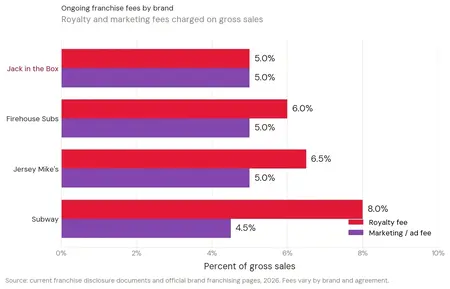
A few things stand out. Sub brands ask for less money up front. But look at the ongoing royalty. Jack in the Box charges a 5% royalty on gross sales, the lowest in this group, plus a 5% marketing fee. Over the life of a business, the royalty rate matters, because you pay it on every dollar of sales for years. You can see the full cost picture on our franchise costs page.
If you served in the military, franchising may fit you better than you think. The whole model runs on following a system. You get a proven playbook, a brand, training, and support. Your job is to run the plan well and lead a team. That is close to what many veterans did in uniform.
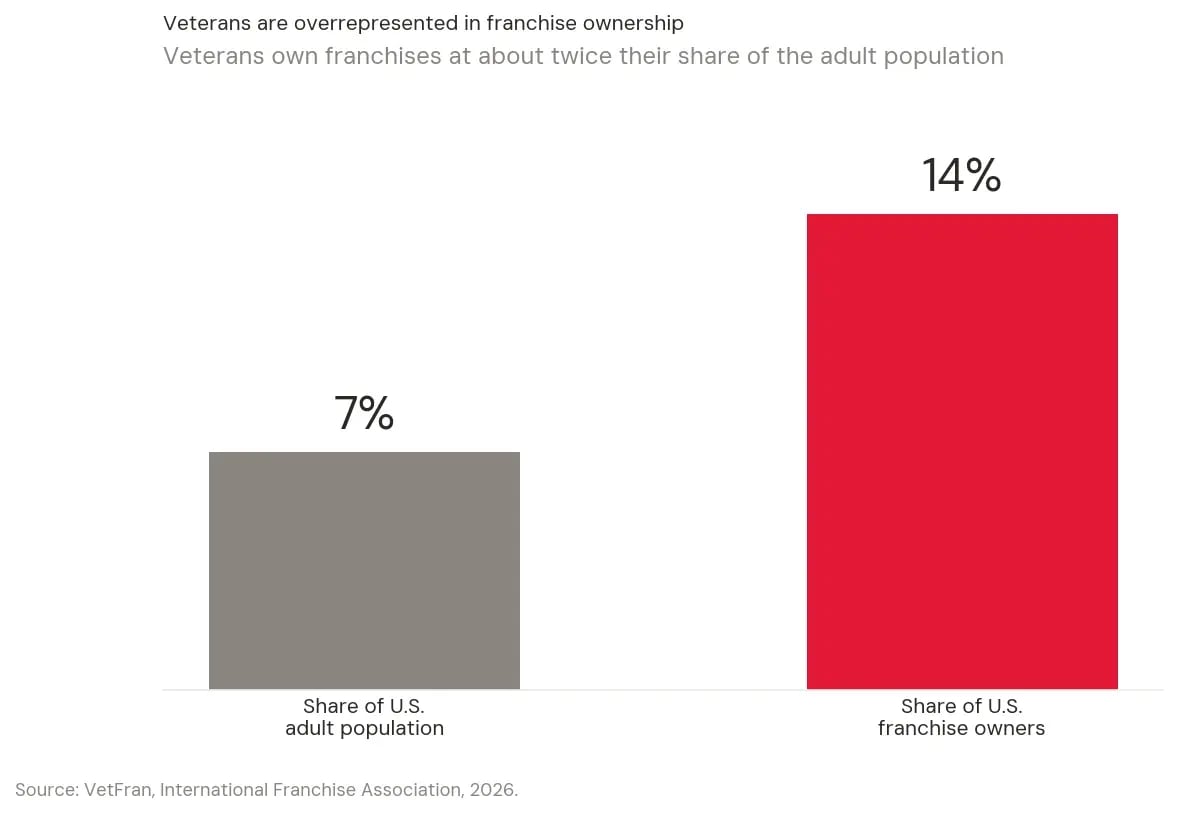
The data backs this up. Veterans make up about 7% of the adult population, but they account for about 14% of franchise owners in the United States, according to VetFran, part of the International Franchise Association. Put simply, veterans own franchises at about twice their share of the population.
Why the strong fit? FranNet and the IFA point to the same traits: discipline, leadership, teamwork, and the skill of following a set of defined steps inside a proven model. Franchisors see it too, and most say veterans make excellent owners.
At Jack in the Box, we lean into this. We take part in VetFran through the Jack in the Box Veterans Program. Qualifying veterans can receive a 25% reduction on the initial franchise fee for their first new restaurant, which brings that fee from $50,000 down to $37,500. To qualify, you must request the program when you apply, meet our current franchisee qualifications, and have at least 51% ownership held by people who meet our qualifying veteran status. The program cannot be combined with other incentives, and we may change or end it at any time. You can learn more on our franchising for veterans page.
The system side matters after you open, too. New owners lean on training and support to learn the playbook. That structure is one reason the model works for people who are used to running to a standard.
If the burger side is starting to make sense, here is what we look for. These are our current minimum requirements:
You will also pay ongoing fees of a 5% royalty and a 5% marketing fee, both on gross sales. The estimated initial investment for one restaurant runs from $1,909,500 to $4,041,500, based on Item 7 of our March 2026 FDD. That range covers a lot of ground, since land, construction, and local costs vary. Learn more about why operators choose Jack in the Box.
We build our brand around multi-unit operators. If you sign a development agreement for three or more restaurants and meet the other terms, you may be eligible for our Development Incentive Program. Under the current program, and at our sole discretion, we may loan you $150,000 at 0% interest for development costs on a qualifying restaurant. Eligibility rules apply, and we may change or end the program at any time. See our multi-unit development page for more.
We also run a Select Market Incentive in certain markets we designate. When you qualify, the royalty can drop to 2% of gross sales for the first five years on a qualifying restaurant. Like the other programs, it has eligibility rules, and we can change or end it at any time.
Right now we are actively developing in Florida, Georgia, Illinois, Kentucky, and Tennessee. If you are near one of those states, there may be room to grow. Check our available markets to see where we are focused.
People often ask what our restaurants sell. Our March 2026 FDD reports a system average gross sales figure of $1,913,335 for fiscal year 2025. That number is a systemwide average of gross sales. It is not profit, it is not earnings, and it is not a promise of your results. A new restaurant's sales can be higher or lower, and the base of restaurants behind an average is not the same as your single location. Read Item 19 of the FDD in full for the details.
Ready to see the steps? They are laid out on our franchise process page.
There is no single right answer. A sub shop can be a lower cost way into food service, with a simple kitchen and strong walk-in demand. A burger brand like Jack in the Box asks for more capital and a drive-thru site, and it gives you a broader menu, all five dayparts, and a path to build several units.
If your goal is one small unit with a lower entry cost, a sub brand may fit. If your goal is to build a multi-unit business with a drive-thru format, a burger brand is worth a hard look. Many of the operators I speak with land on the burger side once they weigh the full picture.
Usually, yes. Most sub brands open for a few hundred thousand dollars. A drive-thru burger brand like Jack in the Box runs from $1,909,500 to $4,041,500 per restaurant, based on Item 7 of our 2026 FDD. The bigger cost comes mostly from the site and the buildout.
Most do not. The classic sub shop is built for walk-in and delivery. A few brands, such as Firehouse Subs, now offer drive-thru formats. Jack in the Box requires a drive-thru at every restaurant.
Many veterans do well in franchising because the model runs on following a proven system. Veterans are about 7% of the adult population but about 14% of U.S. franchise owners, per VetFran. Qualifying veterans can also get 25% off the initial franchise fee for their first new Jack in the Box restaurant.
Our current minimums are $750,000 in liquidity, $1,500,000 in net worth, and a $50,000 franchise fee per restaurant. Ongoing fees are a 5% royalty and a 5% marketing fee on gross sales.
Want more detail? These pages go further:
Have questions? Contact our franchise team and we will help you weigh your options.
This article is for general information only. It is not an offer to sell or the solicitation of an offer to buy a franchise. An offer is made only through our Franchise Disclosure Document. Figures for other brands come from their public FDDs and official pages and can change. Always review the current FDD for any brand before you decide.
About the author
Dustin Thompson leads Franchise Marketing and Development for Jack in the Box franchising. He works with prospective and multi-unit operators across the country, and he writes about the real numbers and steps behind franchise ownership. Read more from Dustin.
This article does not make any financial performance representation. Any earnings or sales information is disclosed only in the Franchise Disclosure Document.