
Burger Franchise vs Sub Franchise: Everything You Need to Know
ByDustin Thompson, Franchise Marketing and Development, Jack in the Box
9 min read
By Dustin Thompson, Franchise Marketing and Development, Jack in the Box
Last updated: July 14, 2026
I work in franchise marketing and development at Jack in the Box, which means I spend my weeks talking with multi-unit QSR operators who are comparing burger brands. The same questions come up in almost every conversation. What does it actually cost? What do I pay every month? And which brands will even return my call?
This guide answers those questions with published numbers. Every figure below comes from a brand's current Franchise Disclosure Document or its official franchising page, and every source is linked. Where a brand does not disclose its terms, I say so instead of guessing. I have also pulled the relevant figures from the 2026 Jack in the Box FDD issued by Different Rules, LLC, dated March 13, 2026, because I work with that document daily and can cite it precisely.
One note before we start: nothing here is an earnings claim or a prediction of your results. Franchise investing carries risk, and the FTC's Consumer's Guide to Buying a Franchise is required reading before you sign anything.
Franchising as a whole is growing, and experienced operators are driving much of that growth. The International Franchise Association projects that franchise establishments will grow 1.5% to 845,000 units in 2026, with output exceeding $921 billion, according to its 2026 Franchising Economic Outlook. The same report notes that multi-unit franchisees now control a majority of all franchised locations.
That consolidation matters for burger investors. The operators winning territory today are the ones who compare brands on documented terms, not on brand affinity. So that is exactly how I structured this list.
I ordered the six brands using three criteria I apply when operators ask me to help them build a comparison shortlist: how much the brand publicly discloses (investment ranges, fees, and financial performance data), whether the brand publishes programs specifically for multi-unit development, and how accessible the opportunity is to new franchisee candidates right now. The ranking reflects disclosure and accessibility, not a judgment about any brand's performance or your potential results.
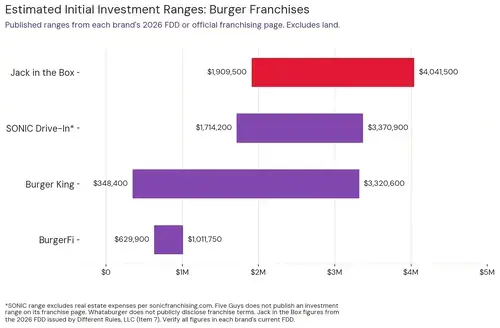
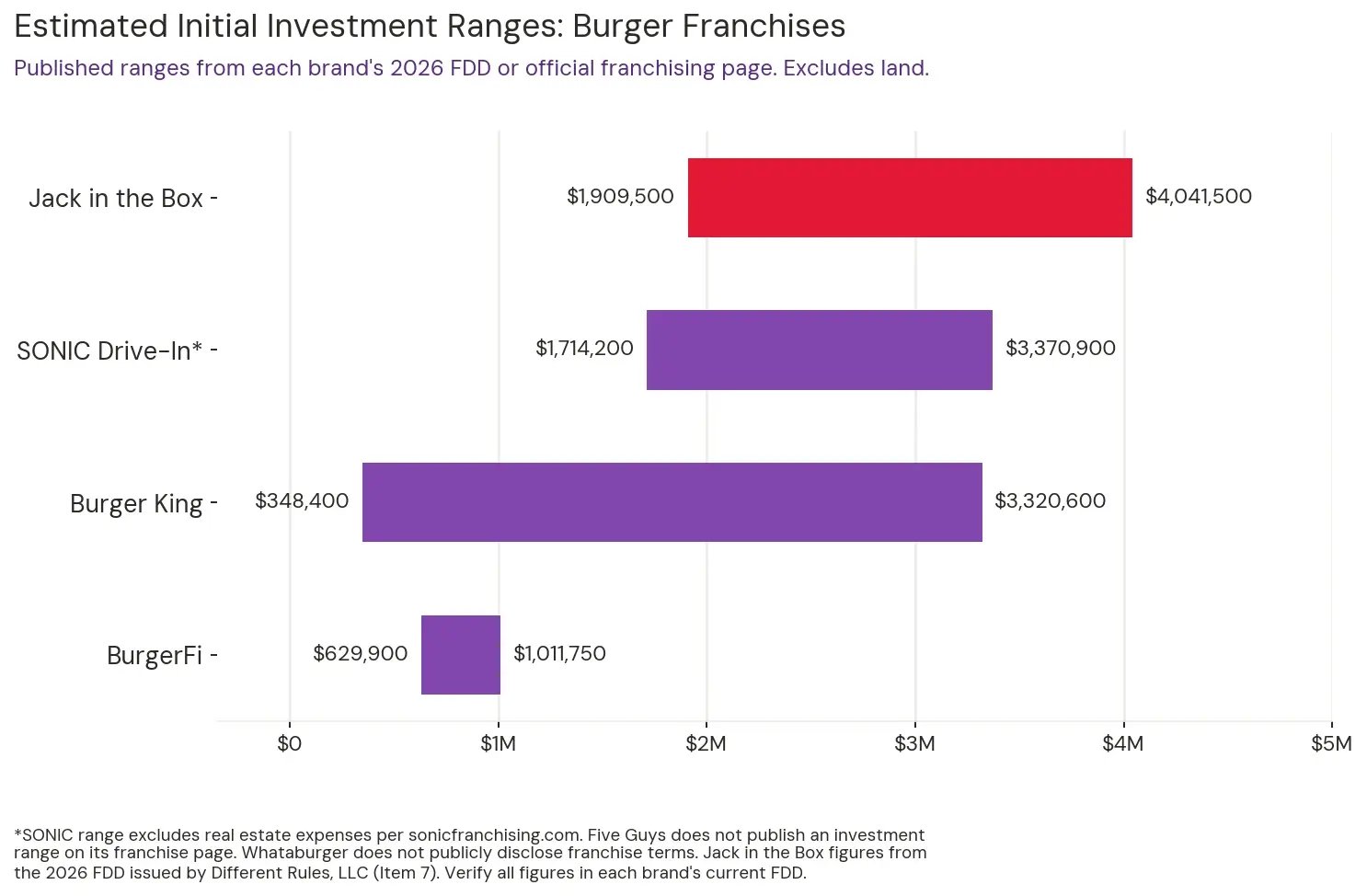
Here is how the published initial investment ranges compare before we get into the brand by brand detail.
I will start with the brand I represent, and I will hold it to the same standard as everyone else on this list: published numbers only.
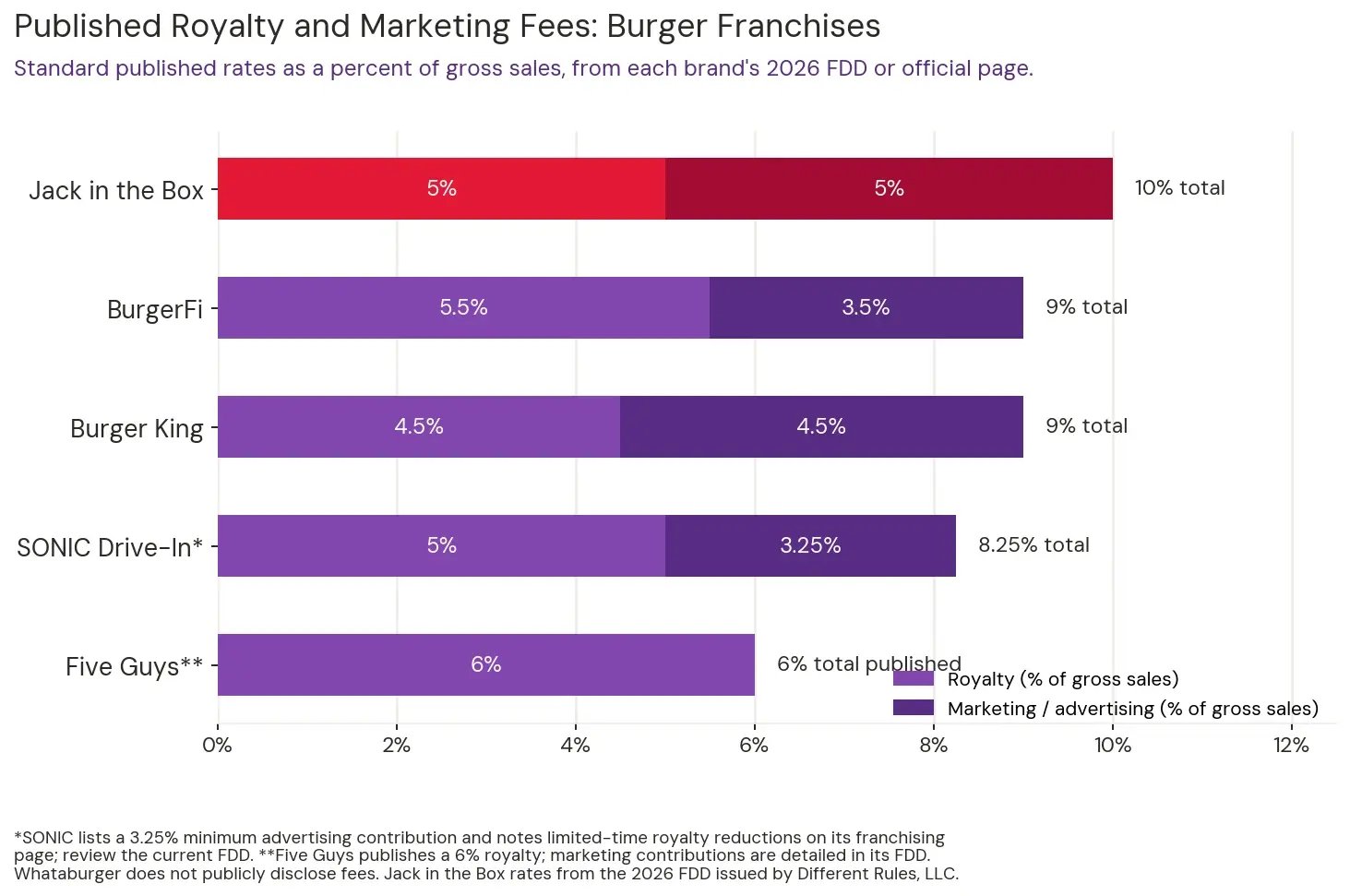
The 2026 Jack in the Box FDD lists an estimated initial investment of $1,909,500 to $4,041,500 for a prototypical restaurant, excluding land, with a $50,000 initial franchise fee. Ongoing fees are a 5% royalty and a 5% marketing fee on gross sales. Candidates need $750,000 in minimum liquidity and $1,500,000 in minimum net worth. You can see the full breakdown on our franchise costs page.
On performance disclosure, the 2026 FDD Item 19 reports FY2025 average gross sales of $1,913,335 across the franchised restaurants included in that table. I want to be direct about what that number is and is not: it reflects gross sales only, before food costs, labor, rent, royalties, and every other operating expense. It is not profit, and it is not a promise. Individual results differ, and the restaurants in the Item 19 table may differ from a restaurant you would open in location, size, and operating history.
Where the brand stands out for multi-unit investors is its published development programs. Qualifying operators who commit to three or more restaurants may access a Development Incentive of $150,000 at 0% interest, and the Select Market Incentive can reduce the royalty to 2% for five years in qualifying markets. Both programs are subject to eligibility requirements and may be modified or discontinued, so confirm current terms in the FDD before building them into a pro forma. Details are on our multi-unit development page, and qualifying veterans can review the 25% franchise fee reduction available through VetFran on our veterans page.
Best fit: experienced operators pursuing multi-unit development in open territories, particularly across the Southeast and Midwest. Our current focus areas are listed on the available markets page.
Burger King publishes clear terms on its official franchising site: an estimated cost to build a new restaurant of $348,400 to $3,320,600 depending on format, a $50,000 initial franchise fee for a 20 year term, a 4.5% royalty, and a 4.5% advertising fee. Candidates need at least $1 million in net worth and $500,000 in liquid assets.
The wide investment range reflects the variety of formats the brand builds, from nontraditional facilities up to freestanding traditional restaurants. Operators comparing Burger King against other legacy brands should pay close attention to which format the low end of that range actually describes, because a freestanding build sits far above $348,400.
Best fit: operators drawn to a global legacy brand with format flexibility, including those evaluating acquisitions of existing restaurants alongside new builds.
SONIC's official franchising site lists an investment of $1,714,200 to $3,370,900, excluding real estate expenses, with a $45,000 initial license fee. The site currently notes that $30,000 of that fee can be credited back via royalty and describes limited time royalty terms, with a 3.25% minimum advertising contribution. Because several of those terms are labeled as limited time offers, treat the current FDD as the controlling document and confirm what applies to your agreement before you model anything.
The drive-in format is genuinely different from a standard QSR box. It carries its own real estate profile, staffing model, and daypart mix, which is worth factoring into any side by side comparison with drive-thru concepts.
Best fit: operators in markets suited to the drive-in format who want a differentiated service model within the burger category.
Five Guys publishes its candidate requirements on its official franchise page: a $25,000 franchise fee, a $50,000 development fee, a 6% royalty, liquid capital above $2,500,000, and net worth above $5,000,000. Previous restaurant, franchising, or business ownership experience is required, and any operating partner must hold equity. The brand also offers a $10,000 franchise fee reduction for qualified veterans.
Two things to know before you spend time here. First, Five Guys does not publish a total investment range on that page, so you will need the current FDD for Item 7 figures. Second, its financial thresholds are the highest on this list, which effectively narrows the candidate pool to well capitalized, experienced groups. Confirm current domestic territory availability directly with the franchisor, since third party reports describe new US availability as limited.
Best fit: deeply capitalized operators who meet the experience requirement and can verify open territory in their target markets.
BurgerFi's franchising FAQ lists an estimated total initial investment of $629,900 to $1,011,750 including a $45,000 franchise fee, with a 5.5% royalty, a 2.0% national brand fund contribution, and 1.5% for local restaurant marketing. Franchisees must be actively involved as operators, either personally or through a dedicated operating partner with equity.
One caution I flag for every operator who asks about this brand: BurgerFi's parent company has changed ownership in recent years, so verify that the figures on its franchising page match the brand's most current FDD before relying on them. When a system restructures, published web figures and the active disclosure document can fall out of sync.
Best fit: hands-on operators interested in the fast casual better burger segment at a lower published entry cost than the legacy QSR brands on this list.
Whataburger has a devoted following and an expanding footprint, but its franchise terms are not publicly disclosed. The brand does not publish investment ranges, fees, or financial requirements, and third party figures circulating online cannot be verified against a primary source, so I will not repeat them here. Interested operators should go straight to Whataburger's franchise page and request information directly.
Publicly announced growth has come in part through joint ventures with existing franchise partners, which suggests a selective development model. If Whataburger is on your shortlist, plan for a direct conversation with the franchisor as your only reliable source of terms.
Best fit: operators with strong regional ties in the brand's growth markets who are prepared for a selective qualification process.
Ongoing fees compound over a 20 year agreement, so a half point of royalty matters more than most first time buyers realize. Here are the standard published rates side by side.
And here is the full requirements picture in one table.
| Brand | Published investment | Franchise fee | Royalty + marketing | Financial requirements |
|---|---|---|---|---|
| Jack in the Box | $1,909,500 to $4,041,500 (excl. land) | $50,000 | 5% + 5% | $750K liquid, $1.5M net worth |
| Burger King | $348,400 to $3,320,600 (format dependent) | $50,000 | 4.5% + 4.5% | $500K liquid, $1M net worth |
| SONIC Drive-In | $1,714,200 to $3,370,900 (excl. real estate) | $45,000 (see brand page for credits) | Up to 5% + 3.25% min. | Confirm with franchisor |
| Five Guys | Not published; request FDD | $25,000 + $50,000 development fee | 6% royalty; marketing per FDD | $2.5M+ liquid, $5M+ net worth |
| BurgerFi | $629,900 to $1,011,750 | $45,000 | 5.5% + 3.5% | Confirm with franchisor |
| Whataburger | Not publicly disclosed | Not publicly disclosed | Not publicly disclosed | Not publicly disclosed |
Figures from each brand's 2026 FDD or official franchising page as of July 2026. Terms change; the current FDD controls in every case.
After years of walking operators through this process, I use a five point checklist. It works for any brand on this list.
Read Item 7 against your market, not the national range. Construction and site costs in your specific DMA can sit at either end of a published range. Get local contractor input before you anchor on a midpoint.
Model total fee load, not just royalty. A 4.5% royalty with a 4.5% advertising fee costs the same as a 5% royalty with a 4% fee. Add technology fees, cooperative contributions, and any per transaction charges from Item 6.
Ask what the multi-unit path actually looks like. Development agreements carry schedules and remaining fees. In the Jack in the Box 2026 FDD, for example, a two restaurant development agreement lists its own fee structure separate from the single restaurant table. Our franchise process page walks through how that works step by step.
Verify Item 19 methodology. When a brand shares sales figures, check which restaurants were included and excluded, and remember that gross sales are not earnings. Validate against Item 20 franchisee contacts, which the FTC specifically recommends.
Weigh training and ongoing support. The systems behind the brand determine how fast your second and third restaurants ramp. Ours are documented on the training and support page.
Published estimated initial investments among the brands compared here range from $348,400 (Burger King, lowest format) to $4,041,500 (Jack in the Box, high end of its 2026 FDD Item 7 range, excluding land). Most freestanding traditional builds across the category fall well above $1 million once construction, equipment, and working capital are included.
Among brands that publish figures, BurgerFi lists the lowest complete range at $629,900 to $1,011,750. Burger King lists a lower floor of $348,400, but that reflects its smallest nontraditional format rather than a freestanding restaurant.
Published standard royalties among these brands run from 4.5% (Burger King) to 6% (Five Guys) of gross sales. Marketing and advertising contributions add another 3.25% to 5% where disclosed, bringing published combined fee loads to between 8.25% and 10% of gross sales.
The 2026 Jack in the Box FDD Item 19 reports FY2025 average gross sales of $1,913,335 across the franchised restaurants included in that table. This figure represents gross sales only, before all operating expenses, and is not profit, earnings, or a prediction of any individual restaurant's results. Restaurants included in the table may differ from yours, and there is no assurance you will do as well.
Published thresholds range from $500,000 liquid and $1 million net worth (Burger King) to more than $2.5 million liquid and $5 million net worth (Five Guys). Jack in the Box requires $750,000 in minimum liquidity and $1.5 million in minimum net worth per its 2026 FDD.
Request the current FDD from each brand on your shortlist, review Items 5 through 7, 19, and 20 with a franchise attorney and accountant, and call existing franchisees. The FTC's guide outlines the full due diligence sequence. If Jack in the Box makes your shortlist, our team walks candidates through every step, starting on our Why Jack in the Box page or with a direct conversation through our contact page.
About the author: Dustin Thompson works in Franchise Marketing and Development at Jack in the Box, where he helps prospective franchisees, particularly multi-unit QSR operators, evaluate the brand's development opportunities across its active growth markets. He works directly with the brand's Franchise Disclosure Document and development programs every day, and writes about franchise costs, qualification, and market selection for jackintheboxfranchising.com.
This article is for informational purposes only and is not an offer to sell a franchise. An offer can be made only through delivery of a Franchise Disclosure Document in compliance with applicable law. Nothing in this article is a financial performance representation, and figures cited from any FDD Item 19 reflect historical gross sales only, not profits or earnings. Individual results differ. Competitor figures come from the sources linked above as of July 2026 and may change; consult each brand's current FDD.