
Burger Franchise vs Sub Franchise: Everything You Need to Know
See how burger and sub franchises compare on cost, fees, real estate, and menu, plus why franchising is a strong fit for veterans.
7 min read
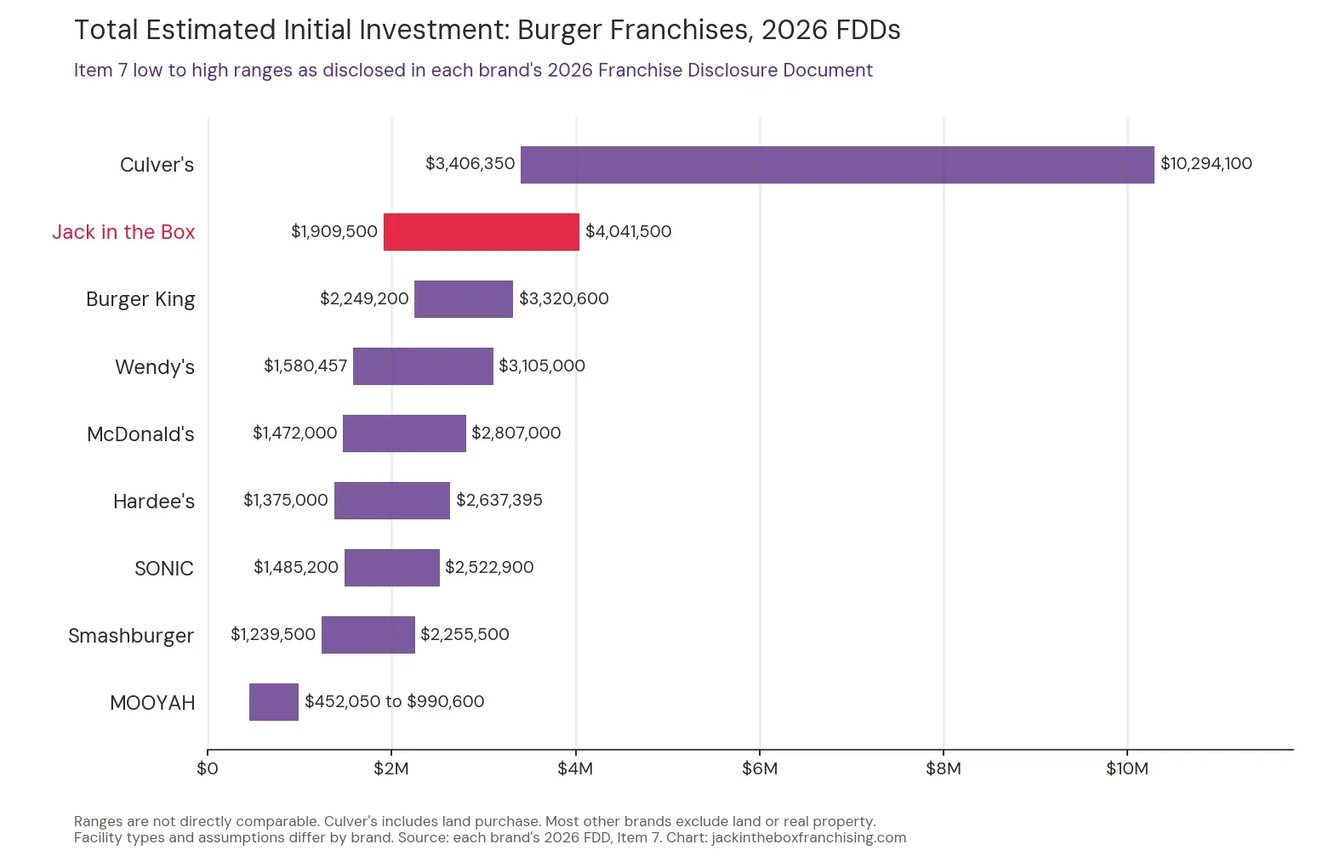
Total upfront investment for the major US burger franchises in 2026 runs from roughly $452,050 at the low end for a leased fast casual space to $10,294,100 at the high end for a ground up build that includes land. Every figure in this article comes from Item 7 of each brand's current Franchise Disclosure Document. Nothing here is an estimate I made up or a number scraped from an aggregator site.
I work in franchise development for Jack in the Box, and the first question serious candidates ask me is almost never about the brand. It is about the check they need to write. So I pulled the 2026 FDDs for nine burger brands, went straight to Item 7 in each one, and lined the numbers up side by side. Here is what the documents actually say.
The table below shows the total estimated initial investment disclosed in Item 7 of each brand's 2026 FDD, along with what each range assumes. Read the basis column carefully. It matters more than the dollar figures.
| Brand (2026 FDD) | Total Estimated Initial Investment | Basis Disclosed in Item 7 |
|---|---|---|
| Jack in the Box | $1,909,500 to $4,041,500 | New prototypical restaurant. Excludes land, financing, and certain other costs. |
| McDonald's | $1,472,000 to $2,807,000 | Traditional restaurant. McDonald's acquires the real estate and building; the franchisee pays rent, so land and building purchase are not in the range. |
| Burger King | $2,249,200 to $3,320,600 | Traditional freestanding facility. Non traditional formats such as co brand and in line disclose lower ranges. |
| Wendy's | $1,580,457 to $3,105,000 | Cash purchase of building, equipment, and pre opening costs. Real property disclosed separately as varies. |
| Hardee's | $1,375,000 to $2,637,395 | New freestanding restaurant of about 2,200 square feet. Real property listed as variable and excluded from the total. |
| SONIC | $1,485,200 to $2,522,900 | Freestanding drive in on leased land. Excludes freestanding real estate costs. Leased c store and urban in line formats disclose lower ranges. |
| Culver's | $3,406,350 to $10,294,100 | Ground up build that includes land purchase of $225,000 to $2,400,000, site work, and a new building of roughly 4,060 to 4,310 square feet. |
| Smashburger | $1,239,500 to $2,255,500 | Leased space with leasehold improvements. No land or building purchase in the range. |
| MOOYAH | $452,050 to $990,600 | Leased space of about 2,000 square feet, no drive thru. Excludes land acquisition and building construction. |
Source: Item 7 of each brand's 2026 Franchise Disclosure Document. Jack in the Box figures from the FDD issued March 13, 2026 by Different Rules, LLC.
Because the brands are not measuring the same project. This is the single biggest mistake I see candidates make when they compare FDDs, and I review these documents for a living.
Three basis differences explain most of the spread:
1. Land treatment. Culver's includes buying the dirt, which is why its high end reaches eight figures. Jack in the Box, Wendy's, Hardee's, and SONIC exclude land or real property from the total. McDonald's goes a different direction entirely: the company typically controls the real estate and the franchisee pays rent, so property purchase never enters the franchisee's Item 7 range.
2. Facility type. A SONIC drive in building runs 1,250 to 1,500 square feet. A Culver's prototype runs over 4,000. A MOOYAH sits in about 2,000 square feet of leased inline space with no drive thru at all. Smaller box, smaller build cost, but also a very different real estate strategy and operating model.
3. What counts as opening costs. Working capital assumptions vary from $10,000 to $452,000 across these nine documents. Training cost estimates vary just as widely. Each franchisor sets its own assumptions, and the FDD notes explain them.
The practical takeaway: never rank brands by the headline range alone. Open each FDD, read the Item 7 notes, and rebuild the comparison on a like for like basis for the specific real estate strategy you plan to use. The FTC's Consumer Guide to Buying a Franchise walks through how to read these disclosures if you have never worked with one.
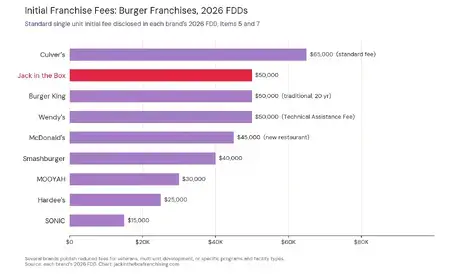
The initial franchise fee gets outsized attention because it is the number brands put on their websites. In reality it is usually 1 to 4 percent of the total project. Here is what each 2026 FDD discloses for a standard single unit:
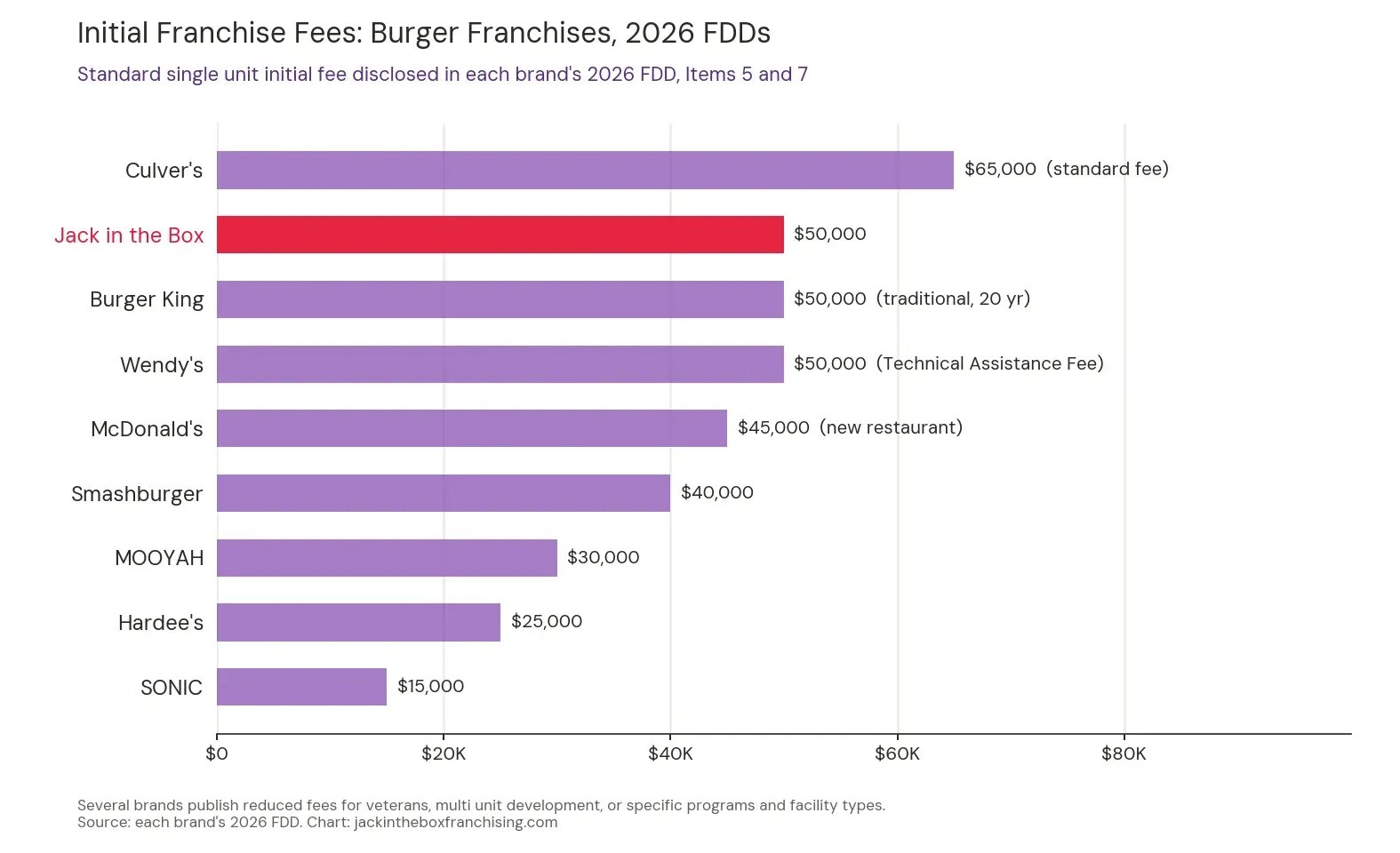
Two caveats from the documents themselves. Culver's discloses a fee range of $35,000 to $65,000 depending on program and discounts, with $65,000 as the standard figure. And most brands publish reduced fees for veterans or multi unit commitments, so the standard fee is a starting point, not a fixed price for every buyer.
Since this is the FDD I know line by line, I will break ours down the way I do on calls with candidates. Per Item 7 of the March 13, 2026 FDD from Different Rules, LLC, the total estimated initial investment for a new prototypical Jack in the Box restaurant is $1,909,500 to $4,041,500, excluding land, financing, and certain other costs. The major line items:
| Item 7 Expenditure | Low | High |
|---|---|---|
| Initial franchise fee | $50,000 | $50,000 |
| Building improvements | $626,000 | $1,250,400 |
| Furniture, fixtures, and equipment | $499,000 | $967,000 |
| On site improvements | $337,000 | $825,000 |
| Architect and engineering services | $44,000 | $216,000 |
| Additional funds, 3 months | $165,300 | $458,600 |
| Pre opening training and inventory expenses | $110,000 | $115,000 |
| IT equipment and installation | $45,000 | $60,000 |
| Total (excluding land, financing, certain other costs) | $1,909,500 | $4,041,500 |
Selected line items from Item 7, 2026 Jack in the Box FDD (Different Rules, LLC). The table above is not the complete Item 7 schedule. See the full breakdown on our franchise costs page.
One thing candidates consistently tell me they did not expect: pre opening training carries a real budget. Ours is estimated at $110,000 to $115,000 because operators and their management teams go through a structured program before doors open. You can read what that covers on our training and support page. If you are earlier in the research phase, start with why operators choose Jack in the Box.
Investment ranges tell you the project cost. Qualification standards tell you whether a franchisor will talk to you. For Jack in the Box, candidates need minimum liquidity of $750,000 and minimum net worth of $1,500,000. Other brands in this comparison set their own thresholds in their FDDs and application processes, and several of the larger legacy brands screen specifically for multi unit restaurant experience. If you are weighing a multi unit commitment, our multi unit development page explains how we structure development agreements.
Yes, and this is where the fine print earns its keep. Current Jack in the Box programs include:
Eligibility requirements apply to each program, and incentive programs can be modified or discontinued. The controlling terms are always the ones in the current FDD and your signed agreements, not a blog post, including this one. Other brands in this comparison publish their own incentive structures in Items 5 and 6 of their FDDs, so check each document rather than assuming the standard fee applies to you.
Do not take my word for any of this, and definitely do not take a listing site's word for it. Here is the verification process I recommend to every candidate:
Request the current FDD directly from each franchisor. Under the FTC Franchise Rule, you must receive the FDD at least 14 days before signing or paying anything.
Use a state registry for independent copies. Several registration states publish FDDs. Minnesota's Commerce Department CARDS system is free and searchable, and it is the registry I used to cross check filings for this article.
Read Item 7 notes, not just the table. The notes disclose whether land is in or out, what square footage is assumed, and how working capital was estimated. Franchising remains a large and growing sector, with the International Franchise Association's Franchising Economic Outlook tracking output across hundreds of thousands of franchised establishments, and disclosure quality is what separates informed buyers from optimistic ones.
When you are ready to see our numbers in full context, the franchise process page shows exactly where FDD review fits in our timeline.
Among the nine 2026 FDDs reviewed here, MOOYAH discloses the lowest total estimated initial investment at $452,050 to $990,600 for a leased space of about 2,000 square feet with no drive thru. The trade off is a fast casual leased format rather than a freestanding drive thru building, which is a different real estate and operations model.
Per Item 7 of the March 13, 2026 FDD issued by Different Rules, LLC, the total estimated initial investment for a new prototypical Jack in the Box restaurant is $1,909,500 to $4,041,500, excluding land, financing, and certain other costs. The initial franchise fee is $50,000. Candidates need minimum liquidity of $750,000 and minimum net worth of $1,500,000.
The Culver's Item 7 range of $3,406,350 to $10,294,100 includes land purchase of $225,000 to $2,400,000 plus site work and construction of a building over 4,000 square feet. Most other brands in this comparison exclude land or real property from their totals, so the Culver's figure covers a larger scope, not necessarily a more expensive like for like project.
No. Initial franchise fees among these nine brands run $15,000 to $65,000, while total project costs run from the mid six figures into the millions. Construction, equipment, site improvements, and working capital make up the large majority of the investment in every FDD reviewed.
Request the current FDD directly from each franchisor, or search a public state registry such as Minnesota's Commerce Department CARDS system. Federal law requires that you receive the FDD at least 14 days before signing an agreement or making a payment.
About the author: Dustin Thompson works in Franchise Marketing and Development at Jack in the Box, where he helps qualified candidates evaluate the brand across active development markets including Florida, Georgia, Illinois, Kentucky, Tennessee, and Michigan. He works with FDD disclosures, market data, and multi unit operators daily. Questions about this comparison or our markets? Reach out to our team.
This article is for informational purposes only and is not an offer to sell a franchise. An offer can only be made through a Franchise Disclosure Document. Figures cited are total estimated initial investment ranges and fees as disclosed in each brand's 2026 FDD and are not statements or guarantees of costs you will actually incur, nor representations of financial performance. Programs, fees, and requirements can change; consult the current FDD and your own legal and financial advisors.