
Top 7 Profit Drivers in Multi-Unit Burger Franchising
Seven profit drivers multi-unit operators should weigh before adding burger franchise locations, with 2026 FDD data on fees, sales, and deal terms.
6 min read
By Dustin Thompson, Franchise Marketing and Development, Jack in the Box • Last updated: July 10, 2026
The burger category rewards operators who read documents and punishes operators who read headlines. If you already run restaurants and you are weighing a burger brand for your next three, five, or ten units, the evaluation is less about the food and more about four files: the FDD, the franchise agreement, the development agreement, and your own financial model.
My name is Dustin Thompson. I work in franchise marketing and development at Jack in the Box, and reading Franchise Disclosure Documents is a core part of that job. For this guide I reviewed the 2026 FDDs for Jack in the Box, McDonald's, Wendy's, Burger King, and Culver's cover to cover. What follows is the evaluation framework I would hand any experienced operator assessing a multi-unit burger franchise, with 2026 figures and sources you can verify.
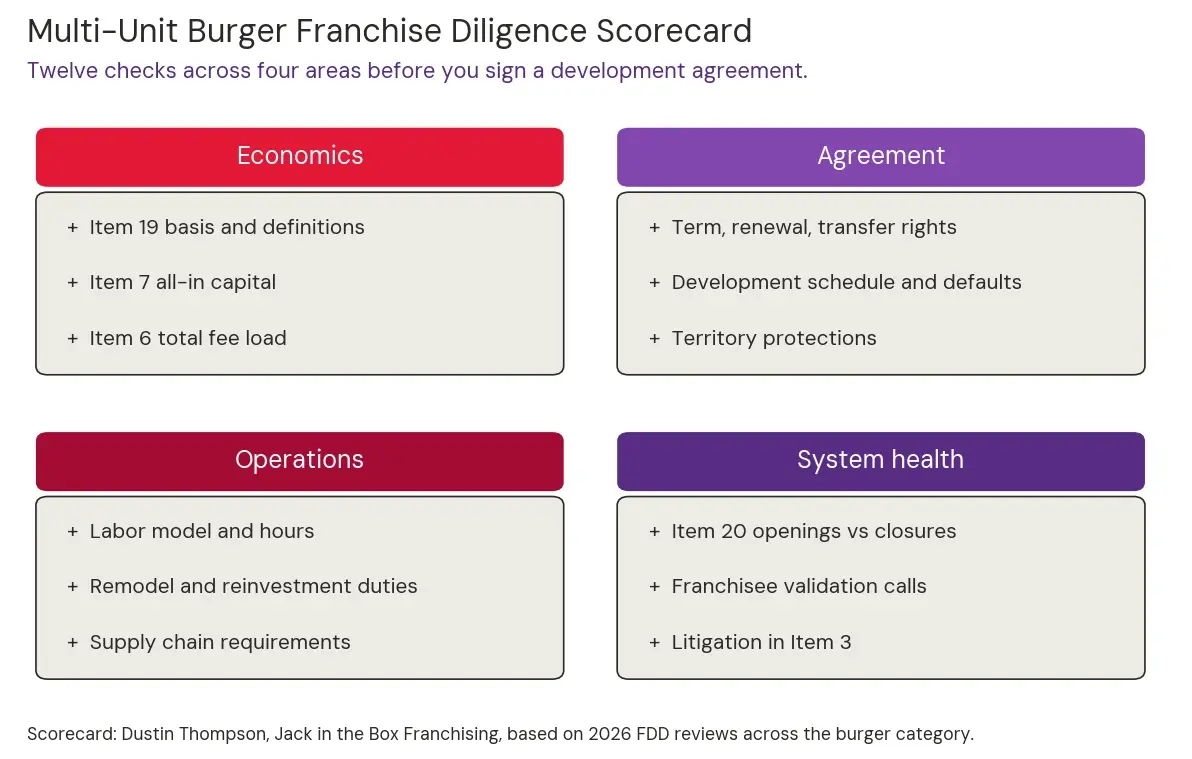
Twelve checks in four groups: economics (Item 19 basis, Item 7 capital, Item 6 fees), agreement terms (term and renewal, development schedule, territory), operations (labor model, remodel obligations, supply chain), and system health (Item 20 trends, franchisee validation, Item 3 litigation). Here is the scorecard, then each group in detail.
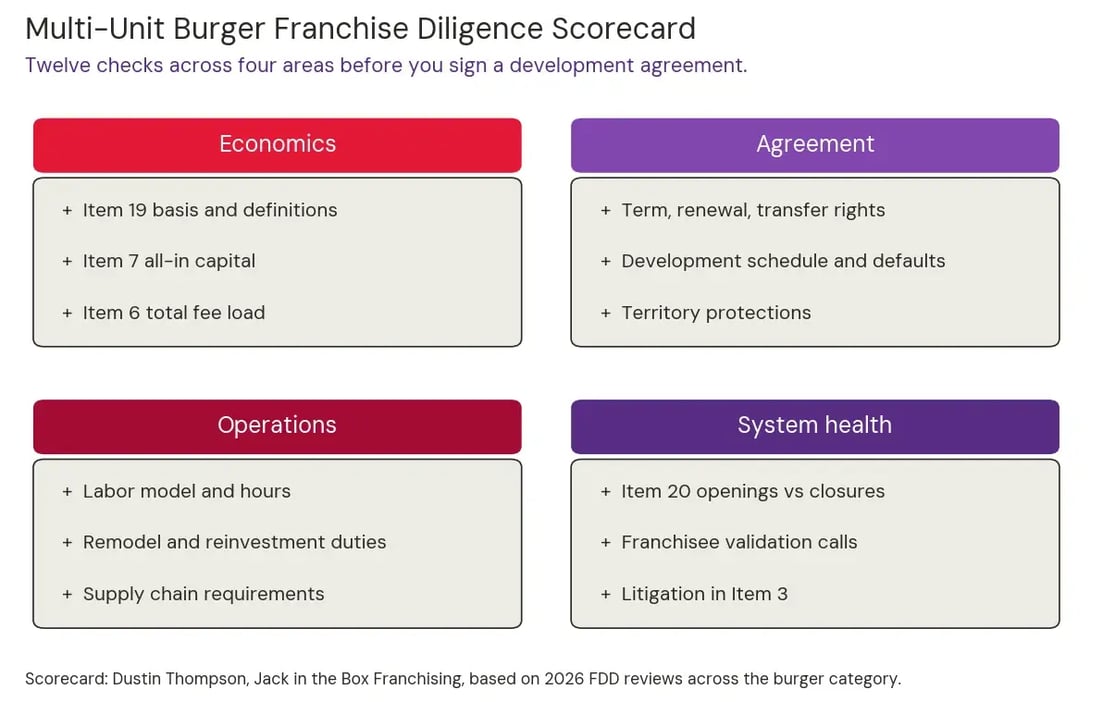
Twelve diligence checks across four areas, each tied to a specific FDD disclosure or validation step.
Start with Item 19, and read the average against the median. In the 2026 disclosures: Culver's reports average sales of $4,142,737 and median sales of $4,036,492 for franchised restaurants open 12 months. McDonald's reports a $4,057,000 average and a $3,887,000 median for domestic traditional franchised restaurants open at least a year. Wendy's reports average gross sales of $1,993,657 and a median of $1,866,652. Burger King reports a $1,692,549 average and a $1,593,606 median for franchisee-owned traditional restaurants. Jack in the Box discloses a fiscal 2025 systemwide average of $1,913,335 in gross sales.
Average versus median gross sales from 2026 Item 19 disclosures. A wide gap means top units pull the average up. Gross sales only, not earnings.
When an average sits meaningfully above its median, stronger units are pulling the number up, and a new unit is statistically more likely to land nearer the median than the average. Every figure above is gross sales, not profit, and each brand computes its table on a different restaurant population, so read the Item 19 notes before drawing any conclusion.
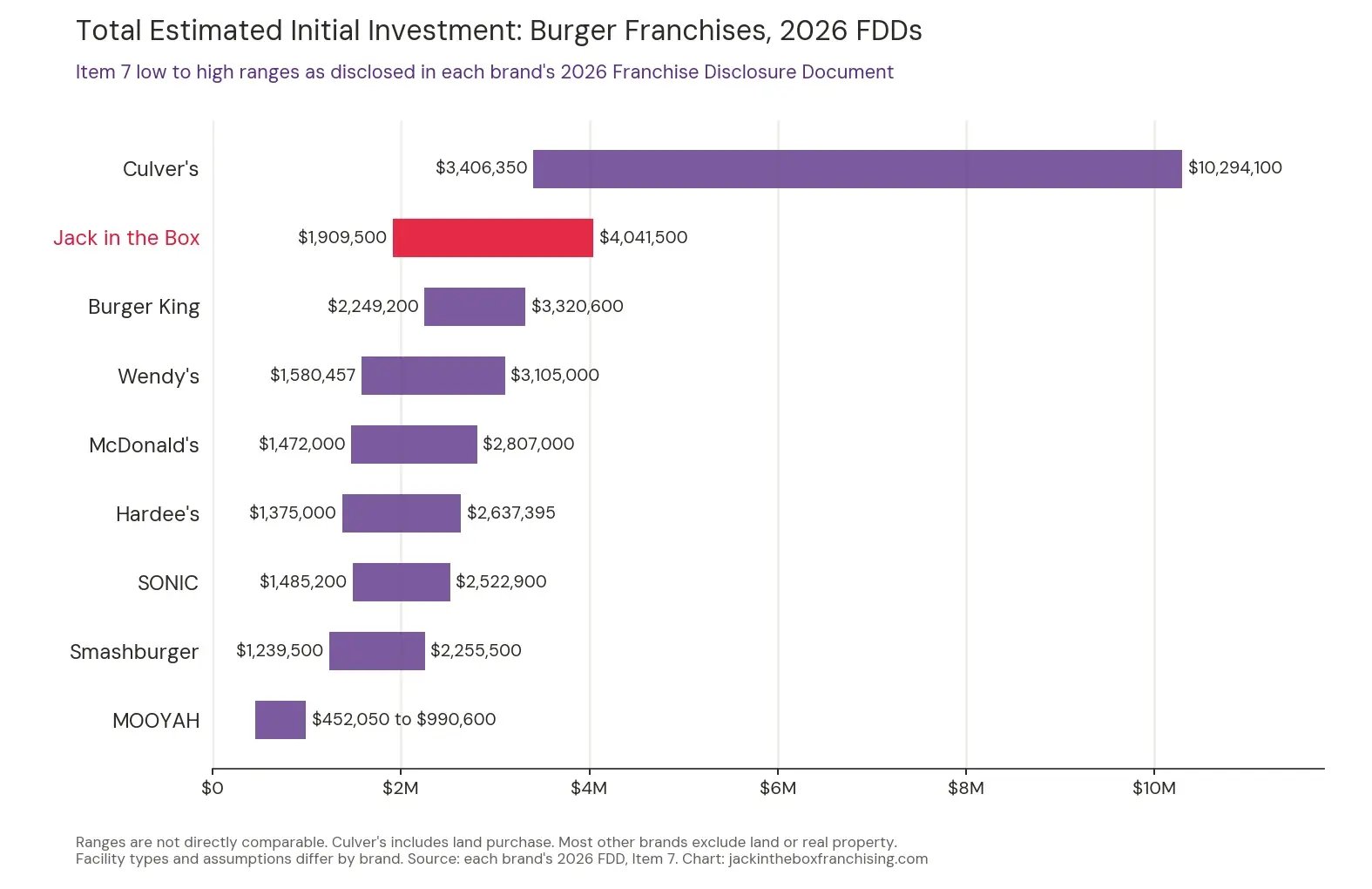
Then check capital per unit in Item 7. Jack in the Box publishes $1,909,500 to $4,041,500, itemized on our franchise costs page. McDonald's publishes $1,472,000 to $2,807,000 for traditional restaurants. Culver's publishes $3,406,350 to $10,294,100. Wendy's publishes $1,580,457 to $3,105,000 and Burger King $348,400 to $3,320,600, both excluding real estate, which means you must add land and building costs yourself before comparing. Finally, stack the Item 6 fee load: Jack in the Box runs 5% royalty plus 5% marketing, McDonald's 5% or 4% royalty plus at least 4% advertising, Burger King 4.5% plus up to 4.5%, Wendy's 4% to 6% plus up to 4.5% in combined advertising, and Culver's 4% plus 2.5%.
Three things: what you get, what you owe, and what happens when plans slip.
What you get is term, renewal rights, transfer rights, and territory protection. Terms and protections vary by brand and by site type, and transfer provisions decide how easily you can exit or restructure a portfolio later. Have a franchise attorney map these across every brand you compare.
What you owe is where development structures diverge. Burger King's programs require prepaying the $50,000 franchise fee per committed restaurant, minimum $100,000 for a two-restaurant commitment. Culver's charges a $50,000 development fee per restaurant on the schedule. Wendy's current development agreement forms require no up-front fee. Jack in the Box structures commitments through development agreements, and its 2026 FDD discloses a Development Incentive that can provide a $150,000 interest-free loan for qualifying commitments of three or more restaurants and a Select Market Incentive that can reduce the royalty to 2% for five years in qualifying markets. Treat every incentive at every brand as conditional: eligibility requirements apply and programs may be modified or discontinued. Our multi-unit development page explains the Jack in the Box approach.
What happens when plans slip is the part investors skip. Development agreements specify what becomes of deposits and fee credits if an opening date is missed. Read those provisions before signing, not after a construction delay. The FTC Franchise Rule guarantees you 14 days with the documents; your attorney will want all of them.
Three show up in every burger system I have reviewed. Required operating hours shape your labor model; extended and late-night hours add sales opportunity and staffing complexity together, and wage pressure is persistent across food service, which you can track through the Bureau of Labor Statistics CPI program. Remodel and reinvestment obligations recur across a portfolio, so a requirement that feels minor on one unit compounds across ten. Supply chain requirements determine your input costs and flexibility, and Item 8 of each FDD discloses required suppliers and how purchasing works.
Multiply each obligation by your planned unit count before you evaluate it. That single habit reframes most franchise agreements.
Item 20 tables three years of openings, closures, terminations, and transfers. Look for direction, not perfection. Then call franchisees from the Item 20 contact lists, including former ones, and ask multi-unit operators how the franchisor behaved at scale: site approvals, opening support, field coverage. Item 3 discloses litigation history. The FTC's Consumer's Guide to Buying a Franchise walks through this diligence step by step.
Market direction is part of system health too. From my seat, the clearest 2026 example is geographic: Jack in the Box opened its first Florida restaurant in Longwood on February 19, 2026, and is developing across Florida, Georgia, Illinois, Kentucky, and Tennessee. For an operator in those regions, open contiguous territory is a system-health signal you can verify by looking at our available markets page and at Item 20 of any competing FDD.
Run the twelve checks, normalize the numbers, call the operators, then model the full development schedule with your attorney and accountant. If Jack in the Box makes your shortlist, the path runs through our franchise process page, with qualification thresholds of $750,000 in liquidity and $1,500,000 net worth, training details on the training and support page, the brand case on why Jack in the Box, a 25% franchise fee reduction for qualifying veterans through VetFran, and my team on the other end of the contact page.
The basis of its Item 19 disclosure. Before comparing any sales figure, confirm which restaurants it covers, whether it is average or median, and remember it is gross sales only. The basis determines whether a comparison means anything.
Because a wide gap between them means high performers pull the average up. In 2026 disclosures the gap runs from roughly $99,000 at Burger King to $170,000 at McDonald's among brands publishing both figures. Both numbers remain gross sales, not earnings.
Not always. Among 2026 FDDs, Wendy's and Burger King publish ranges excluding real estate, while others include site costs. Always read the Item 7 notes and build an all-in per-site figure for your own market.
The 2026 FDD sets minimums of $750,000 in liquidity and $1,500,000 in net worth, with a $50,000 initial franchise fee and an estimated total initial investment of $1,909,500 to $4,041,500 per restaurant.
Dustin Thompson works in Franchise Marketing and Development at Jack in the Box, guiding experienced restaurant operators through evaluation and entry into the system. The figures in this guide come from his direct review of the 2026 Franchise Disclosure Documents of the brands discussed.
This article is for informational purposes only and is not an offer to sell a franchise. Offers are made only through a Franchise Disclosure Document in compliance with applicable law. Nothing here is a financial performance representation, and no statement should be read as a claim or projection of earnings, profits, or success. Item 19 figures cited are gross sales only and do not reflect costs or profits. Incentive programs described are subject to eligibility requirements and may be modified or discontinued. Competitor figures come from each brand's 2026 FDD or official franchise materials and may change; verify all figures in current documents with qualified legal and financial advisors. Jack in the Box franchises are offered by Different Rules, LLC.