
How to Evaluate a Multi-Unit Burger Franchise in 2026
How experienced operators evaluate a multi-unit burger franchise in 2026: a 12-check scorecard covering FDD economics, agreements, and system health.
6 min read
By Dustin Thompson, Franchise Marketing and Development, Jack in the Box • Last updated: July 10, 2026
Experienced restaurant investors do not pick brands off a ranking list. They run a screen. The screen has criteria, the criteria have sources, and most of those sources are sitting in Franchise Disclosure Documents that anyone can request.
I work in franchise marketing and development at Jack in the Box, which means I spend an unusual amount of time inside FDDs. For this piece I read the 2026 filings for Jack in the Box, McDonald's, Wendy's, Burger King, Culver's, and Taco Bell's Express unit program side by side. What follows is the seven-point screen I would use for any QSR franchise investment aimed at portfolio growth, with real 2026 numbers attached and links so you can check my work.
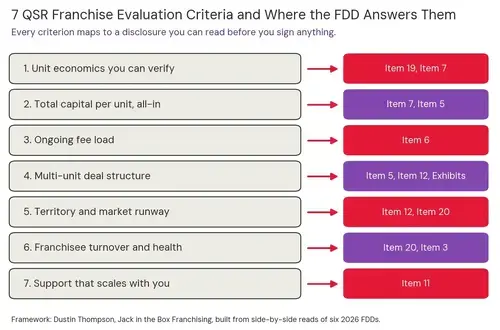
Seven: verifiable unit economics, all-in capital per unit, ongoing fee load, multi-unit deal structure, territory runway, franchisee turnover, and support that scales. Here is where each one lives in the FDD.
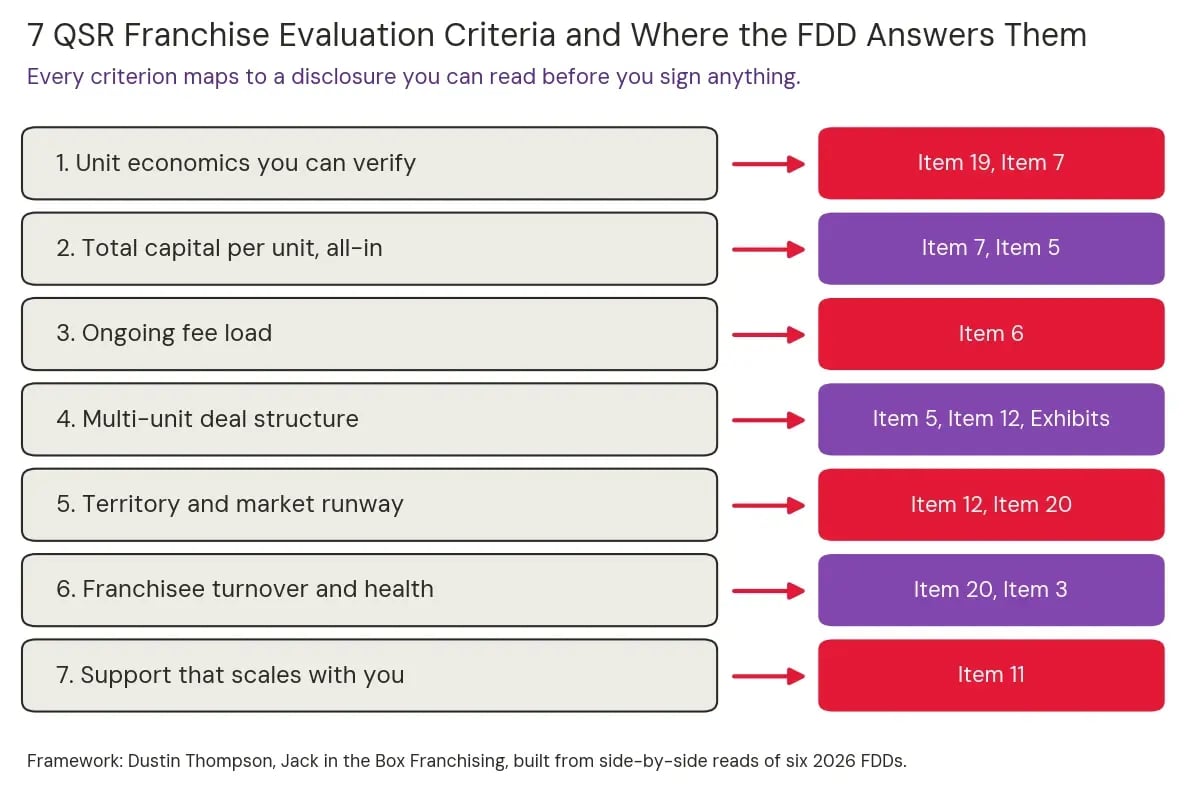
Each evaluation criterion maps to specific FDD disclosures you can read before signing anything.
The FTC's Consumer's Guide to Buying a Franchise explains the FDD item structure if it is new to you. Now the criteria, one at a time.
Start with Item 19, and start skeptical. Among 2026 disclosures: Culver's reports average sales of $4,142,737 across franchised restaurants open a full 12 months. McDonald's reports $4,057,000 for domestic traditional franchised restaurants open at least a year. Wendy's reports average gross sales of $1,993,657 for franchise restaurants. Jack in the Box reports a systemwide average of $1,913,335 in gross sales for fiscal 2025. Burger King reports $1,692,549 for franchisee-owned traditional restaurants. The Taco Bell Express FDD I reviewed does not include a comparable average sales table.
All of these are gross sales, not earnings. And the bases differ, which is exactly why the criterion is "can you verify" rather than "which number is biggest." The real verification happens in Item 20, where you get franchisee contact information and can ask operators about their actual economics yourself.
Item 7 publishes the estimated ranges, and in 2026 they look like this. Taco Bell Express units: $287,950 to $857,700, a figure specific to its Express format for locations like airports, universities, and convenience stores. Burger King: $348,400 to $3,320,600, excluding real estate. McDonald's traditional restaurants: $1,472,000 to $2,807,000. Wendy's: $1,580,457 to $3,105,000 for a cash purchase, excluding real estate. Jack in the Box: $1,909,500 to $4,041,500, detailed on our franchise costs page. Culver's: $3,406,350 to $10,294,100.
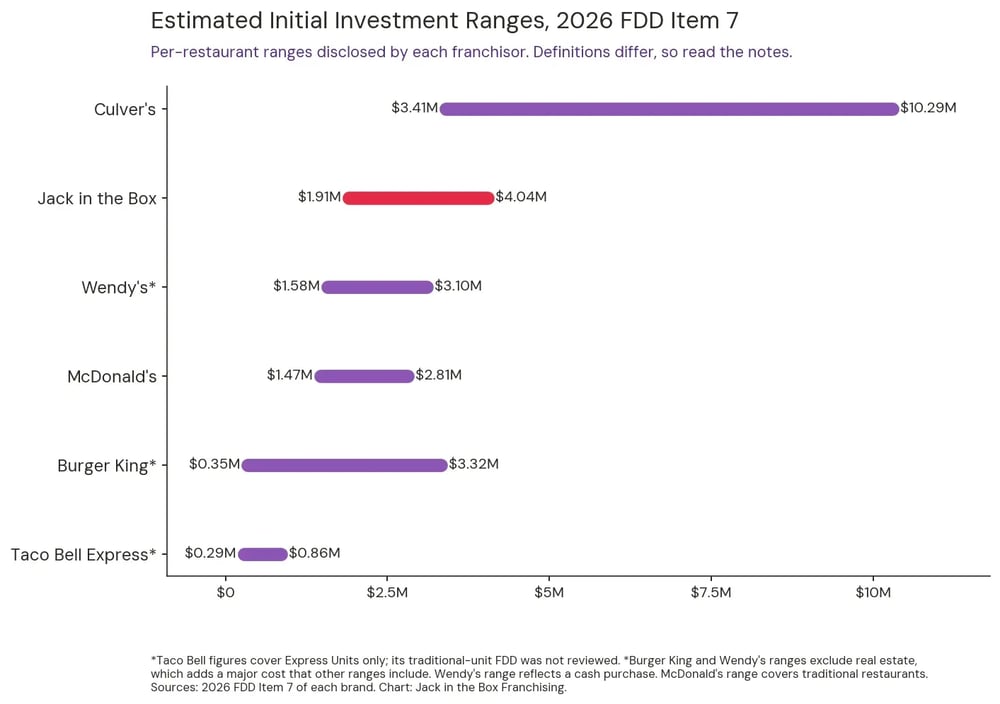
Estimated initial investment ranges from 2026 FDD Item 7. Taco Bell figures cover Express Units; Burger King and Wendy's ranges exclude real estate.
Watch the footnotes. A range that excludes real estate is answering a different question than a range that includes it, and Express-format numbers describe a different asset than a freestanding drive-thru restaurant. Build your own per-site model before comparing anything.
Item 6 is short reading with long consequences. Standard 2026 rates: Jack in the Box, 5% royalty plus 5% marketing. McDonald's, 5% or 4% royalty depending on circumstances, plus advertising of not less than 4%. Burger King, 4.5% royalty plus advertising up to 4.5%. Wendy's, 4% to 6% royalty by program, plus 1.5% to 4% national advertising and 0.5% local. Culver's, 4% service royalty plus 2.5% advertising royalty. Taco Bell Express units, a 10% royalty with a $22,500 initial license fee.
Fee load only means something next to what it buys: advertising weight, technology, supply chain leverage, field support. That is a question for Item 11 and for the franchisees you call, not for a percentages table alone.
If you are building a portfolio, this criterion outranks the franchise fee. Burger King's development structures involve prepaying $50,000 franchise fees per committed restaurant, with a $100,000 minimum for two-restaurant commitments. Culver's charges a $50,000 development fee per restaurant on a development schedule. Wendy's current development agreement forms carry no up-front fee. McDonald's approaches growth differently altogether; its model historically centers on operators acquiring existing restaurants, with its FDD describing requirements like 25% of a purchase price in unencumbered funds in certain transactions.
Jack in the Box uses development agreements for portfolio commitments, and its 2026 FDD describes a Development Incentive that can provide a $150,000 interest-free loan for qualifying commitments of three or more restaurants, plus a Select Market Incentive that can reduce the royalty to 2% for five years in qualifying markets. Both carry eligibility requirements and may be modified or discontinued, so confirm current terms before building them into a model. Our multi-unit development page covers how these commitments work.
Item 20 shows outlet counts by state, and it answers this question fast. A mature system may have little contiguous territory near your infrastructure. A brand entering new regions may have entire metros open.
Jack in the Box is currently developing in Florida, Georgia, Illinois, Kentucky, and Tennessee, and opened its first Florida restaurant in Longwood on February 19, 2026. I was part of the team watching that market entry happen, and the difference between developing in an open market versus squeezing into a saturated one shows up in everything from site quality to hiring. Current openings are on our available markets page.
Item 20 also tables three years of openings, closures, transfers, and terminations. Read the trend, not one year. Then use the franchisee contact lists to call operators, including former ones, which the tables identify. Item 3 discloses litigation, which tells you how disputes in the system get resolved. The FTC Franchise Rule requires all of this disclosure precisely so investors can do this check.
Item 11 lists the franchisor's actual training and support obligations, which can differ from what recruiting websites imply. For a multi-unit investor the question is specific: does the brand have training capacity, field structure, and opening support built for operators running several restaurants at once? Our training and support page lays out the Jack in the Box version, and our franchise process page shows where each piece of support lands in the timeline from application to opening.
Openly stated: I work here, so weigh that. On the screen above, Jack in the Box brings a $1,909,500 to $4,041,500 investment range, a $50,000 franchise fee, a 5% royalty and 5% marketing fee, qualification thresholds of $750,000 in liquidity and $1,500,000 net worth, disclosed incentive programs for qualifying multi-unit commitments, and open development territory in five states. The why Jack in the Box page makes the fuller case. Qualifying veterans receive a 25% reduction in the initial franchise fee through VetFran, and our team is reachable through the contact page.
For multi-unit investors, deal structure and territory usually matter more than any single fee, because they determine whether a portfolio can actually be built. Unit economics set the ceiling, but agreements and market runway decide whether you reach it.
Published 2026 FDD ranges among brands reviewed here run from $287,950 at the bottom of the Taco Bell Express range to $10,294,100 at the top of the Culver's range. Definitions vary, and some ranges exclude real estate, so build a local all-in model per site.
Item 20 of any FDD tables three years of openings, closures, terminations, and transfers, plus contact information for current and former franchisees. The FTC Franchise Rule requires it.
Because they come from Taco Bell's 2026 Express unit FDD, which covers smaller-format locations like airports and convenience stores. Traditional Taco Bell restaurants are offered under a separate FDD with different fees and investment ranges, which was not part of this review.
Dustin Thompson works in Franchise Marketing and Development at Jack in the Box. Every competitor figure in this article comes from his direct reading of that brand's 2026 Franchise Disclosure Document.
This article is for informational purposes only and is not an offer to sell a franchise. Offers are made only through a Franchise Disclosure Document in compliance with applicable law. Nothing here is a financial performance representation, and no statement should be read as a claim or projection of earnings, profits, or success. Item 19 figures cited are gross sales only and do not reflect costs or profits. Incentive programs described are subject to eligibility requirements and may be modified or discontinued. Competitor figures come from each brand's 2026 FDD or official franchise materials and may change; verify all figures in current documents with qualified legal and financial advisors. Jack in the Box franchises are offered by Different Rules, LLC.