
7 Best Burger Franchises to Open in Michigan: A 2026 Insider Guide
ByDustin Thompson, Franchise Marketing and Development, Jack in the Box • Updated July 13, 2026
14 min read
By Dustin Thompson, Franchise Marketing and Development, Jack in the Box · Last updated July 17, 2026
Plenty of franchise comparison articles exist. Most of them are thin: a brand name, a couple of history paragraphs, a call-to-action, and repeat.
This one is built differently.
My name is Dustin Thompson. I work in Franchise Marketing and Development at Jack in the Box, which means my day-to-day involves talking with serious franchise investors, working through development markets, and digging into the details of what it actually takes to bring a legacy QSR brand into new territory. I see what questions experienced operators ask. I also see which answers are hard to find and which ones brands tend to bury.
I'm not going to pretend I'm objective. Jack in the Box is my employer, and it leads this list. But I've worked in this space long enough to know that the best candidates we speak with have already done their homework across the competitive set. Operators who sign development agreements because they chose Jack in the Box, not because it was the only option they looked at, tend to be better partners.
So this list is written for the person doing real evaluation. Investment ranges come from Franchise Disclosure Documents where available. Data is cited. Opinions are labeled as such.
Let's get into it.
The International Franchise Association projected 0.5 percent growth for the QSR franchise sector in 2026, a measured pace after years of more aggressive expansion. Margins are tighter. Labor costs are up. Consumer traffic growth has slowed at several major chains.
That said, the macro story is not pessimistic. It just requires more precision than it used to. The QSR market reached $419 billion in U.S. sales in 2025, up 4.8 percent year over year. Digital orders (apps, kiosks, web) now represent 42 percent of all QSR transactions, a number that was 15 percent in 2019. Larger operators are actively acquiring underperforming units and growing portfolios. Strong franchisees are using the current environment to scale.
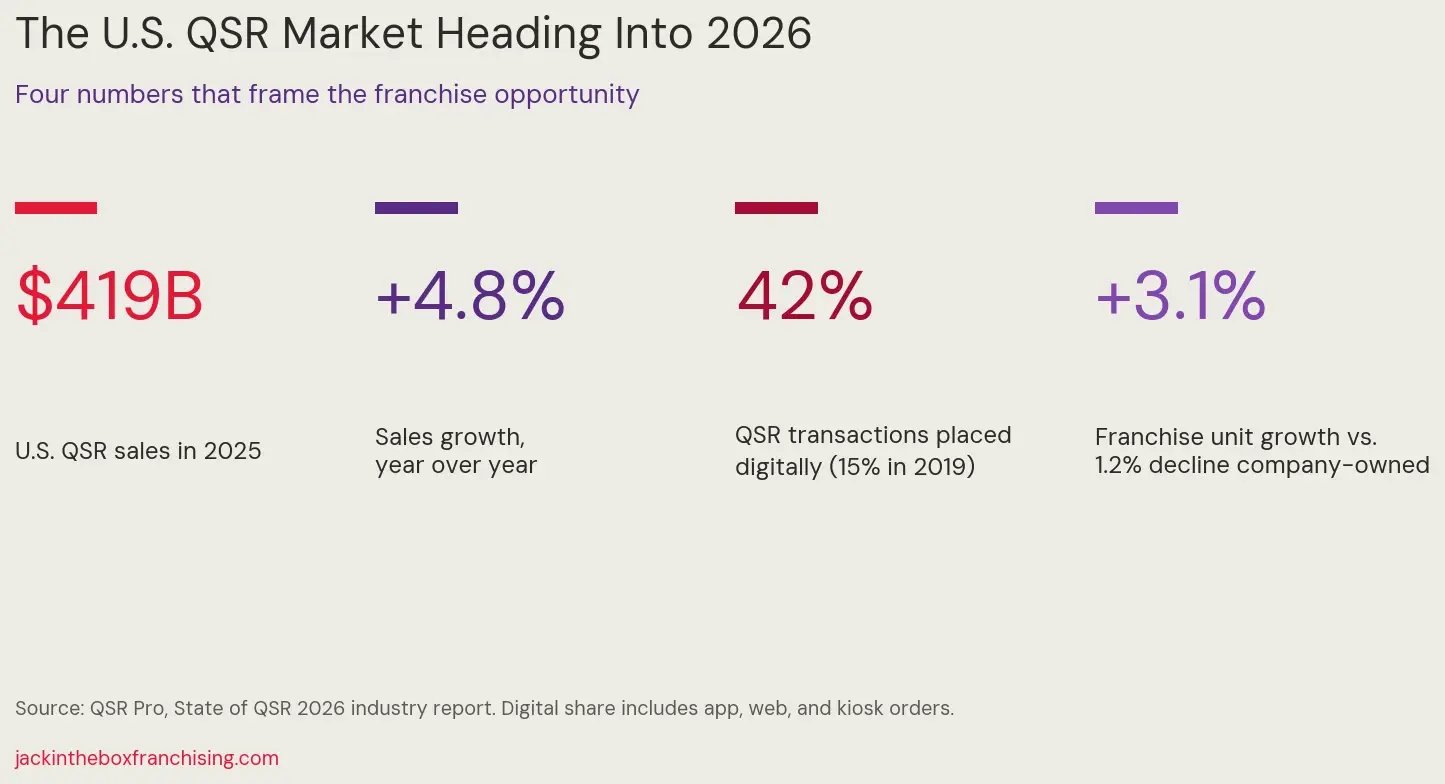
Data: QSR Pro, State of QSR 2026 industry report.
Geography matters more than ever. The Southeast accounts for nearly 30 percent of all U.S. franchised businesses and continues to lead new-unit growth, per the IFA. The top-growth franchise states in 2026 include Texas, Florida, Georgia, Arizona, North Carolina, Colorado, Michigan, Utah, Ohio, and Maryland. If available territory is part of your criteria, and it should be, these markets are worth a close look.
National recognition is not the same as investable opportunity. Some of the best-known brands in QSR have limited white space in the markets where most people want to operate. Here are the things that matter most when you're comparing options seriously:
This is not a ranked list. Every operator's situation (capital, market, experience, goals) shapes which options belong at the top of their personal evaluation. What follows is a factual, FDD-informed look at the landscape.
I'll be direct: this is the brand I know better than any other on this list. If you've read this far, you already knew that.
Jack in the Box has been supporting franchisees for more than 75 years. The menu is built across five dayparts, and guests can order any item, burgers, tacos, breakfast sandwiches, loaded fries, late-night bites, at any hour. That's not marketing language. That's a fundamentally different sales structure from daypart-limited concepts, and it's one of the reasons the brand's drive-through lanes hold volume at 2 a.m. when most QSR competitors are closed.
The current prototype lineup ranges from 1,317 square feet (modular option) up to 2,440 square feet, with configurations designed around dual drive-through lanes and walk-up windows for mobile order pickup. These buildings are engineered for throughput, not dining rooms that have been retrofitted with a drive-through added on.
Per the 2026 Jack in the Box Franchise Disclosure Document (Different Rules, LLC, issued March 13, 2026):
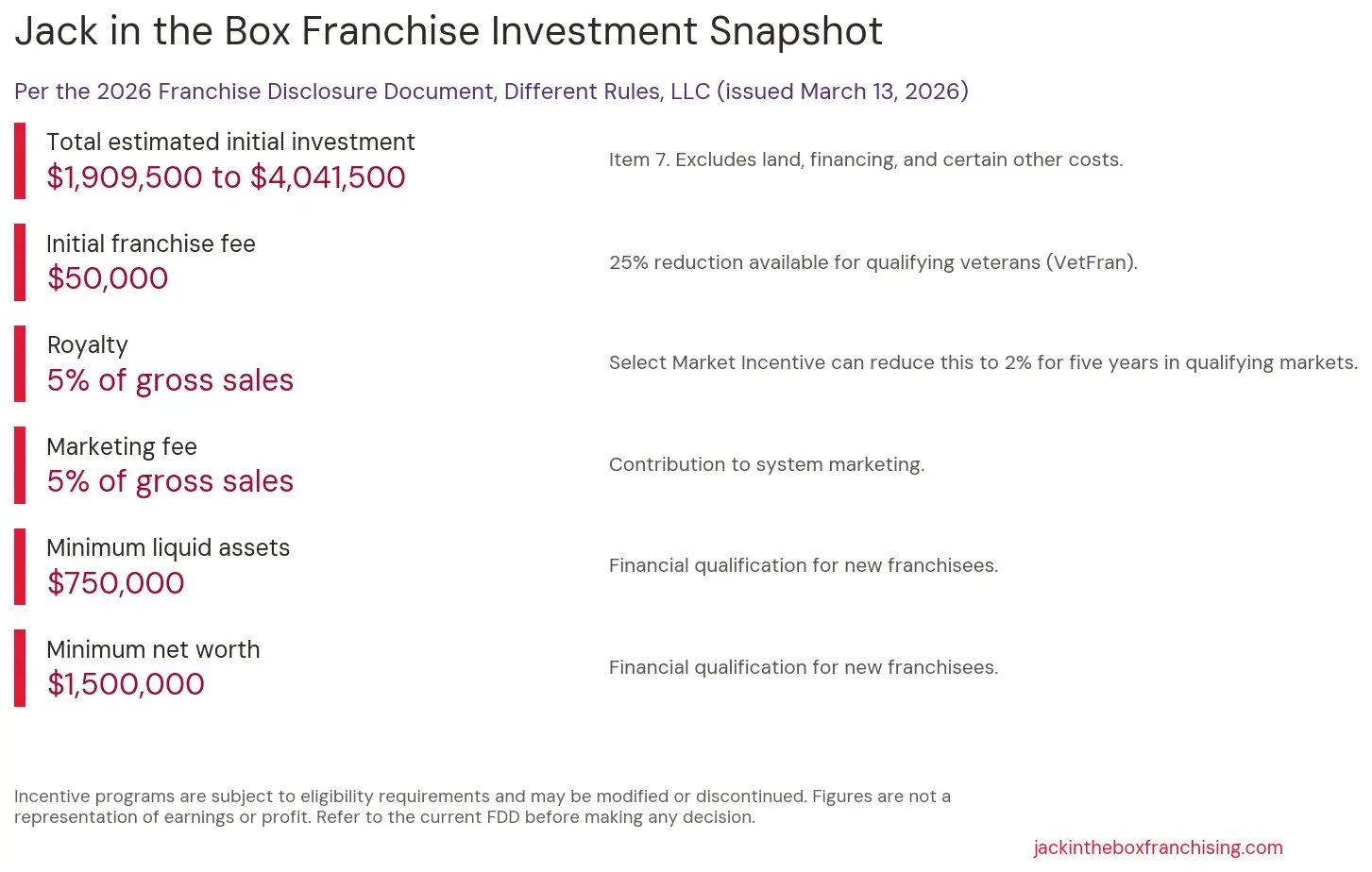
Data: 2026 Franchise Disclosure Document, Different Rules, LLC (issued March 13, 2026).
Two financial incentive programs are available for qualifying candidates:
Both incentive programs are subject to eligibility requirements and may be modified or discontinued at any time. The current FDD governs the terms.
Financial qualifications for new franchisees: minimum $750,000 in liquid assets, minimum $1,500,000 net worth.
Jack in the Box is actively recruiting multi-unit operators in Florida, Georgia, Illinois, Michigan, Ohio, Indiana, North Carolina, South Carolina, Kentucky, and Tennessee. Multi-unit development is the expectation for new franchisees entering the system, not a stretch goal.
Learn more about how much a Jack in the Box franchise costs, or get started with Jack in the Box.
McDonald's is the largest quick-service restaurant chain in the world by unit count. More than 90 percent of its U.S. restaurants are owned and operated by franchisees.
Total initial investment for a traditional U.S. McDonald's typically ranges from approximately $1.5 million to $2.7 million, per 2026 FDD data, with a franchise fee of $45,000. Combined ongoing fee load is roughly 9 percent: 5 percent royalty plus 4 percent advertising fund. McDonald's typically owns or controls the real estate at its locations, meaning franchisees pay rent to the company in addition to royalties.
Available territory is limited in most established U.S. markets. Most new franchisees enter the system through existing restaurant transfers, not greenfield development in primary metros.
Crumbl has built a rapid following around its weekly rotating specialty cookie menu. More than 200 flavors have been introduced to date. The model is tech-forward, with digital ordering and a distinct pink-box identity that generates strong social media engagement.
The concept is suited to operators looking for a dessert or bakery category rather than full-menu QSR. Menu rotation creates return visit frequency without requiring a loyalty program.
Chick-fil-A is the highest-volume quick-service chicken concept in the U.S. A traditional standalone Chick-fil-A generated just under $9.2 million in average annual sales in 2025.
The franchise fee is $10,000, among the lowest in the industry. But the structure is not conventional franchising. Chick-fil-A retains ownership of all property and equipment. Operators pay a royalty of 15 percent of sales. You're managing a business, not owning one in the traditional sense. Acceptance rates are famously low and the selection process is rigorous.
Taco Bell operates more than 7,200 U.S. restaurants and holds the position of the largest Mexican QSR brand globally by unit count. The chain is part of Yum! Brands, which provides significant operational and marketing infrastructure.
Total initial investment for a traditional Taco Bell franchise ranges from approximately $1.3 million to $3.4 million, per available FDD data. The royalty rate is 5.5 percent. Density in major U.S. markets is high, which limits new-development territory in many areas.
Wendy's was founded in 1969 in Columbus, Ohio and operates approximately 7,000 restaurants worldwide. The brand is known for its fresh, never-frozen beef commitment, Frosty desserts, and a breakfast daypart that has grown since its broader rollout.
Wendy's is actively recruiting franchisees in California, Oregon, Washington, Colorado, Alabama, Tennessee, Minnesota, Wisconsin, and Massachusetts. Net worth requirements are higher than many brands in this category, reflecting the scale of the commitments Wendy's expects from operators entering the system.
Dunkin' has operated for more than 70 years and has more than 8,500 U.S. locations today. The brand shifted its identity from Dunkin' Donuts to Dunkin' to signal a broader emphasis on beverages, particularly coffee and cold drinks.
Drive-thru-only and inline formats are both available. Operators with site access in suburban or commuter-corridor markets tend to find the drive-thru format particularly well-suited to the concept.
Del Taco was acquired by Yadav Enterprises in December 2025 and operates more than 590 locations across 15-plus states. It runs its own franchisee recruiting process and stands on its own as a distinct concept.
The menu combines Tex-Mex staples with a fresh-ingredient commitment uncommon in QSR: slow-cooked beans made from scratch, house-grated cheddar, fresh-made guacamole, and freshly grilled marinated proteins. That combination of freshly prepared food at QSR price points is why Del Taco holds the position of the second-largest Mexican QSR brand nationally. The brand is actively recruiting multi-unit operators.
Zaxby's built its base in the Southeast with chicken fingers, wings, sandwiches, and salads. The brand operates more than 900 locations across 18 states, with headquarters in Athens, Georgia.
New development territory exists outside the core Southeast footprint for operators interested in expanding a chicken-forward QSR concept into new regional markets.
Jimmy John's has operated for more than 40 years and has grown to over 2,600 locations in 43 states. The brand is known for hand-sliced meats and cheeses, fresh-baked bread, and a speed-of-service model built around delivery and carry-out.
Prime development markets remain available. The concept suits operators comfortable with a delivery-heavy operating model.
Founded in Atlanta in 2000, Moe's is a fast-casual Mexican concept built around burritos, bowls, tacos, and customizable menu items. The brand targets franchisees interested in building a local following in a fast-casual format with a distinct brand personality.
The customizable format and fast-casual price point appeals strongly to younger consumer segments.
Wingstop has grown to more than 2,000 global locations, built entirely around chicken wings, tenders, and a rotating lineup of sauces. Texas, California, and Florida represent its core domestic markets.
Delivery is a significant revenue driver for the concept. Operators in markets with strong delivery demand and chicken affinity tend to see strong repeat purchase frequency.
Freddy's is a fast-casual concept built around cooked-to-order steakburgers, hot dogs, shoestring fries, and frozen custard. The brand has approximately 400 locations and positions itself as a nostalgia-forward alternative to commodity fast food.
Exclusive territories are available in the U.S. and internationally, making Freddy's worth a look for operators interested in a greenfield development play.
KFC operates more than 25,000 locations worldwide, with close to 99 percent of its locations franchised. The brand's domestic sales run approximately $4.6 billion annually. KFC's growth in recent years has leaned heavily on international expansion rather than new U.S. units.
Yum! Brands provides the operational and technology infrastructure behind the KFC franchise system.
Arby's is the second-largest sandwich restaurant brand globally, with more than 3,400 restaurants across eight countries. The brand is built around quality proteins, particularly beef, at accessible price points, and has differentiated itself clearly from burger-centric competitors.
The menu skews toward operators whose customers want something other than a burger or chicken sandwich. It's a distinct lane.
Whataburger has operated for more than 70 years, growing from a 24-hour burger stand in Corpus Christi, Texas to more than 890 locations across the United States. The brand moved from family ownership to private equity in 2019, which accelerated expansion into new markets.
Whataburger has deep loyalty in the South and Southwest. Its expansion is deliberate and still in progress.
Subway is one of the largest sub sandwich franchise systems in the world by unit count, with more than 20,000 U.S. locations. The brand completed a significant menu and brand refresh in recent years, the "Subway Series" menu overhaul being the most visible example.
Subway is recruiting franchisees with restaurant operations experience capable of managing multiple locations. The entry investment is lower than most QSR competitors in this category.
Caribou Coffee is a Midwest-based premium coffee brand with more than 300 U.S. locations. Franchisees can choose between a drive-thru-only cabin format and a traditional coffeehouse concept, giving some site flexibility.
Regional awareness is strongest in the Midwest, which creates opportunity and brand-awareness challenges simultaneously in new markets.
Burger King operates more than 7,000 U.S. restaurants under Restaurant Brands International. Total initial investment ranges from approximately $1.9 million to $3.4 million, per available FDD data, with a $50,000 franchise fee and a 4.5 percent royalty.
Development incentives and remodel support programs are available in target markets. Domestic growth opportunities remain open.
Teriyaki Madness started in Seattle and has grown to more than 130 locations nationally, built around made-to-order teriyaki bowls with fresh ingredients and a broad sauce selection.
The fast-casual model and growing consumer interest in Asian cuisine concepts make Teriyaki Madness worth tracking for operators looking outside the burger-and-chicken mainstream.
Domino's has more than 19,000 restaurants globally, making it one of the most widely distributed pizza delivery brands in the world. More than 95 percent of U.S. franchisees entered the system through hourly or management roles.
That internal pathway is a defining feature of Domino's. The system tends to promote from within rather than recruit external multi-unit operators. Candidates typically need at least one year of general management experience within the system before applying.
Scooter's Coffee is a drive-thru coffee franchise with more than 400 locations, primarily in the Midwest and South. Founded in Bellevue, Nebraska in 1998, the brand is built on consistent quality, speed of service, and lower price points than premium coffee competitors.
Scooter's is actively expanding beyond its core regional footprint. Operators with site access in under-penetrated markets may find meaningful territory available.
Dairy Queen has operated for more than 80 years and runs more than 7,000 locations worldwide. The brand is known for Blizzard frozen treats, Dilly Bars, and the DQ Grill & Chill format, which combines a food menu with the dessert concept.
Dairy Queen is actively recruiting franchisees across the U.S. and Canada.
Pizza Hut has more than 6,500 U.S. locations and employs more than 150,000 team members. The brand began as a 500-square-foot restaurant in Wichita, Kansas, more than 60 years ago and has since shifted heavily toward delivery and carry-out formats.
New franchisees are expected to share the brand's operational standards and a clear commitment to quality. The Yum! Brands infrastructure provides system-wide support.
Steak 'n Shake is a long-standing American casual restaurant known for its steakburgers and milkshakes. The current franchise model is distinct from greenfield development: the brand is recruiting "Franchise Partners" to take over operations of existing company-owned locations.
This carry-in model has a different risk and capital profile from new development. You assume management of an operating unit rather than building from scratch.
PJ's Coffee has operated since 1978 with a New Orleans-rooted identity that includes chicory-blend coffees and beignets. The brand has more than 100 locations, primarily in the South and Southeast.
For operators interested in a regional brand story with genuine roots, PJ's Coffee offers a point of difference from the national coffeehouse chains.
Jersey Mike's has operated since 1956 and has grown into one of the strongest-performing brands in the sandwich category. The concept is built around jumbo subs with fresh cold cuts and a strong brand culture centered on community involvement.
New franchisees are expected to have enthusiasm for the brand and a genuine interest in being part of the local community, not just operating a transaction location.
Popeyes was founded in 1972 in New Orleans and has grown to nearly 3,500 locations across 46 states and 30 countries. The brand is built around spicy fried chicken, chicken tenders, and a Cajun/Creole flavor profile that's distinct in the category.
Popeyes is part of Restaurant Brands International, which provides significant operational and marketing infrastructure to franchisees.
Biggby Coffee is headquartered in Lansing, Michigan and has grown to more than 375 locations across the U.S. The brand is built around community engagement, fresh-brewed coffee, and a welcoming environment that encourages repeat visits.
Biggby is looking for franchisees who see their shop as a neighborhood gathering point. That community-first positioning shapes both the brand culture and the operator profile they recruit.
Founded in 1973, Smoothie King has grown from a single location in Louisiana to more than 1,400 locations worldwide. The concept is built around blended drinks with real fruit, vegetables, and functional nutrients, targeting health-conscious consumers.
The brand benefits from growing consumer demand for better-for-you quick-service options, a category that has outperformed the QSR average on traffic trends in recent years.
Culver's has operated since 1984 and now runs more than 800 locations in 25 states. The brand is known for its fresh-frozen custard, ButterBurgers, and Wisconsin cheese curds: a loyal regional following with steady national expansion.
Culver's is selective about its operators. The brand looks for hands-on owner-operators with strong team leadership skills who are prepared to execute to high operational standards every day.
Before any contract gets signed, these questions belong on your list regardless of which brand you're evaluating. The FTC's Consumer's Guide to Buying a Franchise is a strong companion resource for this stage.
According to the IFA's 2026 Franchising Economic Outlook, the top franchise growth states for 2026 are Texas, Florida, Georgia, Arizona, North Carolina, Colorado, Michigan, Utah, Ohio, and Maryland. The Southeast as a region continues to lead new-unit franchise development, accounting for nearly 30 percent of all U.S. franchised businesses.
Strong operators are using this environment to acquire underperforming units, grow portfolios, and position for the next cycle. Brands with legitimate open territory and development incentives in high-growth states are getting real attention from the multi-unit operator community right now.
For Jack in the Box specifically, Florida, Georgia, Illinois, Michigan, Colorado, Kentucky, North Carolina, South Carolina, and Tennessee are the markets where we're most actively looking for new development partners. These are markets with brand awareness, drive-through-friendly real estate availability, and genuine room to grow.
Operators who meet the financial qualifications ($750,000 in liquid assets, $1,500,000 in net worth) and are interested in multi-unit development are exactly who we want to hear from. Learn why experienced operators are choosing Jack in the Box.
The brands on this list include some of the most recognized franchise names in QSR. Each has a different investment structure, ownership model, royalty load, and territory picture. None of them is the right answer for every operator.
If you've spent time in this industry, have the capital to move, and are looking at markets where genuine development opportunity still exists with a legacy brand, Jack in the Box is worth a serious conversation.
The data is in the FDD. The incentives are real. The territory is open. Talk to our franchise team.
Questions? Contact our franchise sales and support team.
About the author: Dustin Thompson works in Franchise Marketing and Development at Jack in the Box, where he supports franchise recruitment across the brand's active development markets and works directly with multi-unit operators evaluating the opportunity. His work draws on the brand's current Franchise Disclosure Document, primary competitor filings, and daily conversations with candidates moving through the development process.
This article is for informational purposes only. It is not an offer to sell a franchise, and nothing in it is a representation of financial performance, earnings, or profit. Franchise offers are made only through delivery of a Franchise Disclosure Document in compliance with applicable law. Figures cited from the Jack in the Box FDD reflect the disclosure document issued March 13, 2026 by Different Rules, LLC and are subject to change. Consult the current FDD and independent legal and financial advisors before making any franchise decision.