
The 15 Best Burger Business Opportunities in 2026
Are you looking for a list of the best burger businesses opportunity this year? In this article, we'll highlight fifteen of the best burger...
10 min read
By Dustin Thompson, Franchise Marketing and Development, Jack in the Box • Updated July 13, 2026
I work on franchise development for Jack in the Box, and Michigan is one of the states I get asked about most right now. Candidates want to know two things: where we are actively recruiting, and what the deal actually looks like on paper.
Here is the short answer. We are recruiting multi-unit franchisees in two Michigan markets, the Detroit DMA and the Grand Rapids DMA. Our 2026 Franchise Disclosure Document puts the total estimated initial investment at $1,909,500 to $4,041,500 per restaurant, and qualified candidates need $750,000 in liquidity and a $1,500,000 net worth.
The rest of this guide covers the market data behind those two DMAs, the full cost picture, the incentive programs that may apply to a development agreement, and how Michigan franchise law works in your favor as a buyer. Everything comes from primary sources: our FDD issued March 13, 2026, U.S. Census Bureau estimates, and published economic reports. You can check every number yourself, and I link to each source so you can.
Two reasons: the consumer demand backdrop and the amount of open ground.
On demand, the National Restaurant Association projects U.S. restaurant and foodservice sales of $1.55 trillion in 2026 in its 2026 State of the Restaurant Industry report, with total industry employment projected to reach 15.8 million. Quick service remains a major share of that spending.
On open ground, Michigan is a newer development state for our brand. Legacy quick service burger competitors have operated at density in Detroit and Grand Rapids for decades. We have not. That is precisely why our development team flagged both DMAs, and it is why candidates who want territory instead of leftovers keep calling about them. You can see how we structure territory commitments on our multi-unit development page, and current recruiting markets are listed on our available markets page.
One practical note from my side of the desk. When we open a new state, franchise agreements in our system grant a one mile protected radius around each approved market point under a multi-unit development agreement, subject to the terms in the agreement itself. Early candidates in a new DMA typically have more market points to choose from. That is not a projection about performance. It is a statement about site selection math.
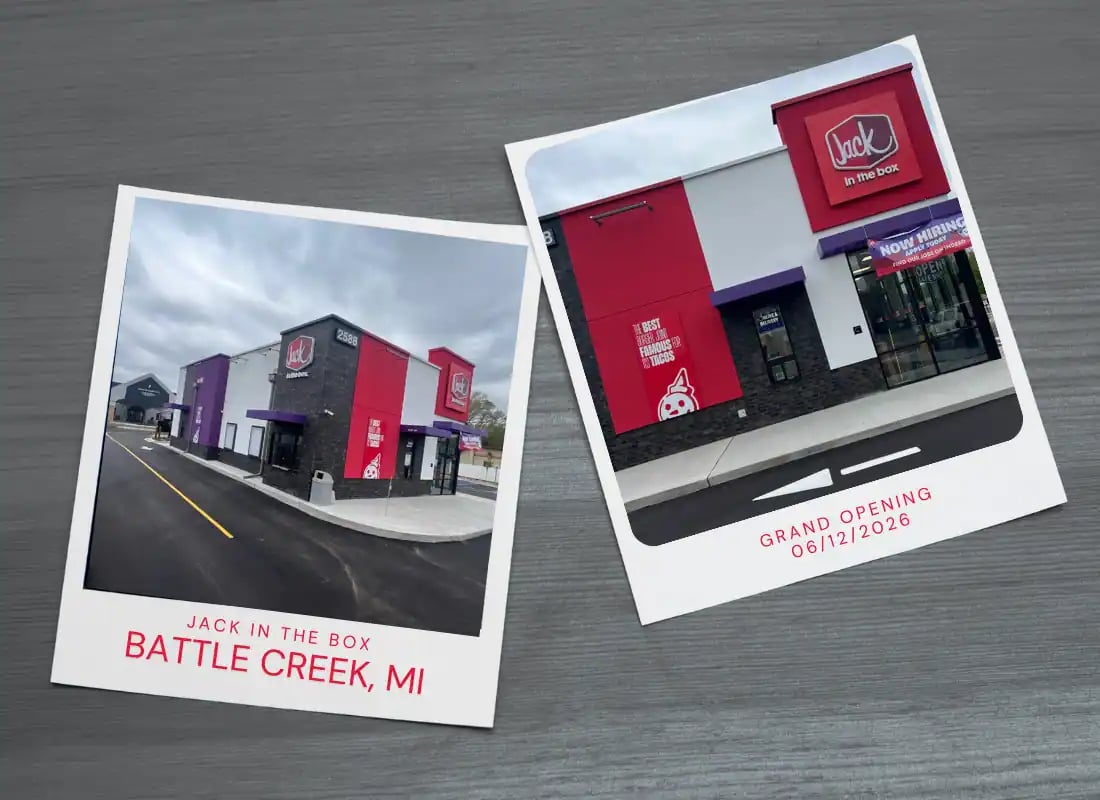
We recently opened our first Jack in the Box in Battle Creek, MI, giving us an operating foothold in the Grand Rapids DMA and real sales data from a Michigan market that has been on our development radar for years.
I pulled the most recent Census figures for both markets so you do not have to take my word for anything.
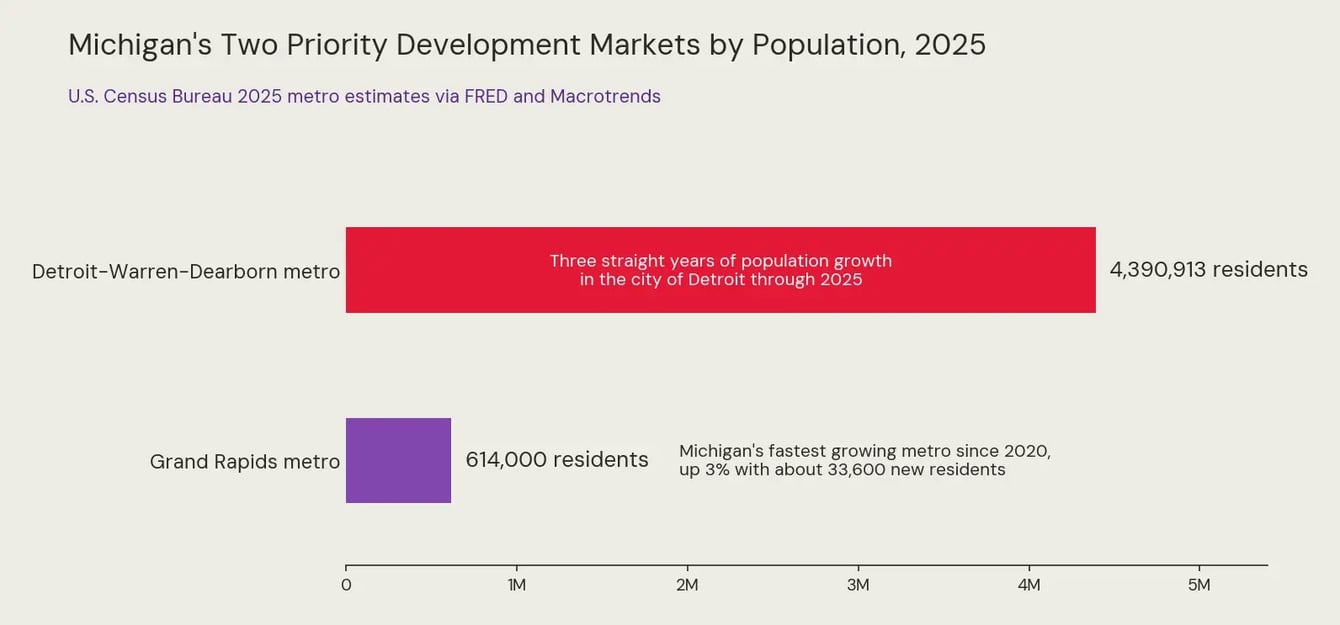
The Detroit-Warren-Dearborn metro held an estimated 4,390,913 residents in 2025, according to U.S. Census Bureau data published through FRED. The trend inside the city matters too. The City of Detroit reported that 2025 Census estimates show a third consecutive year of population growth, with 5,060 residents added in the latest estimate after decades of annual decline.
For a drive-thru heavy brand like ours, a four million resident metro with dense freeway corridors is the kind of trade area our real estate model was built for. Late-night demand is a real factor here as well. Our menu and hours are structured around it, which I cover in more depth on our why Jack in the Box page.
Grand Rapids has been Michigan's fastest growing metropolitan area since 2020, adding about 33,600 residents for a 3% increase, according to Census figures reported by The Detroit News in March 2026. The Grand Rapids Chamber's State of the Region report adds that regional household income reached $80,296 and that private business counts grew 33.3% from 2013 to 2023.
Metro population sits around 614,000 per Macrotrends compilation of Census estimates. Smaller than Detroit, obviously. But a growing population paired with rising household income is a demand signal any QSR developer should take seriously, and the market has far fewer entrenched late-night drive-thru options than a coastal metro of similar size.
A serious candidate compares brands, and I would rather you do that comparison with current numbers than the stale ones floating around aggregator sites. Here is the field, with location counts updated to the most recent filings and industry reporting available.
We simply had to put ourselves on this list because of our innovative menu, flexible restaurant designs, and franchise opportunities in prime U.S. markets.
Jack in the Box offers a large and distinctive 24/7 menu with five dayparts to our customers. This means you can get anything on our menu at any time, day or night.
Plus, our 1,350 square foot prototype features dual drive-throughs for higher order volume and a walk-up window for mobile orders to ensure you're ready to serve today's consumer.
When it comes to Michigan, our franchise development team is focused on the Detroit DMA and the Grand Rapids DMA. Within those two markets, we are primarily interested in the following cities:
Detroit DMA:
Detroit, Warren, Sterling Heights, Ann Arbor, Dearborn, Dearborn Heights, Livonia, Clinton Township, Canton, Westland, Troy, Farmington Hills, Macomb, Shelby Township, Southfield, Waterford, Wayne, Beverly Hills, Highland Park, Grosse Pointe, Eastpointe, Chesterfield, Pontiac, Auburn Hills, and Port Huron.
Grand Rapids DMA:
Grand Rapids, Wyoming, Kalamazoo, Battle Creek, Holland, and Muskegon.
These cities meet most of our site requirements and should be a good fit for Jack in the Box based on our Real Estate Planning Software.
If you're interested in a Michigan market that isn't listed above, please reach out to our team and we will take a deeper look into your preferred location.
McDonald's is one of the most well-known burger franchises in the world. It's hard to find anyone who isn't familiar with their "I'm Lovin' It" advertising campaign.
They reported 45,356 restaurants systemwide at the end of 2025, and the company states that approximately 95% of its U.S. restaurants are owned and operated by independent local business owners.
The availability of restaurants in specific areas is uncertain until you've completed your franchisee training. You may be required to relocate to your nearest restaurant opportunity.
The story of Whataburger began at a 24-hour burger stand in Corpus Christi, Texas. More than 75 years later, they have grown to roughly 1,200 locations across 17 states.
Their original idea was to serve a burger so big it took two hands to hold, and so good it caused customers to exclaim, "What a burger!" after their first bite.
Whataburger was family-owned until its 2019 acquisition by an investment firm, which has allowed for more restaurants to open in new markets. One thing to know if you plan to compare terms side by side: Whataburger does not publicly disclose its franchise fees or investment requirements, so any figures you see on third party sites are unverified.
In 1969, Dave Thomas opened the first Wendy's restaurant in Columbus, Ohio. It didn't take long for their quick-service chain restaurant to become famous for square beef patties and Frosty desserts.
Today, they operate 7,397 restaurants worldwide per their fiscal 2025 annual report, including 5,969 in the U.S., and are looking for new and diverse franchisees to join their team.
They have a variety of limited and available markets with opportunities across the Southeastern USA in Florida, Georgia, Alabama, South Carolina, and North Carolina.
Burger King reached nearly 20,000 restaurants worldwide in 2025, with opportunities for growth across the U.S. and international markets.
This burger franchise is known for creating signature recipes and providing family-friendly dining experiences. Every day, more than 11 million guests visit Burger King restaurants around the world.
They empower franchisees with built-in support for ongoing operations along with training to gain access and know-how across all aspects of the business.
Culver's is a drive-thru burger franchise known for their frozen custard, butterburgers, and cheese curds.
Since 1984, they have grown from their first location in Sauk City, Wisconsin to 1,041 restaurants entering 2026, per QSR Magazine's review of the brand's latest FDD. Worth noting for anyone reading this article: the same report shows Michigan was one of Culver's fastest growing states last year, rising to 107 restaurants from 98.
They are looking for owner-operators with the skills to take a team of people and operate a Culver's according to their high standards.
Freddy's is a nostalgic fast-casual restaurant with cooked-to-order steakburgers, hot dogs, shoestring fries, and frozen custard.
They are one of the fastest-growing franchises in the United States, approaching 600 restaurants with about 60 openings planned for 2026. That reporting also lists Michigan at five locations entering the year, with more planned.
Currently, they offer exclusive territories that are available across the U.S. along with international opportunities.
These figures come straight from our Franchise Disclosure Document issued by Different Rules, LLC on March 13, 2026. I keep a copy on my desk because candidates quote stale numbers from aggregator sites at me weekly. Trust the FDD, not a listing portal.
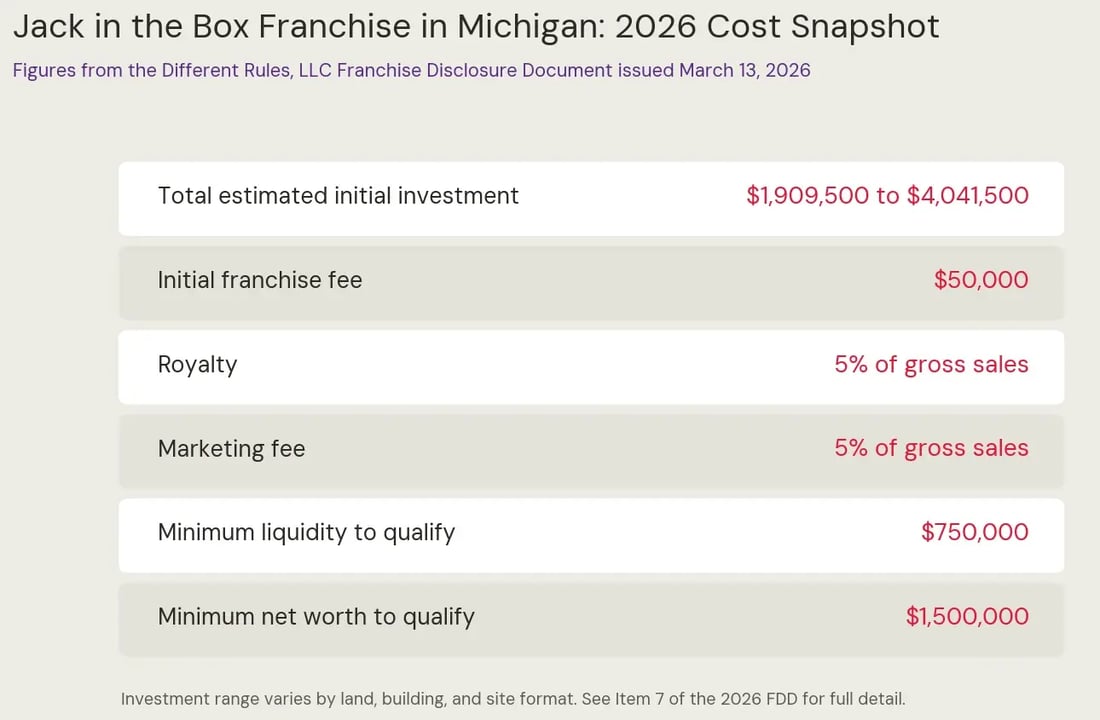
The wide investment range reflects real estate. A ground-up build on purchased land sits at the high end. A conversion or leased site lands lower. Item 7 of the FDD breaks down every line, from site work to signage to the technology package, and I walk through each category on our franchise costs page.
Ongoing fees are a 5% royalty and a 5% marketing fee, both calculated on gross sales. Qualification requires $750,000 in liquid assets and a $1,500,000 net worth. Those thresholds exist because multi-unit development agreements carry real construction timelines, and undercapitalized developers miss them.
Two programs in the 2026 FDD are worth understanding before you talk to our team. Both are subject to eligibility requirements, both are applied at the company's sole discretion, and both may be modified or discontinued at any time. I am quoting the document, not hedging for fun.
If you sign a development agreement for a minimum of three restaurants and open each one on or before its scheduled date, you may be eligible for a $150,000 loan at 0% interest per qualifying restaurant, used solely for development costs. The loan is repaid by crediting 100% of that restaurant's royalty payments until the balance clears. Certain conditions apply, including full compliance with your agreements.
For franchisees who commit to at least three restaurants in a market the company designates as a Select Market, the royalty on each qualifying restaurant may be reduced from 5% to 2% of gross sales for the first five years after that restaurant opens. Whether a given market qualifies is determined by the company, so ask directly whether it applies to the Detroit or Grand Rapids DMA when you speak with our development team.
Qualifying veterans should also know we participate in VetFran, which reduces the initial franchise fee on a first restaurant by 25%, or $12,500. Details are on our veterans program page.
Item 19 of our 2026 FDD reports historical gross sales at franchised restaurants in the continental U.S. For the 12 month period ended September 30, 2025, average gross sales across the reporting franchised system were $1,913,335.
Read that number the way a lender would. It is gross sales, not profit, not earnings, and not a prediction. Individual results vary widely by restaurant, and the FDD reports a low figure well under seven figures within the same data set. A new restaurant in a new market may perform differently than an established one, and your costs will differ from other operators. Request the FDD and review the full Item 19 tables with your accountant before you rely on any of it.
Here is a detail most franchise blogs skip because their writers have never filed a state notice. Michigan is a franchise notice state. Our current disclosure document is on file for Michigan as of March 13, 2026, and Michigan law requires that we deliver the disclosure document to you at least 10 business days before you sign any binding agreement or pay any consideration, whichever comes first.
Michigan also prohibits certain unfair franchise contract provisions by statute, and questions can go to the Consumer Protection Division of the Michigan Attorney General's office in Lansing. The FTC's guide to buying a franchise is worth an evening of your time as well.
Use that 10 day window. Hire a franchise attorney, have your CPA stress test the investment range against your liquidity, and call existing franchisees from the contact list in the FDD. A franchisor confident in its disclosure document will never rush you through it. We do not.
The screening criteria are straightforward, and I would rather you self-assess before we get on a call:
If that describes you, the path runs through a defined sequence: introductory call, qualification review, FDD delivery and your 10 business day Michigan review period, discovery day, market planning, and a signed development agreement. The full sequence is mapped on our franchise process page, and what happens after signing, from site selection through opening, is covered on our training and support page.
Ready to talk about Detroit or Grand Rapids specifically? Start the conversation here and my team will follow up with market-level detail.
The 2026 Franchise Disclosure Document lists a total estimated initial investment of $1,909,500 to $4,041,500 per restaurant, including a $50,000 initial franchise fee. The final figure depends on real estate approach, site format, and construction costs.
Candidates need a minimum of $750,000 in liquid assets and a minimum net worth of $1,500,000. Ongoing fees are a 5% royalty and a 5% marketing fee on gross sales.
Jack in the Box is currently recruiting multi-unit franchisees in the Detroit DMA and the Grand Rapids DMA. Both markets are structured for development agreements covering multiple restaurants.
The 2026 FDD describes a Development Incentive Program offering a $150,000 loan at 0% interest per qualifying restaurant for three unit commitments that open on schedule, and a Select Market Incentive Program that can reduce the royalty to 2% for five years in qualifying markets. Both are subject to eligibility requirements and franchisor discretion, and either may be modified or discontinued.
Yes. The current disclosure document from Different Rules, LLC is on file for Michigan effective March 13, 2026. Michigan law requires delivery of the disclosure document at least 10 business days before any binding agreement is signed or any payment is made.
About the author: Dustin Thompson works in Franchise Marketing and Development at Jack in the Box, where he helps qualified multi-unit operators evaluate development opportunities in the brand's active growth markets, including the Detroit and Grand Rapids DMAs.
This article is for informational purposes only and is not an offer to sell a franchise. An offer can only be made through delivery of a Franchise Disclosure Document in compliance with applicable law. This article does not contain a financial performance representation. Historical gross sales figures referenced above are reproduced from Item 19 of the 2026 Franchise Disclosure Document issued by Different Rules, LLC, reflect gross sales only, and do not predict the results of any new restaurant. Incentive programs are subject to eligibility requirements and may be modified or discontinued at any time.