
How to Evaluate a Multi-Unit Burger Franchise in 2026
How experienced operators evaluate a multi-unit burger franchise in 2026: a 12-check scorecard covering FDD economics, agreements, and system health.
8 min read
By Dustin Thompson, Franchise Marketing and Development, Jack in the Box • Last updated: July 10, 2026
Adding a second, fifth, or fifteenth burger restaurant is a different decision than opening your first. The brand question is mostly settled. What matters now is whether each new unit strengthens your portfolio or drags it down.
I work in franchise marketing and development at Jack in the Box, and part of my job is reading Franchise Disclosure Documents. Not summaries of them. The actual documents. For this article I went through the 2026 FDDs for Jack in the Box, McDonald's, Wendy's, Burger King, and Culver's, plus the public franchise materials Five Guys posts on its own site. Every figure below comes from one of those sources, and I link to where you can verify it.
These are the seven factors I see shaping profitability most directly when experienced operators evaluate a multi-unit burger franchise.
Seven things: per-unit sales volume, ongoing fee load, capital required per unit, the structure of the franchise and development agreements, market availability, the labor and operating model, and the support systems behind you. Each one is knowable before you sign. Most of the answers sit in five FDD items: 5, 6, 7, 12, and 19.
The FTC's Consumer's Guide to Buying a Franchise is worth reading before any of this, because it explains how to use those items. Now let's go through the seven drivers one at a time.
Sales volume is the top line everything else works against. Item 19 of an FDD is where franchisors may disclose it, and in the burger category the FY2025 numbers cover a wide range.
Culver's discloses average sales of $4,142,737 across 988 franchised restaurants open for the full 12 months of 2025. McDonald's discloses $4,057,000 as the average annual sales volume of domestic traditional franchised restaurants open at least one year. Wendy's discloses $1,993,657 in average gross sales across 5,347 franchise restaurants. Jack in the Box discloses a systemwide average of $1,913,335 in gross sales for fiscal 2025, which you can read more about on our franchise costs page. Burger King discloses $1,692,549 for franchisee-owned traditional restaurants.
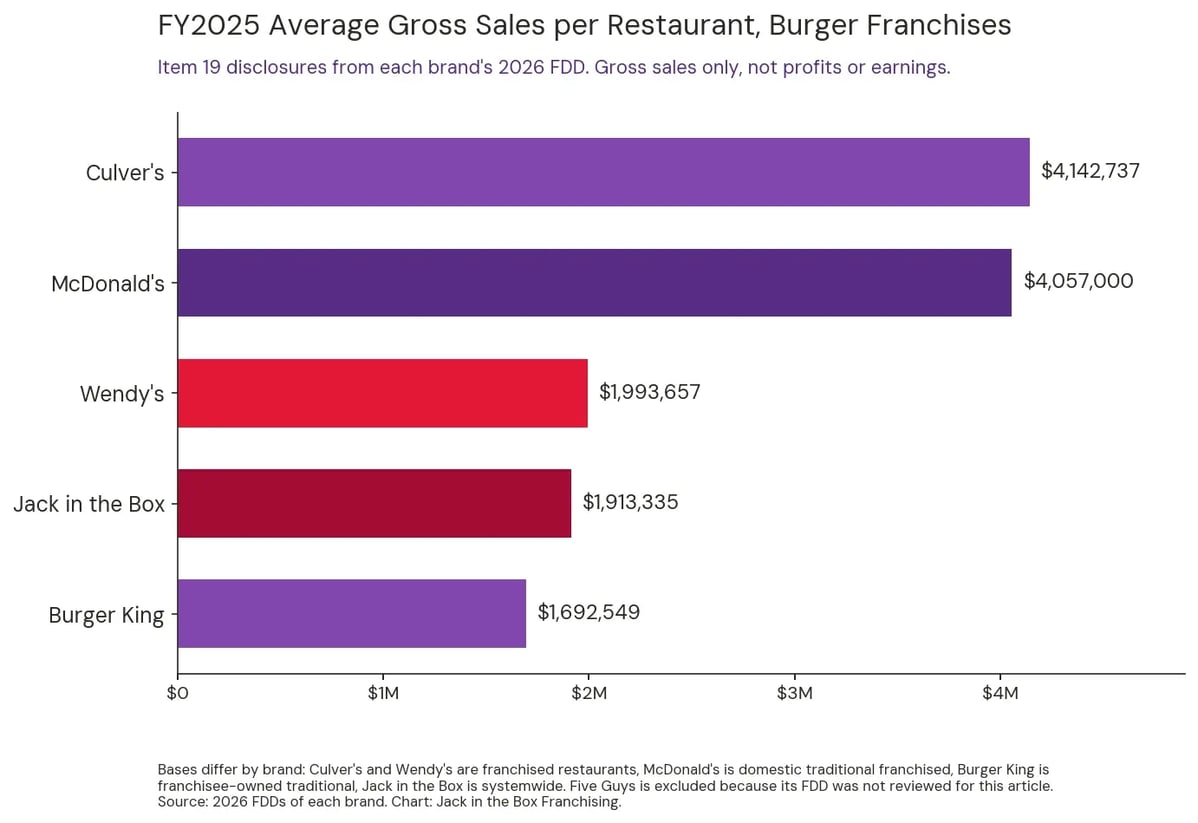
FY2025 average gross sales per restaurant as disclosed in each brand's 2026 FDD Item 19. Gross sales only, not profits or earnings, and calculation bases differ by brand.
Two cautions here, and I mean them. First, these are gross sales figures, not profits, earnings, or take-home anything. A restaurant with higher gross sales can produce worse economics once rent, labor, food cost, and fees come out. Second, the bases differ. Systemwide averages, franchised-only averages, and traditional-only averages are not the same population. Read each brand's Item 19 notes before you compare anything.
Ongoing fees hit every dollar of gross sales, at every unit, for the life of every agreement. Across a ten-unit portfolio, a 1.5 point difference in fee load is real money every single month.
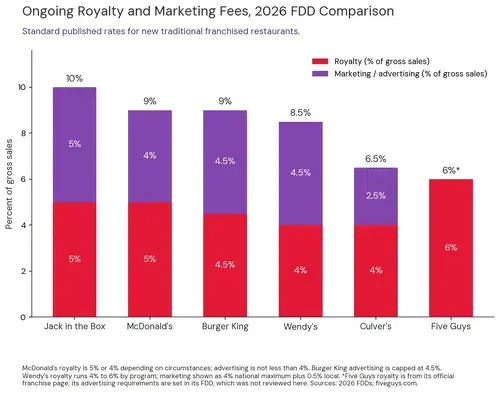
Here is what the 2026 FDDs publish as standard rates. Jack in the Box charges a 5% royalty and a 5% marketing fee. McDonald's charges a royalty of 5% or 4% depending on the circumstances, plus advertising of not less than 4% of gross sales. Burger King charges 4.5% royalty and advertising of up to 4.5%. Wendy's royalty runs from 4% to 6% depending on restaurant type and development program, with national advertising of 1.5% to 4% plus 0.5% local. Culver's charges a 4% service royalty and a 2.5% advertising royalty. Five Guys lists a 6% royalty on its official franchise page.
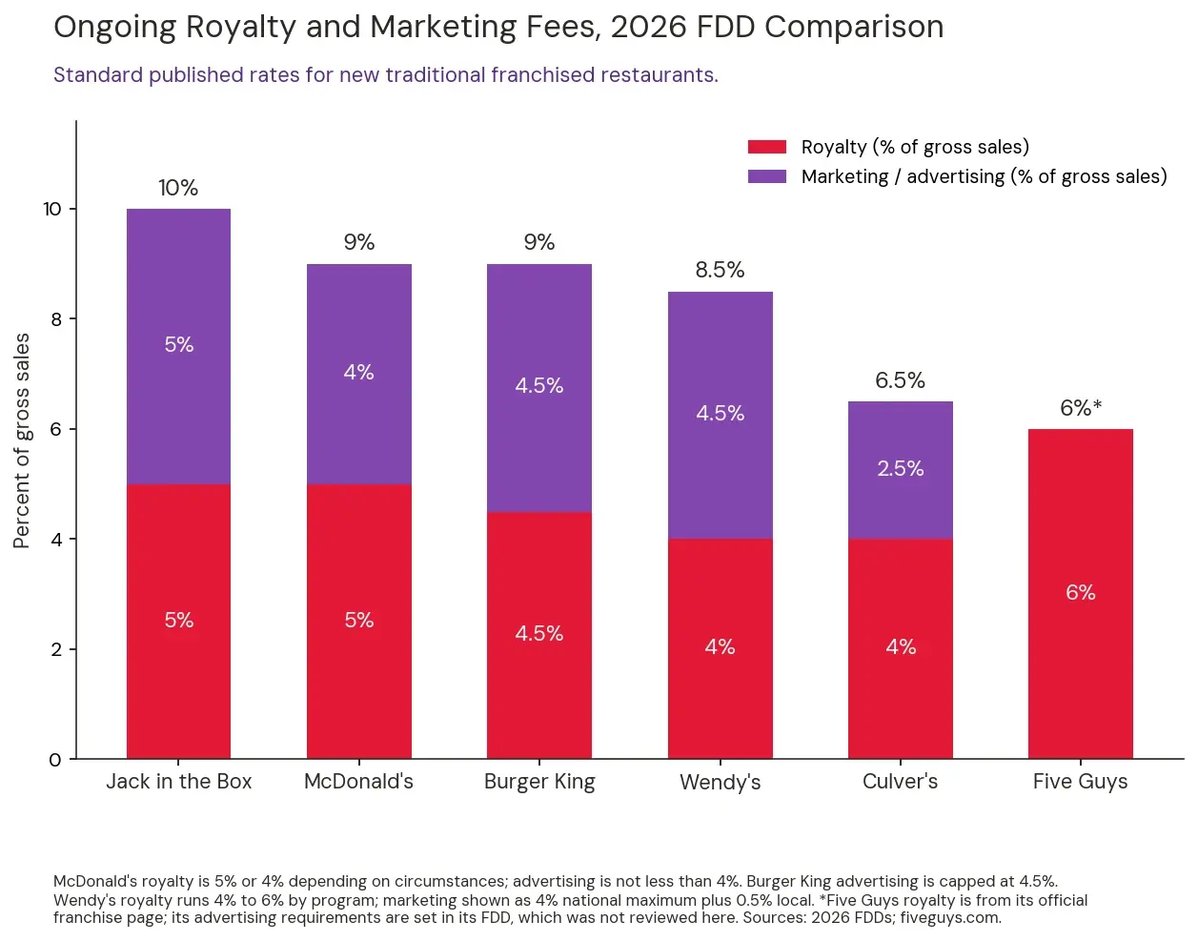
Standard published royalty and marketing rates from 2026 FDDs. Five Guys royalty is from its official franchise page; its advertising requirements are set in its FDD.
Lower is not automatically better. Fees fund advertising reach, technology, and field support, and those things affect the top line too. The question is what you get for the percentage, which is a conversation to have directly with each franchisor and with existing franchisees.
Item 7 answers this, with a catch: definitions differ. The 2026 Jack in the Box FDD estimates a total initial investment of $1,909,500 to $4,041,500 per restaurant. McDonald's publishes $1,472,000 to $2,807,000 for a traditional restaurant. Culver's publishes $3,406,350 to $10,294,100. Wendy's publishes $1,580,457 to $3,105,000 for a cash purchase, excluding real estate. Burger King publishes $348,400 to $3,320,600, also excluding real estate.
That "excluding real estate" clause is where side-by-side comparisons go wrong. Land and building costs can be the largest line in the whole project. When you model a three-unit or five-unit commitment, build your own all-in number per site using local real estate data, and pressure test it with a lender before you rely on any published range. Our cost breakdown walks through what the Jack in the Box range includes.
Multi-unit economics live in the development agreement. The differences between brands here are bigger than most people expect.
Burger King's 2026 FDD describes development structures that require prepaying the $50,000 franchise fee multiplied by the number of restaurants committed, with a minimum prepaid fee of $100,000 for a two-restaurant commitment, plus deposit requirements under its Multiple Target Reservation Agreement. Culver's charges a $50,000 development fee for each restaurant you agree to develop under a development schedule. Wendy's current development agreement forms require no up-front fee, and the brand offers programs that can temporarily adjust royalty rates for developed restaurants.
Jack in the Box structures multi-unit growth through development agreements as well, and the 2026 FDD describes two programs worth knowing about. The Development Incentive can provide a $150,000 interest-free loan for qualifying operators who commit to three or more restaurants. The Select Market Incentive can reduce the royalty to 2% for five years in qualifying markets. Both are subject to eligibility requirements and may be modified or discontinued, so confirm current terms in the FDD before you count on either. Details on how we approach portfolio growth are on our multi-unit development page.
Whatever brand you evaluate, have a franchise attorney read the development schedule, the default provisions, and what happens to fees you have already paid if you miss an opening date. The FTC Franchise Rule guarantees you time with these documents. Use it.
A strong brand with no open territory near your existing infrastructure is not a growth vehicle for you. It is a growth vehicle for someone else.
This is a real advantage for operators looking at newer markets. Jack in the Box is actively developing in Florida, Georgia, Illinois, Kentucky, and Tennessee, and I watched the brand's first Florida restaurant open in Longwood on February 19, 2026. Markets like these give a multi-unit operator something the most saturated systems cannot: contiguous territory to build a cluster with shared supervision, shared marketing spill, and realistic site selection. Our available markets page shows where development is open, and the why Jack in the Box page explains how we think about market entry.
For any brand, check Item 20 of the FDD for outlet counts by state. It tells you quickly whether the territory conversation will be short.
Multi-unit operator challenges are mostly people challenges. Every added unit needs a general manager, shift leadership, and a bench, and wage trends keep pressure on all of it. The Bureau of Labor Statistics tracks food service wage and price trends through its Consumer Price Index program, and the direction has been consistent for years.
Operating models differ in ways that change your labor math. Extended hours and late-night dayparts add sales opportunity and staffing complexity at the same time. Drive-thru-heavy formats need different labor deployment than dining-room-heavy ones. Before adding units, map the operating requirements in the franchise agreement, including required hours, against your actual ability to recruit managers in that specific market.
Training one restaurant team is a project. Training five is a system. Item 11 of each FDD spells out what the franchisor actually commits to for training, opening support, and ongoing field help, and the differences between what brands promise on their websites and what they commit to in Item 11 can be instructive.
On the Jack in the Box side, our training and support page describes the programs available to franchisees, and the franchise process page shows where support enters the timeline. Whichever brand you evaluate, ask existing multi-unit franchisees one question: did support keep up when you went from two units to five? Item 20 gives you their names and numbers.
On qualification thresholds: Jack in the Box requires $750,000 in liquidity and a $1,500,000 net worth. Five Guys lists more than $2,500,000 in liquid capital and more than $5,000,000 in net worth on its official page, along with required prior restaurant, franchising, or business ownership experience, a $25,000 franchise fee, and a $50,000 development fee. Culver's requires 20% of your total projected initial investment in cash or liquid assets. Five Guys does not consistently publish a total investment range on its own site, and third-party figures conflict, so treat any Five Guys investment number you see on aggregator sites with caution and go to its current FDD instead.
No single brand wins all seven drivers. The right answer depends on your capital, your market, and your infrastructure. If a growth market with development runway matters to your model, that is the conversation my team has every day. Start on our contact page, and qualifying veterans should also see our VetFran program, which reduces the initial franchise fee by 25%.
There is no single one. Per-unit gross sales volume sets the ceiling, but ongoing fees, capital per unit, agreement terms, market runway, labor, and support determine what you keep and how fast you can grow. All seven are disclosed or discoverable before signing.
Only as a starting point. They are gross sales figures, not earnings, and each brand calculates them on a different base of restaurants. Read the notes in each Item 19 and confirm what population the average covers.
The 2026 FDD estimates a total initial investment of $1,909,500 to $4,041,500 per restaurant, including a $50,000 initial franchise fee. Requirements include $750,000 in liquidity and a $1,500,000 net worth.
Some do. Jack in the Box's 2026 FDD describes a Development Incentive with a $150,000 interest-free loan for qualifying three-plus-unit commitments and a Select Market Incentive with a 2% royalty for five years in qualifying markets. Both are subject to eligibility and may be modified or discontinued. Other brands offer their own programs with their own conditions, so compare current FDDs.
Dustin Thompson works in Franchise Marketing and Development at Jack in the Box, where he helps qualified operators evaluate and enter the system. The figures in this article come from his direct review of the 2026 Franchise Disclosure Documents of the brands discussed.
This article is for informational purposes only and is not an offer to sell a franchise. Offers are made only through a Franchise Disclosure Document in compliance with applicable law. Nothing here is a financial performance representation, and no statement should be read as a claim or projection of earnings, profits, or success. Item 19 figures cited are gross sales only and do not reflect costs or profits. Incentive programs described are subject to eligibility requirements and may be modified or discontinued. Competitor figures come from each brand's 2026 FDD or official franchise materials and may change; verify all figures in current documents with qualified legal and financial advisors. Jack in the Box franchises are offered by Different Rules, LLC.