
Top Burger Franchise Options for Fast Food Investors
ByDustin Thompson, Franchise Marketing and Development, Jack in the Box
10 min read
By Dustin Thompson, Franchise Marketing and Development, Jack in the Box
Last updated June 29, 2026
I work in Franchise Marketing and Development at Jack in the Box. Most weeks, my job is reading Franchise Disclosure Documents and talking with operators who are deciding where to put their next two or three restaurants. So when someone asks me which quick service restaurant brand is best for multi-unit growth, I do not start with the food. I start with the parts of the agreement that decide whether a second, third, and fourth unit are realistic.
That is the lens for this ranking. The franchise sector is still growing in 2026. The International Franchise Association projects franchise establishments rising from 832,521 to about 845,000 units this year, with total output above $921 billion. The more telling number for this audience comes from the same report: multi-unit and multi-brand operators now own 58.8% of all franchised locations. Growth in this industry is increasingly a portfolio game, and the brands that make portfolios easy to build are not always the ones with the biggest signs.
I weighed four things, all of them pulled from public disclosures rather than opinion:
One thing I will not do here is predict income. Federal and state rules, and frankly good ethics, keep me from suggesting what you will make. I am ranking how the disclosed terms support a growth plan. The dollar figures below are costs and fees from each brand's Franchise Disclosure Document. If you have never worked through one, start with what a Franchise Disclosure Document is and then come back.
Two facts shape this year. First, the quick service segment is growing slowly. FRANdata expects QSR, automotive, and real estate to grow below 0.5% in 2026, as discretionary spending stays tight. That does not mean QSR is a bad place to be. It means new units have to be sited and operated well, because the rising tide is gentle.
Second, geography is doing a lot of the work. The Southeast holds nearly 30% of all franchise establishments, and the top states for franchise growth in 2026 are Texas, Florida, Georgia, Arizona, and North Carolina. There is also a tax tailwind: the One Big Beautiful Bill Act restored permanent 100% bonus depreciation, which lets operators deduct qualifying equipment and buildout in the year it is placed in service. The IFA reports those provisions touch 98% of franchisees. If you are weighing where to build, my best states for franchising breakdown goes deeper on the regional picture.
Now to the ranking. I ordered these by expansion accessibility and disclosed development structure for a new multi-unit operator. Read every figure as a disclosed cost or fee, never as a forecast of results.
I am biased here by employment, so I will let the disclosure carry the argument. Jack in the Box runs an explicit Multi-Unit Development Agreement, with a minimum commitment of two restaurants, and the incentives are aimed squarely at operators who want to build a group rather than a single store.
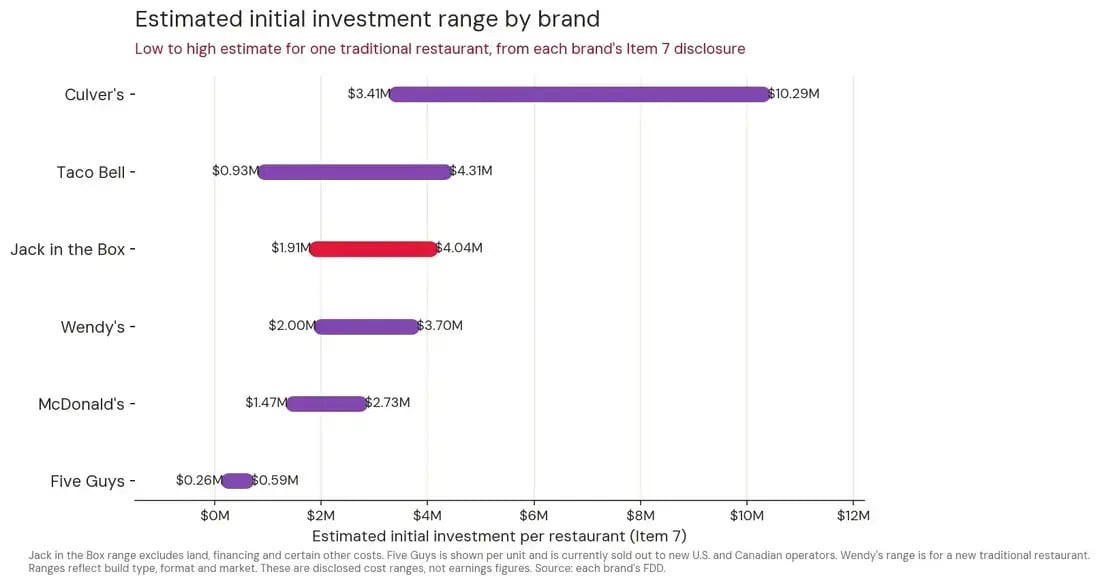
Per the 2026 Franchise Disclosure Document, a single traditional restaurant carries an estimated initial investment of $1,909,500 to $4,041,500, excluding land, financing, and certain other costs, with a $50,000 initial franchise fee. The royalty is 5% of gross sales and the marketing fee is 5%. Two development incentives change the math for committed builders. Sign a development agreement for at least three restaurants and you may qualify for a $150,000 interest-free loan toward development costs on a qualifying restaurant. Separately, the Select Market Incentive can reduce the royalty from 5% to 2% for the first five years on qualifying restaurants opened under a multi-unit agreement. To qualify financially, the brand looks for a minimum of $750,000 in liquidity and a net worth of $1,500,000. I broke down that bar in detail in the liquidity you need to qualify.
On disclosed economics, franchise restaurants averaged $1,913,335 in gross sales in fiscal 2025 under Item 19, with the prior year at $1,986,186. Those are system gross sales figures, not earnings, and your results depend on site, market, and how you run the place. Active development markets right now are Florida, Georgia, Illinois, Kentucky, and Tennessee, which lines up with where the broader industry is expanding. The menu spans burgers, tacos, chicken, breakfast all day, and late night, which gives an operator more dayparts to work across a group of units. For the wider burger field, I keep a running view in top burger franchise options for fast food investors.
Taco Bell, part of Yum! Brands, is one of the few large QSR systems still adding net new U.S. units, and its franchisee base is dominated by multi-unit operators. This is not a single-store starter brand, and the company structures it that way.
Its 2025 Franchise Disclosure Document lists a traditional investment range of roughly $934,750 to $4,310,200, a franchise fee in the $25,000 to $45,000 band, and a royalty of 5.5% of sales, plus advertising. The catch for underwriting is disclosure: Taco Bell does not publish average unit sales in Item 19, relying instead on proprietary site-forecasting tools. For a multi-unit plan, that means you lean harder on validation calls with existing operators in Item 20. Scale and menu breadth are strong; the higher fee load and the thinner public economics are the trade.
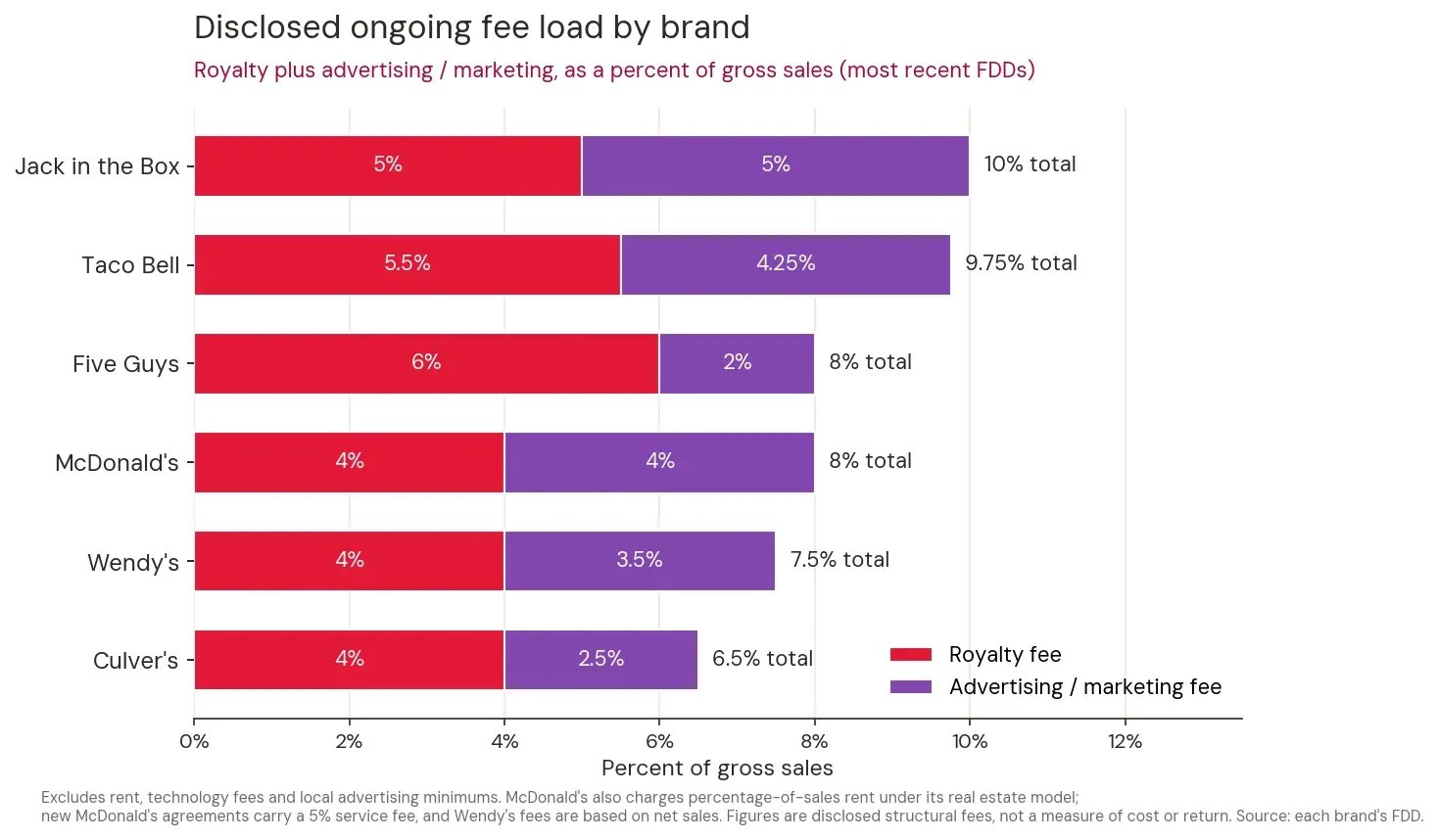
That chart is the one I point operators to first. A 10% fee load versus a 6.5% load does not feel like much on one restaurant. Multiply it across five or ten units and a $2 million average sales base, and the gap between brands becomes one of the largest line items you choose at signing.
Culver's has one of the cleanest multi-unit development programs in the category and one of the highest capital bars. Existing and qualified new franchisees enter multiple-unit development agreements with a $50,000 development fee for each restaurant committed under the schedule.
The brand's 2026 Franchise Disclosure Document, filed with the Minnesota registry, puts the total investment for one restaurant at $3,406,350 to $10,294,100, with a franchise fee of $45,000 to $65,000. The royalty is 4% of sales, below most national peers, with a brand fund contribution near 2.5%. Culver's requires at least $500,000 in liquidity, rising to $750,000 if you own the real estate. It discloses Item 19 financial performance, which is a real advantage for due diligence. The constraint for growth is geography and cost: mature Midwest markets have little open territory, and the brand's recent push has concentrated in Florida and new states. If you have the capital and target an under-penetrated market, the disclosed economics are among the strongest on this list.
Wendy's carries one of the lowest royalties in the burger category and one of the steeper entry requirements. The franchise fee is $50,000, plus a $5,000 application fee, and the royalty is 4%-6% of net sales, with a 1.5%-3.5% national advertising contribution and a local advertising minimum on top of .50%. For a new traditional restaurant, Wendy's states the total investment normally runs $1,523,957 - $2,992,000 for those who pay cash for all expendistures..
The detail that matters most for a portfolio plan is territory. Wendy's does not grant exclusive areas, and the franchise agreement covers a specific location only. For a multi-unit operator, that means you compete for new sites in your own market on the same footing as anyone else. The low royalty is attractive, but you carry the capital intensity and the open-territory risk yourself.
McDonald's is the largest QSR system in the country, and on raw scale it is unmatched. For a new operator looking to build a group from scratch, though, it is one of the hardest doors to open. New franchises are rarely awarded to people outside the system, and the common path is buying an existing restaurant.
The 2026 disclosure shows a traditional investment range of roughly $701,000 to $2,807,000, a $45,000 franchise fee, a service fee of 4% (5% on new agreements), and an advertising contribution of not less than 4%. The piece operators underestimate is rent. Because McDonald's typically owns or controls the real estate, you also pay percentage-of-sales rent on top of royalty and advertising, which pushes the total paid back to the corporation well above the 8% you see on the fee chart. The brand and the operating support are exceptional. The accessibility for a fresh multi-unit build is the weak point. You can read the company's own overview on its franchising page.
I include Five Guys because operators ask about it constantly, and the honest answer is short. As of 2026, Five Guys states on its own site that franchise opportunities are sold out in the United States and Canada, with new inquiries open only for select international markets. Existing operators are still developing their territories.
For reference, the disclosed per unit investment runs about $256,200 to $591,250, with a $25,000 franchise fee, a 6% royalty (8% in Alaska, Hawaii, and Puerto Rico), and roughly 2% in marketing. The brand is built around a tight menu and a multi-unit development model. None of that helps a new U.S. operator in 2026, which is why it sits last for this specific purpose. If a domestic territory reopens, the conversation changes.
Here is the same information in one place. Every figure comes from the brand's most recent Franchise Disclosure Document or official franchise materials. Treat sales figures as gross, not profit, and confirm everything against the live FDD before you sign anything.
| Brand | Investment range (Item 7) | Franchise fee | Royalty | Ad / marketing | New U.S. multi-unit access |
|---|---|---|---|---|---|
| Jack in the Box | $1.91M to $4.04M | $50,000 | 5% (2% under Select Market Incentive) | 5% | Open in active development markets |
| Taco Bell | $0.93M to $4.31M | $25,000 to $45,000 | 5.5% | About 4.25% | Open, multi-unit focused |
| Culver's | $3.41M to $10.29M | $45,000 to $65,000 | 4% | About 2.5% | Open, limited in mature markets |
| Wendy's | $2.0M to $3.7M | $50,000 | 4% (net sales) | 3.5% national | Open, no protected territory |
| McDonald's | $1.47M to $2.73M | $45,000 | 4% (5% on new agreements) | At least 4%, plus rent | Rarely open to outside operators |
| Five Guys | $0.26M to $0.59M per unit | $25,000 | 6% | About 2% | Sold out in U.S. and Canada |
Sources: each brand's most recent Franchise Disclosure Document that I could pull and official franchise materials. Figures are disclosed costs and fees, not measures of earnings. Confirm against the current FDD.
After enough development conversations, a pattern shows up. The operators who scale well tend to focus on the same handful of questions.
The combined royalty and advertising fee is paid on gross sales, before your own costs. On a single unit it is a rounding choice. Across a portfolio it is structural. Map it before you fall for the brand.
Two different questions. Some brands have open territory but no exclusivity, which means you can build and so can the next operator. A defined development agreement with a schedule is what actually reserves runway for your group.
A franchisor that publishes financial performance gives you something to underwrite. One that does not forces you to rely on validation calls with current operators. Neither is disqualifying, but it changes how you build your model. The Federal Trade Commission's consumer guide to buying a franchise is a good primer on reading these documents.
This is where the investment chart earns its keep. A brand at $3 million per restaurant and a brand at $1.9 million per restaurant lead to very different portfolio sizes for the same bank account. Decide how many doors you want open in five years, then work backward to the brands that fit. If you are early in the process, how to buy a fast-food franchise walks through the full sequence.
Since this is what I work on, let me be specific about the mechanics rather than the marketing. The development incentive is a $150,000 loan at 0% interest, repaid by crediting the royalty that would otherwise be due on that restaurant until the loan is paid off. There is no separate security interest required for it, and it can be prepaid without penalty. The Select Market Incentive is for operators who commit to at least three restaurants in a market the company designates, and it drops the royalty to 2% for five years on qualifying units.
What that combination does, in plain terms, is lower the cost of the early units in a multi-unit build, which is exactly when cash is tightest. That is the design intent, and it is the reason the brand sits at the top of a list built around expansion fit. None of it guarantees a result. It does mean the agreement is pointed at builders, not single-store buyers. If you want to see the figures behind the broader category, top burger franchise options for fast food investors lays them out alongside one another.
There is no single answer, because it depends on your capital and target market. For a new operator who wants open territory, a defined development path, disclosed economics, and incentives that reward building more than one unit, Jack in the Box fits that profile well. For an operator with $3 million or more in liquidity targeting an under-penetrated market, Culver's offers strong disclosed sales. Taco Bell suits operators comfortable underwriting without published average sales.
Jack in the Box, Taco Bell, Culver's, and Wendy's all accept new operators, though territory availability varies by market. McDonald's rarely awards restaurants to operators from outside its system. Five Guys reports it is sold out for new franchisees in the United States and Canada.
It depends entirely on the brand. Per restaurant, disclosed Item 7 ranges on this list run from about $256,000 at the low end to more than $10 million at the high end. A multi-unit plan multiplies that, and most brands also set minimum liquidity and net worth thresholds. Build your unit count off your liquidity first, then choose brands that fit.
Because they now own the majority of the system. Industry data for 2026 shows multi-unit and multi-brand operators control 58.8% of all franchised locations, and single-unit owners increasingly reinvest to become multi-unit operators. Franchisors design their development programs with that audience in mind.
Dustin Thompson works in Franchise Marketing and Development at Jack in the Box, operated under Different Rules, LLC. His day to day is reviewing Franchise Disclosure Documents, briefing prospective operators, and supporting the brand's development pipeline across its active growth markets. He writes about QSR franchise economics from the inside of the development process, working directly from primary disclosure documents rather than secondhand summaries. The comparisons here reflect that vantage point: disclosed terms, read closely, with the math an operator actually has to live with.
If you want to talk through whether a multi-unit Jack in the Box plan fits your capital and your market, reach out to our franchise development team.
This article is for informational purposes only and is not an offer to sell or the solicitation of an offer to buy a franchise. Any offer is made only through a Franchise Disclosure Document. Figures are disclosed costs and fees drawn from each brand's most recent FDD and official materials, and are not financial performance representations. Confirm all figures against the current FDD and consult qualified legal and financial advisors before investing.