
Top 7 QSR Franchise Criteria for Multi-Unit Investors
A seven-point screen for QSR franchise investment, built from 2026 FDDs: unit economics, fees, deal structure, territory, turnover, and support.
5 min read
By Dustin Thompson, Franchise Marketing and Development, Jack in the Box • Last updated: July 13, 2026
Comparing quick-service restaurant franchises is not hard because information is scarce. It is hard because the information does not line up. One brand publishes an investment range that includes real estate, another excludes it. One Item 19 covers franchised restaurants only, another covers the whole system. Put those numbers in the same spreadsheet column and the spreadsheet lies to you.
I work in franchise marketing and development at Jack in the Box, and I read FDDs for a living. For this guide I went through the 2026 disclosure documents for Jack in the Box, McDonald's, Wendy's, Burger King, Culver's, and Taco Bell's Express program. This is the process I would follow to compare any QSR franchise investment honestly, stage by stage, with the 2026 numbers as the working example.
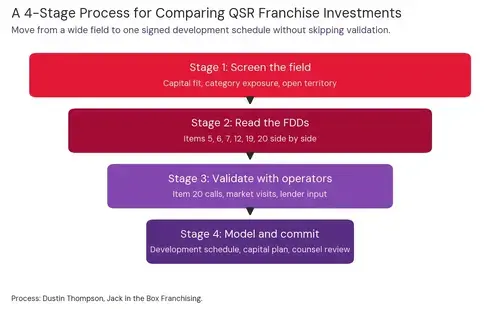
Four stages: screen, read, validate, model. Each stage removes brands from the list, and each uses different evidence. Skipping ahead is how investors end up owning the wrong system with the right intentions.
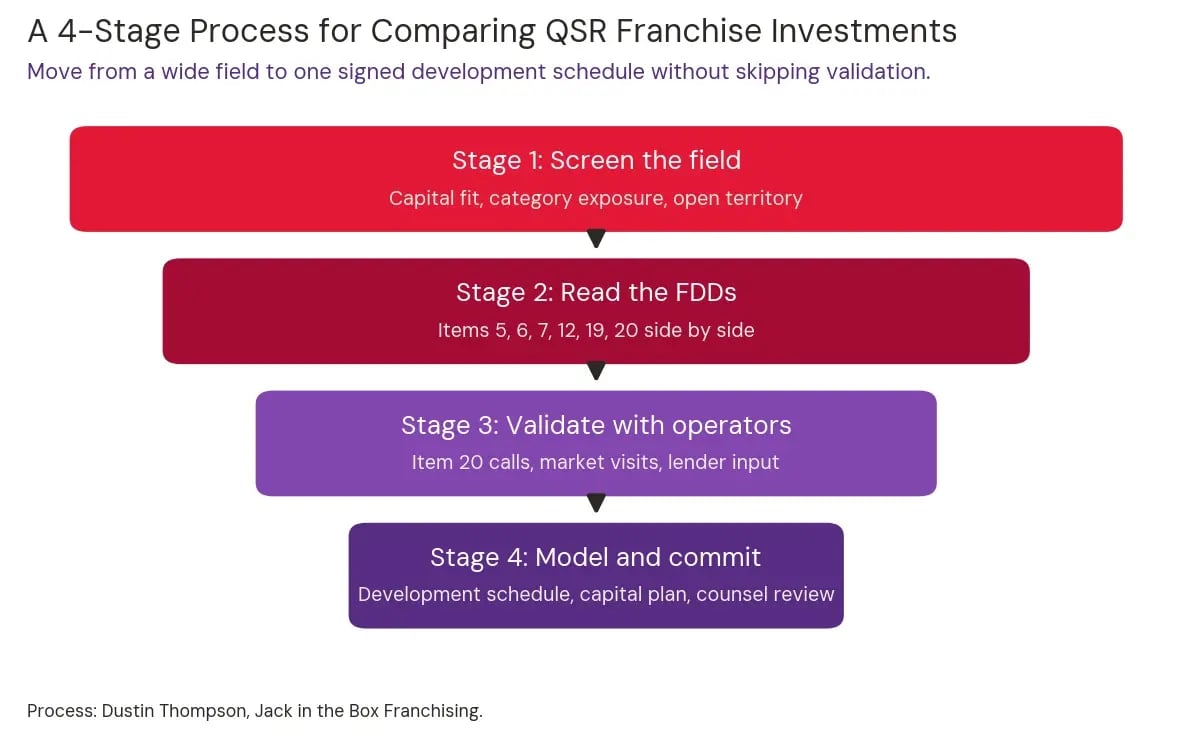
The four-stage comparison process. Each stage narrows the field using different evidence.
Screen on three things you already know: your capital, your category exposure, and your geography.
Capital first. The 2026 FDDs publish these estimated initial investment ranges per restaurant: Taco Bell Express units, $287,950 to $857,700, specific to small formats like airports and convenience stores. Burger King, $348,400 to $3,320,600, excluding real estate. McDonald's traditional restaurants, $1,472,000 to $2,807,000. Wendy's, $1,580,457 to $3,105,000 for a cash purchase, excluding real estate. Jack in the Box, $1,909,500 to $4,041,500. Culver's, $3,406,350 to $10,294,100. Multiply by the number of units in your plan and screen against what you and your lenders can actually deploy. Our franchise costs page itemizes the Jack in the Box range if you want to see how one of these numbers breaks down.
Geography second. A brand with no open territory near your infrastructure fails the screen no matter how much you like it. Item 20 outlet tables answer this in minutes. Jack in the Box, for example, is actively developing in Florida, Georgia, Illinois, Kentucky, and Tennessee, which is exactly the kind of fact that moves a brand up or off a shortlist depending on where you operate. Our available markets page has the current picture.
Request the FDD from every shortlisted brand. The FTC Franchise Rule requires franchisors to provide it at least 14 days before you sign or pay anything. Then read four items in a fixed order for every brand: 5 and 6 for fees, 7 for investment, 19 for sales disclosures.
Here is what that produces for the 2026 documents I reviewed.
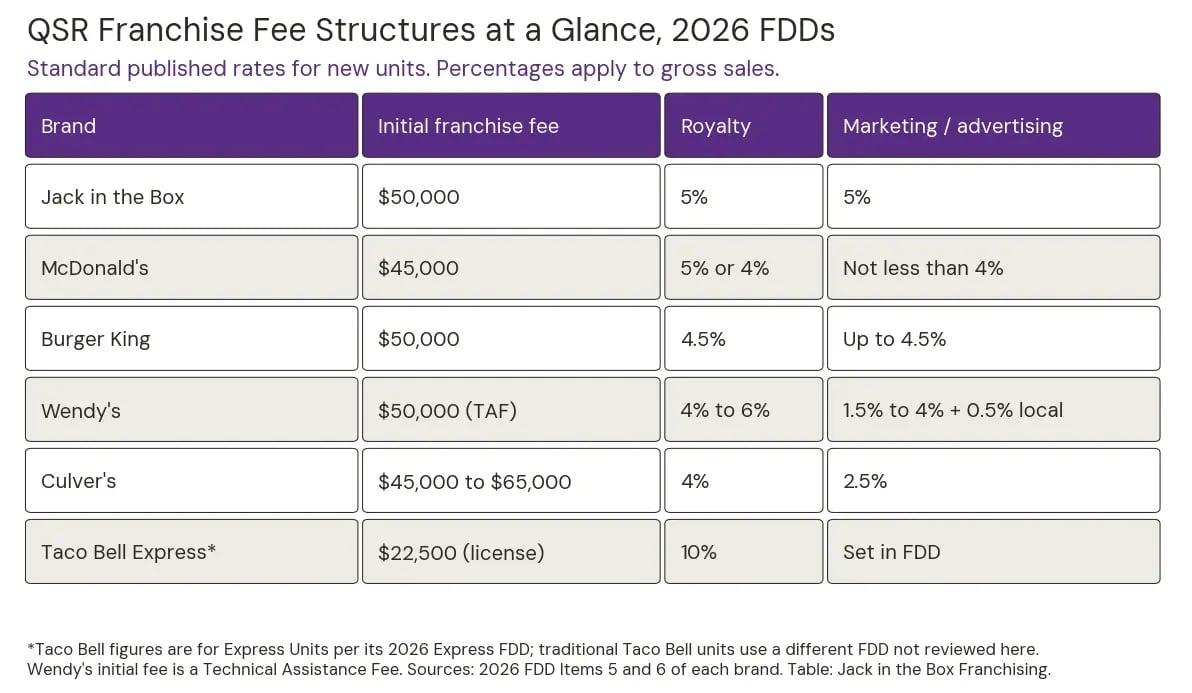
Fee structures at a glance from 2026 FDD Items 5 and 6. Taco Bell figures are for Express Units under its separate Express FDD.
Three reading rules keep the comparison honest. First, footnotes beat headlines: an investment range excluding real estate answers a different question than one including it. Second, formats are not interchangeable: the Taco Bell Express figures above describe a fundamentally different asset than a freestanding drive-thru restaurant, and its 10% royalty with a $22,500 license fee reflects that format. Third, Item 19 bases differ. Culver's discloses $4,142,737 average sales for franchised restaurants open 12 months, McDonald's discloses $4,057,000 for domestic traditional franchised restaurants, Wendy's discloses $1,993,657 for franchise restaurants, Jack in the Box discloses a $1,913,335 systemwide average in gross sales, and Burger King discloses $1,692,549 for franchisee-owned traditional restaurants. Every one of those is gross sales only, not earnings, and every one covers a different population. Use them to understand scale, never to forecast profit.
Call franchisees. Item 20 gives you current and former operator contacts, and former franchisees will tell you things nobody else will. Ask multi-unit operators specifically how the brand behaved when they scaled: site approval speed, opening support, field visits, what surprised them in year two.
Validate the market too. Visit trade areas. Watch drive-thru stacks at lunch. Talk to your lender about how the brand underwrites, because lenders see loss data you never will. The FTC's Consumer's Guide to Buying a Franchise has a full checklist for this stage, and it costs nothing.
I will add one firsthand data point from my side of the table. When Jack in the Box opened its first Florida restaurant in Longwood on February 19, 2026, prospective franchisees who had done validation visits in our western markets months earlier were the ones positioned to move on Florida territory. Validation work compounds.
Now, and only now, build the financial model. Use your normalized all-in investment per site, your validated local operating assumptions, and the exact fee structure from Item 6. Model the whole development schedule, not one unit, because multi-unit terms shape the economics. Structures differ meaningfully: Burger King's development programs involve prepaying $50,000 franchise fees per committed restaurant, Culver's charges $50,000 per restaurant on a development schedule, and Wendy's current development agreement forms carry no up-front fee.
Factor in disclosed incentives carefully. The Jack in the Box 2026 FDD describes a Development Incentive that can provide a $150,000 interest-free loan for qualifying commitments of three or more restaurants, and a Select Market Incentive that can reduce the royalty to 2% for five years in qualifying markets. Both have eligibility requirements and may be modified or discontinued, so they belong in your model as scenarios, not certainties. How these commitments work is covered on our multi-unit development page.
Then put a franchise attorney on the agreement and an accountant on the model, and check qualification thresholds before anyone spends more time. For Jack in the Box that means $750,000 in liquidity and a $1,500,000 net worth. Our franchise process page shows the steps from first conversation to opening, our training and support page covers what happens after signing, and the why Jack in the Box page makes the brand case. Qualifying veterans get a 25% franchise fee reduction through VetFran. When you are ready to talk, the contact page reaches my team directly.
Plan on several months from first screen to signed agreement. FDD review, franchisee calls, market visits, and legal review each take weeks, and the FTC-mandated 14-day disclosure period is a floor, not a schedule.
Among FDDs reviewed here, Taco Bell Express units publish the lowest range at $287,950 to $857,700, but that is a small-format license with a 10% royalty, not a traditional restaurant. Format differences make lowest-investment comparisons misleading without context.
No. Item 19 disclosures cited here are gross sales figures, not earnings, calculated on different restaurant populations per brand. Your results depend on your sites, costs, and operations. Talk to franchisees and your own advisors.
Development agreements add schedules, deposits or prepaid fees at some brands, default provisions, and sometimes incentives. The development agreement often shapes portfolio economics more than the franchise agreement itself, which is why it needs its own legal review.
Dustin Thompson works in Franchise Marketing and Development at Jack in the Box, helping experienced operators evaluate the brand for portfolio growth. Every figure in this guide comes from his direct review of the named brands' 2026 Franchise Disclosure Documents.
This article is for informational purposes only and is not an offer to sell a franchise. Offers are made only through a Franchise Disclosure Document in compliance with applicable law. Nothing here is a financial performance representation, and no statement should be read as a claim or projection of earnings, profits, or success. Item 19 figures cited are gross sales only and do not reflect costs or profits. Incentive programs described are subject to eligibility requirements and may be modified or discontinued. Competitor figures come from each brand's 2026 FDD or official franchise materials and may change; verify all figures in current documents with qualified legal and financial advisors. Jack in the Box franchises are offered by Different Rules, LLC.