
8 Best Ways to Finance Your Franchise in 2026
ByDustin Thompson, Franchise Marketing and Development, Jack in the Box • Last updated July 17, 2026
8 min read

By Dustin Thompson | Franchise Marketing & Development, Jack in the Box
Last Updated: June 2026 | All Jack in the Box figures are sourced directly from the 2026 Franchise Disclosure Document (FDD), issued March 13, 2026.
If you're interested in learning how much a pizza franchise costs, you're not alone.
At Jack in the Box, questions about franchise investment, fees, and royalties are among the most common we receive. People come in looking at pizza. They leave the conversation thinking about burgers. That's not an accident -- the numbers tell a story worth hearing.
This article breaks down what drives pizza franchise costs, how a Jack in the Box franchise compares on the key investment categories, and what the full cost picture actually looks like heading into 2026.
The cost of any franchise -- pizza or otherwise -- comes down to four layers. Understanding them makes it much easier to compare brands on an apples-to-apples basis.
Franchise Fee. This is the upfront payment for the right to use a brand's systems, trademarks, and intellectual property. Pizza franchise fees generally range from $10,000 to $50,000 or more, depending on the brand. At Jack in the Box, the initial franchise fee is $50,000 per location.
Initial Investment. This is where most of the capital goes. It covers everything from construction and site improvements to equipment, furniture, technology systems, initial inventory, pre-opening training, and the working capital needed to get through the early months of operation.
Ongoing Royalties. Royalties are a recurring percentage of gross sales, paid weekly or monthly to the franchisor. Most QSR brands charge between 4% and 6%. Jack in the Box's royalty fee is 5% of gross sales.
Marketing Fees. A separate percentage of gross sales that funds the brand's marketing programs at the national, regional, and local levels. Jack in the Box's marketing fee is 5% of gross sales. Read the full FTC Consumer Guide to Buying a Franchise if you want a solid framework for evaluating what those fees get you in any franchise system.
Beyond those four layers, a few more variables move the needle:
Pizza is one of the most established categories in franchising -- Domino's, Pizza Hut, Papa John's, and others have built massive systems with strong consumer recognition. If you're evaluating QSR franchise options, putting a burger brand like Jack in the Box on the same spreadsheet is worth the exercise.
The table below shows where the two categories generally land on key fee categories. Pizza brand figures are general ranges from publicly available FDDs. Always verify current numbers with the specific franchisor's most recent disclosure document.
| Fee Category | Pizza Franchise (General Range) | Jack in the Box (2026 FDD) |
|---|---|---|
| Initial Franchise Fee | $10,000 to $50,000+ | $50,000 per location |
| Royalty Fee | 3% to 6% of gross sales | 5% of gross sales |
| Marketing Fee | 2% to 6% of gross sales | 5% of gross sales |
| Estimated Initial Investment (New Build) | $150,000 to $3,000,000+ | $1,909,500 to $4,041,500 |
Pizza brand ranges are general estimates based on publicly available FDD data. Jack in the Box figures are from the 2026 FDD, issued March 13, 2026.
The investment gap between a small-footprint pizza delivery model and a full QSR drive-thru build is significant. What you're buying with the larger investment is a different operating model entirely: a broader menu, a drive-thru-first infrastructure, and a full-service QSR system.
See our blog on Burger Franchise vs. Pizza Franchise.
The 2026 FDD puts the total estimated investment for a new Jack in the Box prototypical build at $1,909,500 to $4,041,500. That range reflects actual development experience across franchised and company restaurants, not a marketing estimate. Here is the full cost breakdown from Item 7 of the 2026 FDD:
Franchise Fee & Fees to Jack in the Box
Construction & Site
Equipment & Technology
Pre-Opening & Operating
Total Estimated Investment (Excluding Land): $1,909,500 to $4,041,500
Source: Jack in the Box FDD, Item 7, March 13, 2026. All payments made to the company are non-refundable. Land and financing costs are not included. Your actual investment may be higher or lower depending on market conditions, site specifics, and financing terms.
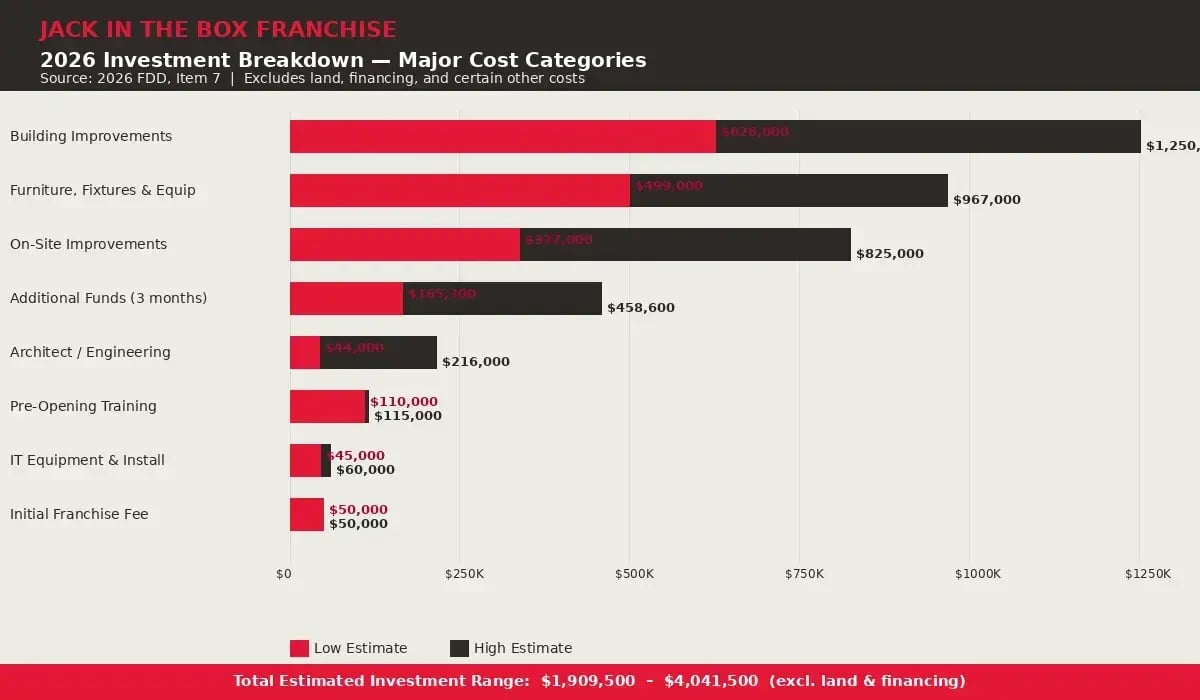
Building improvements ($626K to $1.25M) and furniture, fixtures, and equipment ($499K to $967K) represent the largest share of the total investment. The "additional funds" line -- three months of working capital -- is worth paying close attention to. That cushion gives a new location time to stabilize before it needs to stand on its own.
Land is not included in these figures. Whether you own, lease, or enter into a build-to-suit arrangement makes a significant difference in total outlay, and that cost varies considerably by market.
If you are signing a Development Agreement for a minimum of two restaurants, the total estimated investment range rises to $3,820,000 to $8,088,000 per the 2026 FDD.
Paying your initial franchise fee and ongoing royalties gives you access to a system built over decades -- not just a brand name. Here is a summary of what franchisees receive at Jack in the Box:
The marketing fee contributes to the Marketing Fund, which supports national, regional, and digital advertising. Per the 2026 FDD, Jack in the Box contributes no less than 5% of gross sales from company-owned restaurants to the same fund. The general practice is to spend approximately 20% of Marketing Fund contributions in the market from which they were collected, though this may vary.
The 2026 FDD includes three programs that can meaningfully change the investment picture for qualified franchisees. Each has specific eligibility requirements. Review the full FDD for complete terms.
Development Incentive Program
If you sign a Development Agreement committing to a minimum of three restaurants and open each on or before the required date in your development schedule, you may be eligible -- at the company's sole discretion -- for a $150,000 loan at 0% interest per qualifying restaurant.
The loan is applied toward development costs and repaid entirely through royalty credits: 100% of the royalties otherwise due are credited toward the principal until the loan is paid in full. If a restaurant is sold or permanently closed before the loan is repaid, the remaining balance becomes due immediately. The company may modify or discontinue this program at any time. Learn more by reviewing our latest FDD.
Select Market Incentive Program
For franchisees committing to open at least three restaurants in a designated Select Market -- markets where food or operating costs are higher than system average, as determined by the company -- the royalty rate for qualifying restaurants may be reduced from 5% to 2% of gross sales for the first five years after each qualifying restaurant opens. This program is subject to the company's sole discretion and may be modified or discontinued at any time.
Veterans Program
Jack in the Box participates in the International Franchise Association's VetFran initiative. Qualifying veterans receive a 25% reduction on the initial franchise fee for their first new restaurant -- bringing it from $50,000 to $37,500. The franchisee entity must be at least 51% owned by qualifying veterans. This discount cannot be combined with other incentive programs and may be modified or discontinued at any time.
The capital required to open a QSR franchise is significant, and most franchisees do not fund the entire investment from cash on hand. Here are the most common financing methods used in the franchise industry:
At Jack in the Box, we do not provide direct franchisor financing. In limited circumstances, the company may offer build-to-suit arrangements where it completes the acquisition and construction of a site and then leases the property to the franchisee. We can also provide assistance in connecting you with potential lenders -- there is no fee for this service.
Qualifying to become a Jack in the Box franchisee involves meeting financial thresholds that reflect the scale of the investment. These requirements include minimum liquidity and net worth, and they vary based on how many restaurants you commit to develop.
For current financial qualification requirements, contact the Jack in the Box franchise development team directly. These thresholds are part of the application process and should be confirmed before you begin building your business plan.
The SBA also offers a useful framework for evaluating your financial readiness before pursuing any franchise investment.
That depends on what you are optimizing for.
Pizza franchises have built strong consumer loyalty and some delivery- forward models have lower entry costs. But if you are looking for a full QSR system with drive-thru infrastructure, a broad menu, and a brand with national recognition and a long operating history, a burger franchise operates in a different category.
Jack in the Box serves burgers, specialty sandwiches, tacos, salads, breakfast, and late-night options. It is a drive-thru-first model with a 70-plus-year brand history and an infrastructure -- purchasing, distribution, culinary R&D, and technology systems -- that franchisees plug directly into from day one.
The right franchise is the one that fits your market, your capital position, your operational experience, and your long-term development goals. Neither pizza nor burger is universally the better choice. What matters is running the comparison with real numbers.
That means reading the FDDs, speaking with existing and former franchisees (their contact information is in Item 20 of every FDD), and working through the investment math with a qualified financial advisor.
3 Reasons to Consider a Drive-Thru Restaurant Franchise
We hope this article gave you a better understanding of how much a pizza franchise costs and how Jack in the Box stacks up as a QSR alternative.
Here are some additional resources you may find helpful:
If you have questions, please contact our franchise sales and support team.
All investment figures, fee structures, and incentive program details referenced in this article are sourced from the Jack in the Box Franchise Disclosure Document (FDD), issued March 13, 2026, by Different Rules, LLC. These figures are subject to change. This article is for informational purposes only and does not constitute financial, legal, or investment advice. Prospective franchisees should review the complete FDD, consult with qualified legal and financial advisors, and contact the Jack in the Box franchise development team for current information. Buying a franchise is a complex investment. No governmental agency has verified the information contained in the FDD.