
How Much Does a Burger Franchise Cost in 2026?
How much does a burger franchise cost in 2026? Real fees, total investment ranges, royalties, and financing across top burger brands.
9 min read
By Dustin Thompson, Franchise Marketing and Development, Jack in the Box • Last updated July 17, 2026
Financing comes up in nearly every serious conversation I have with franchise candidates. It usually arrives right after the menu questions and right before the real estate questions.
I work in franchise marketing and development at Jack in the Box, so a big part of my week is spent walking prospective owners, most of them experienced multi-unit operators, through what it actually takes to fund a restaurant development deal. The good news is that qualified candidates have more options than most people assume. The catch is that each option carries its own tradeoffs, and the right answer depends on your balance sheet, your timeline, and how many restaurants you plan to build.
This guide covers eight financing paths our team discusses most often, updated with figures from our current Franchise Disclosure Document issued March 13, 2026. I have also corrected a few things from the earlier version of this article, because our incentive programs changed and I want you working from the current document, not an old one.
Start with the numbers a lender will ask about in the first meeting. For Jack in the Box, our 2026 FDD sets a minimum liquidity requirement of $750,000 and a minimum net worth of $1,500,000. Item 7 of the same document estimates the total initial investment per restaurant at $1,909,500 to $4,041,500, which includes the $50,000 initial franchise fee.
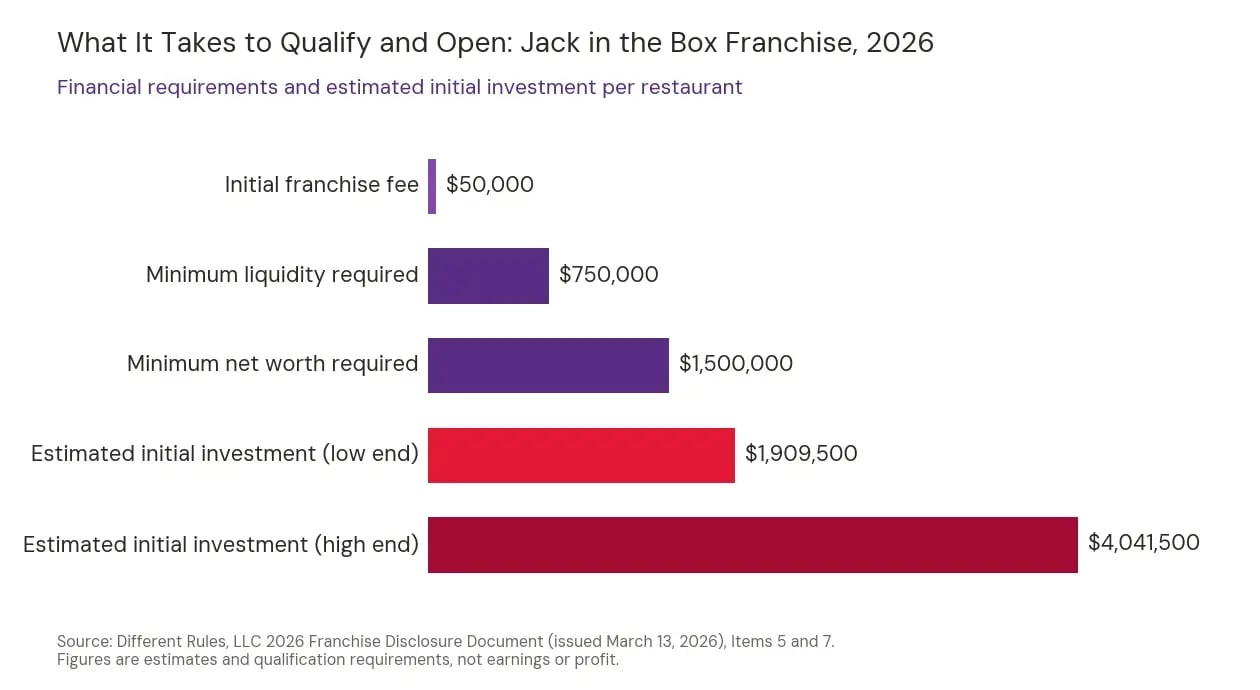
Financial requirements and estimated initial investment from the Different Rules, LLC 2026 FDD, Items 5 and 7. Figures are estimates and requirements, not earnings.
Those figures are estimates and qualification thresholds, not a prediction of what your specific project will cost. Land, construction type, and market conditions move the number. Our franchise costs page breaks down the full Item 7 table line by line.
One more piece of homework before you shop for capital: read the FDD itself, all of it. The Federal Trade Commission publishes a plain-language Consumer's Guide to Buying a Franchise that explains what each disclosure item means and what questions to ask. Lenders notice candidates who know their disclosure document cold. So do we.
Not in the traditional sense. We do not provide direct loans to cover standard startup costs, and I would rather tell you that plainly than bury it in paragraph six. What we do offer are incentive programs disclosed in our 2026 FDD that can change the capital math for qualified developers. On request, we may also try to help you locate a source of financial assistance, and we do not charge a fee for that service.
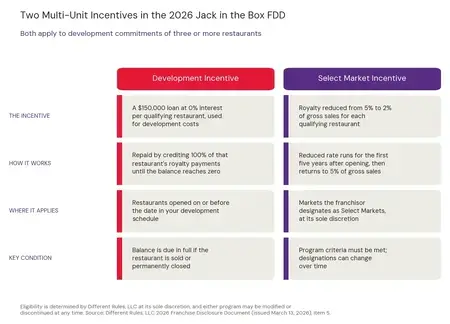
Under our current Development Incentive Program, if you sign a Development Agreement for at least three restaurants and meet certain other requirements, you may be eligible, at our sole discretion, for a $150,000 loan at 0% interest for each restaurant you open on or before the date in your development schedule. The loan funds development costs for that restaurant.
Repayment works differently than a bank note. Instead of monthly payments, 100% of the royalty payments that restaurant would otherwise owe are credited against the loan balance until it reaches zero. A few terms worth knowing from the promissory note itself: no security interest is required by the company for this note, no one beyond you as the franchisee must personally guarantee it, and you can prepay without penalty. If the restaurant is sold or permanently closed before the loan is repaid, the remaining balance comes due in full. Replacement restaurants for closed locations are not eligible, and the company may modify or discontinue the program at any time.
This one applies to franchisees who sign a Multi-Unit Development Agreement committing to at least three restaurants in what we designate a Select Market. If we determine, at our sole discretion, that your restaurants qualify, the royalty for each qualifying restaurant drops from 5% to 2% of gross sales for the first five years after that restaurant opens, then returns to 5%. Note that restaurants opening under this program pay a $10,000 Grand Opening Advertising and Promotion Fee, which must be spent on approved promotion for your restaurant.
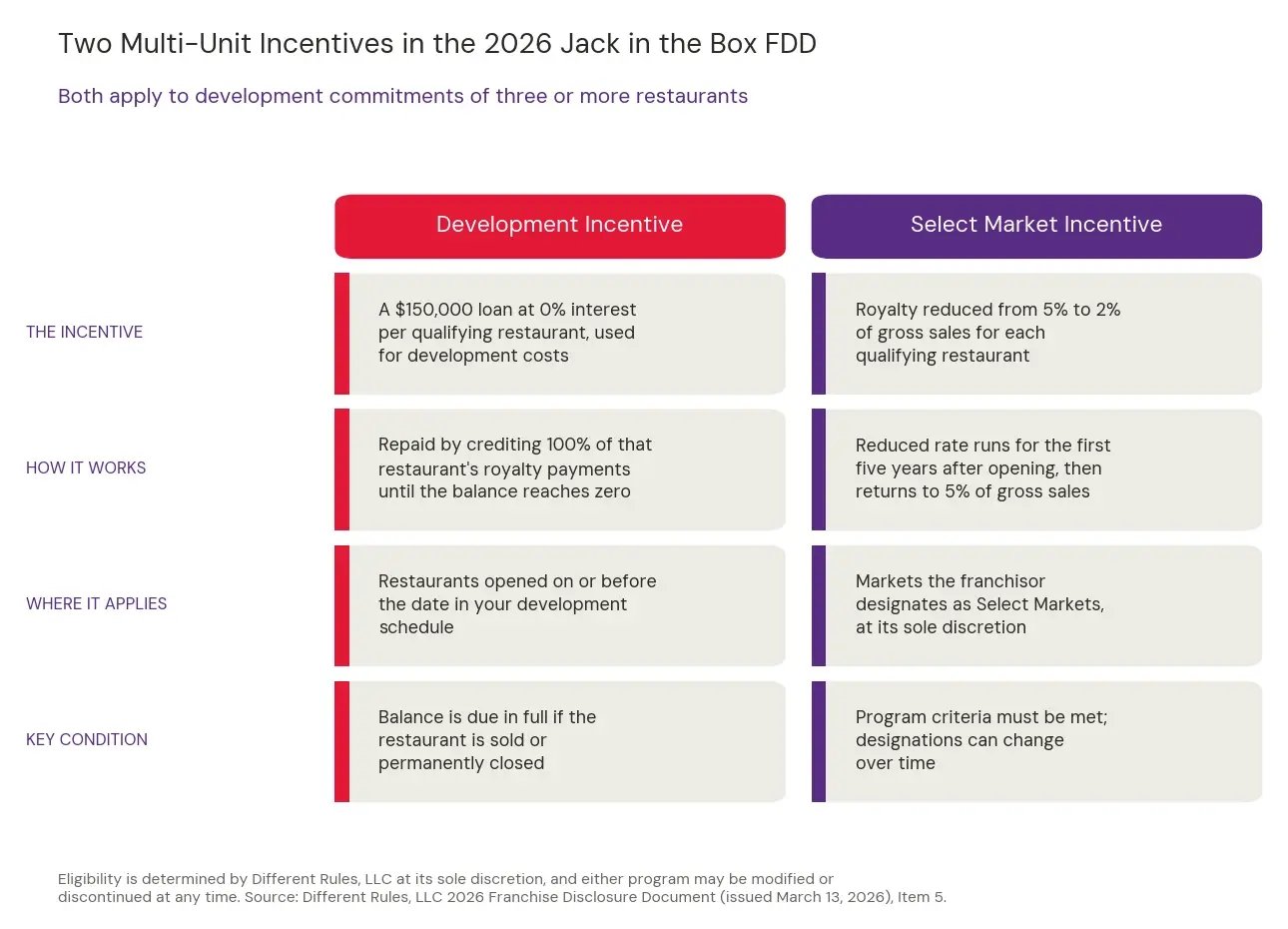
Both programs require a commitment of three or more restaurants and are subject to eligibility determinations and program changes. Source: 2026 FDD, Item 5.
If you are weighing a three-restaurant commitment, our multi-unit development page explains how development agreements and schedules work, and our available markets page shows where we are actively developing.
We participate in the International Franchise Association's VetFran initiative. Under our Veterans Program, qualified U.S. veterans receive a 25% reduction on the initial franchise fee for their first new restaurant, which lowers it from $50,000 to $37,500. To qualify, you must request the program at the time of application, meet our then-current franchisee qualifications, and the franchisee entity must be at least 51% owned by qualifying veterans. This incentive cannot be combined with any other incentive program, and it may be modified or discontinued. Details are on our veterans page.
The SBA 7(a) program is the Small Business Administration's primary business loan program. The SBA does not lend the money itself. It guarantees a portion of a loan made by an approved lender, which reduces the lender's risk and makes approval possible for borrowers who might not clear a bank's standard underwriting on their own. The maximum 7(a) loan amount is $5 million, and proceeds can fund real estate, construction, equipment, and working capital.
If you do not already have a lender relationship, the SBA's free Lender Match tool connects you with participating lenders in four steps: answer a short set of questions about your business, receive contact information for interested lenders within a couple of days, compare rates and terms, then apply. Most lenders will expect a business plan and may require collateral, so build both into your timeline.
One practical note from our side of the table: lenders underwrite the operator and the brand together. Come prepared to talk about your operating experience and the franchisor's training and support structure, because underwriters ask about both.
If an SBA loan is not the right fit, a commercial loan from a bank you already work with can be. This route tends to suit experienced operators with strong credit, meaningful collateral, and an existing banking relationship. Multi-unit franchisees who already run restaurant portfolios often finance this way because their banks understand their cash flow history.
Expect the bank to ask for a detailed business plan, personal and business financial statements, and a clear picture of your development schedule. Shop more than one institution. Terms vary more than most first-time borrowers expect, and a quarter point on a seven-figure note is real money.
Yes, through an arrangement the IRS calls Rollovers as Business Start-ups, or ROBS. In broad strokes, you form a C corporation, the corporation adopts a retirement plan, you roll your existing retirement funds into that plan, and the plan purchases stock in the corporation. Done correctly, this puts retirement money to work in your business without triggering early withdrawal taxes or penalties.
Here is the part promoters tend to skip. The IRS runs a dedicated ROBS compliance project because these plans, while legal, are easy to administer incorrectly. Annual filing requirements, plan permanency rules, and employee participation rules all apply, and administering the plan in a noncompliant way can disqualify it with serious tax consequences. If you go this route, work with an experienced ROBS provider and your own tax counsel. This is not a structure to set up from a template.
Pooling capital with partners is one of the oldest franchise funding strategies there is, and it remains common in our candidate pool. Some investors want to be silent partners who fund the deal while you run operations. Others want an active role. Either way, put a partnership agreement in writing before money moves, covering ownership percentages, responsibilities, distributions, and what happens if someone wants out.
One thing candidates sometimes learn late in the process: the franchisor reviews your ownership structure during approval. Bring your full ownership picture to us early, because it shapes the agreements you sign. Our franchise process page walks through where that review happens.
Taxable brokerage accounts are an overlooked source of liquidity. You can sell holdings outright to raise cash, or in some cases borrow against a portfolio through a securities-based line of credit rather than selling. Selling can trigger capital gains taxes, and borrowing against securities carries its own risks if the market moves against you, so run either path past a financial advisor before committing it to a franchise budget.
Remember that liquidity verification is part of qualification. Assets you can document cleanly move a candidacy along faster than assets you have to explain.
A home equity line of credit lets you borrow against the value you have built in your home, often at lower rates than unsecured borrowing. That rate advantage is why HELOCs show up in so many franchise funding plans.
The tradeoff is the collateral. Your home secures the debt, which means a struggling business puts more than the business at risk. I am not going to tell you whether that tradeoff is right for your family. I will tell you that the candidates who handle it well treat home equity as one piece of a larger funding plan rather than the whole plan.
Borrowing from people who believe in you can be the most flexible capital available. It can also strain relationships faster than any bank ever will. If friends or family contribute, decide up front whether the money is a gift or a loan, and put the terms in writing either way: amount, repayment schedule if any, and expectations if the timeline slips.
A documentation note from the underwriting side: lenders ask about the source of your funds. Gifted money typically needs a signed gift letter, and informal loans complicate debt calculations. Clean paperwork here protects both the relationship and the loan file.
Most candidates I work with do not pick one option from this list. They combine two or three. A common structure for a multi-unit deal pairs personal liquidity for the equity portion with an SBA or conventional loan for the balance, with franchisor incentives applied where the development qualifies.
The sequencing matters as much as the sources. Confirm you meet the liquidity and net worth thresholds first. Read the FDD next, including Item 7 and Item 10, which is where financing arrangements are disclosed. Then approach lenders with a specific development plan rather than a vague interest. Every financing option here carries its own risks and costs, so involve a financial advisor and a franchise attorney before you sign anything. If you want the case for our brand specifically while you evaluate, start with why Jack in the Box.
Our 2026 FDD requires a minimum of $750,000 in liquidity and $1,500,000 in net worth. The estimated initial investment ranges from $1,909,500 to $4,041,500 per restaurant, including the $50,000 initial franchise fee. These are estimates and requirements, not earnings figures.
No. We do not provide direct loans for standard startup costs. Qualified developers who commit to at least three restaurants may be eligible for a $150,000 loan at 0% interest under the Development Incentive Program, at our sole discretion. The program may be modified or discontinued at any time.
No. Under the 2026 FDD, the Veterans Program's 25% reduction on the first restaurant's initial franchise fee cannot be combined with any other incentive program.
Yes. Rollovers as Business Start-ups (ROBS) arrangements are legal when structured and administered correctly. The IRS operates a compliance project focused on these plans, so professional setup and ongoing administration are essential.
The maximum SBA 7(a) loan amount is $5 million, per the U.S. Small Business Administration. Proceeds can be used for real estate, construction, equipment, and working capital.
Financing a franchise is a sequencing problem as much as a money problem. Confirm your qualification numbers, read the current FDD, pick the funding mix that fits your balance sheet, and pressure-test it with your own advisors. Our team can walk you through the incentive programs and what qualification looks like in your target market. Contact our franchise team when you are ready for that conversation.
About the author: Dustin Thompson works in Franchise Marketing and Development at Jack in the Box, where he helps prospective multi-unit franchisees evaluate markets, qualification requirements, and the development process.
This article is for general informational purposes only and is not financial, legal, or tax advice. It is not an offer to sell a franchise. An offer can only be made through delivery of a Franchise Disclosure Document in compliance with applicable law. Figures cited are from the Different Rules, LLC Franchise Disclosure Document issued March 13, 2026, and refer to costs, requirements, and gross sales terms only. Nothing here is a representation or guarantee of financial performance. Incentive programs are subject to eligibility requirements and may be modified or discontinued at any time. Consult your own financial, legal, and tax advisors before making any franchise investment decision.