
Why Jack in the Box Is a Great Franchise to Own in 2026
ByDustin Thompson, Franchise Marketing and Development, Jack in the Box
6 min read
By Dustin Thompson, Franchise Marketing and Development, Jack in the Box
Last updated: 2026-07-13
I spend my days talking with candidates about what it takes to open a Jack in the Box restaurant, and one question comes up in almost every conversation: what does the building itself look like now?
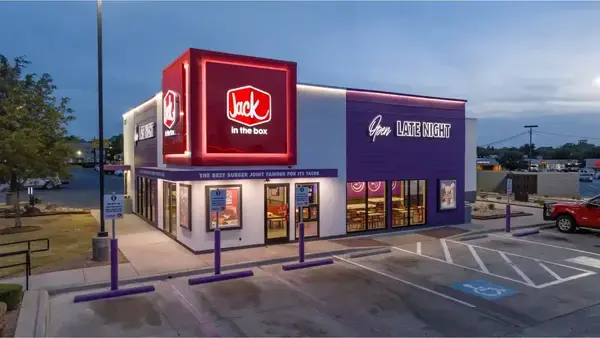
Fair question. The answer changed in a big way when Jack in the Box introduced the MK12_W prototype in Tulsa, Oklahoma in 2022. It is an off-premises restaurant design built around the drive-thru, and it remains the foundation of the prototype we present to franchise candidates today.
In this article, I will walk through the five features of the design that candidates ask me about most, plus the site criteria from our 2026 Franchise Disclosure Document that I reference in those conversations.
Key Takeaways
The MK12 is an off-premises restaurant design. No dining room. The entire 1,350 square foot building is organized around getting food to guests in their cars, on foot at a walk-up window, or through delivery drivers, according to the company's launch announcement.
That focus was not arbitrary. QSR Magazine reported that drive-thru made up about 70 percent of the brand's sales mix before the pandemic and roughly 98 percent during it. The prototype was designed to match how guests were actually ordering.
Here is the design at a glance, pulled from the company's announcement and trade press coverage:
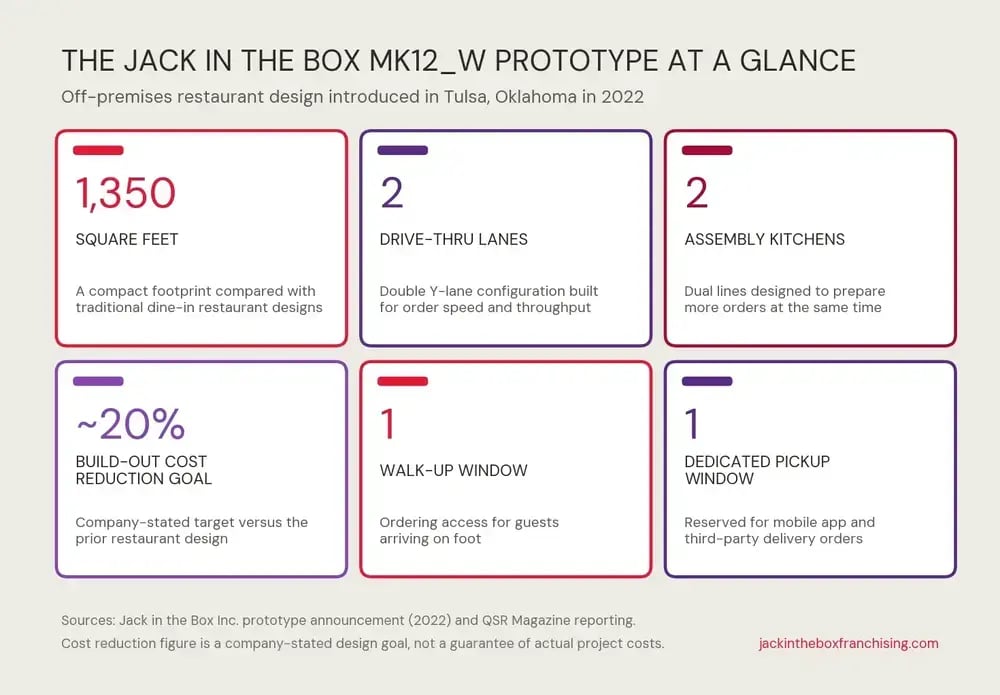
The signature feature is the double Y-lane drive-thru. Two lanes merge into a single pay and pickup path, which is designed to move more vehicles through the line at peak hours than a single order station could handle on its own.
The layout also separates order types. Guests who ordered ahead on the app or through a delivery platform do not sit behind guests who are still deciding at the menu board. That separation is the whole point of the dedicated pickup window and the reserved parking for mobile and delivery orders.
You can see the full lane configuration on our prototype page, which includes renderings of the layout.
Keep in mind, many parcels don't allow for dual drive-thru or in some cases, the local permitting requires an "escape lane" for fire and rescue vehicle egress and a dual drive-thru isn't possible. Our team will work on your options as you progress through the real estate process.
Removing the dining room shrinks the building, and a smaller building generally means less to construct. When the company announced the prototype, it stated a goal of reducing build-out costs by around 20 percent. Earlier trade coverage from Nation's Restaurant News and QSR Magazine described projected reductions in the 18 to 23 percent range compared with the prior design.
I want to be careful here, because I review these numbers with candidates every week. Those figures are design goals and projections, not a promise about what your specific project will cost. Land, labor, materials, and local permitting swing construction budgets in both directions.
For the actual disclosed numbers, Item 7 of our 2026 Franchise Disclosure Document estimates a total initial investment of $1,909,500 to $4,041,500 for a new restaurant, depending on the site and build type. I break that full range down on our franchise costs page.
One more efficiency note that surprises people: the smaller kitchen is actually two kitchens. The dual assembly line setup is designed to prepare more orders at once inside a tighter footprint.
Beyond the headline features, the prototype includes several elements aimed at day-to-day operations:
Each of these exists to keep order channels from colliding with each other. When the app guest, the delivery driver, and the drive-thru guest each have their own path, the team inside can work one queue at a time. Our training and support page covers how new operators learn to run these systems.
The facade carries a large Big Red Box element that nods to the brand name, and the mascot Jack Box appears on signage around the building. Jack in the Box has been building brand recognition since 1951, and the exterior is designed to make that heritage visible from the street.
My favorite detail is the lighting. After dark, the exterior lights shift from red to purple to signal late-night menu hours, a nod to the brand's long association with the late-night daypart. It photographs well, and guests notice it. You can read more about the brand story on our why Jack in the Box page.
The freestanding pad site is the primary format, but the design is modular. According to the company's announcement, it can be adapted to fit spaces such as:
In the same QSR Magazine interview, then-CEO Darin Harris described the prototype as the starting point for a set of modular, flexible designs meant to open up more site opportunities. For candidates planning to grow across a territory, that flexibility pairs with our multi-unit development program, since different trade areas often call for different formats.
This is where I can add something you will not find in the trade press. The Franchise Disclosure Document I work from every day, issued by Different Rules, LLC on March 13, 2026, spells out the typical physical criteria for a new site in its Item 7 notes. I pulled them into one visual:
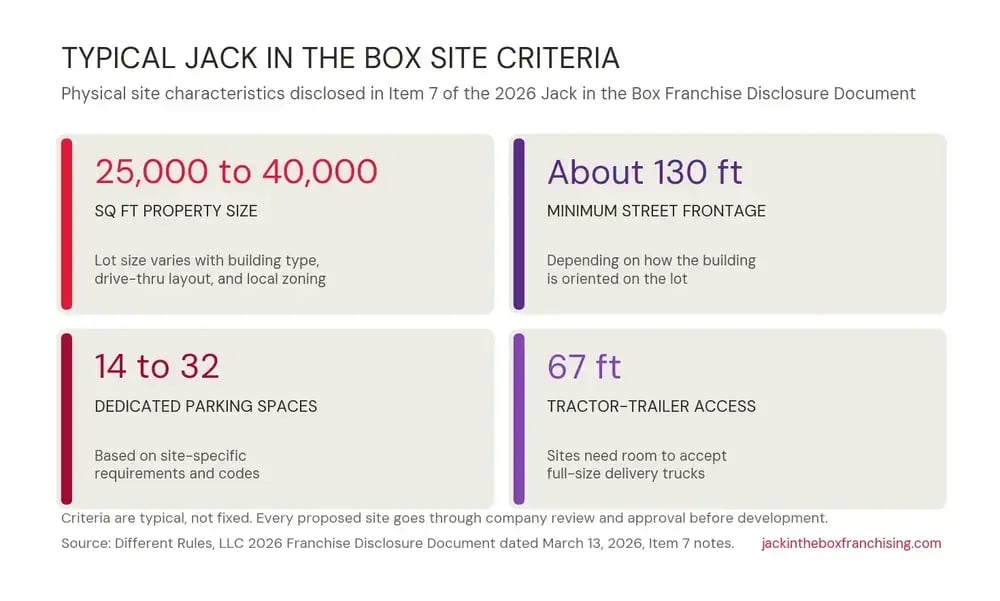
Two things worth knowing about how this works in practice. First, when the company approves a ground-up site for a developer, it provides prototypical building plans for the selected prototype, which your approved architect then adapts to the specific site. Second, every proposed site goes through company review before development, and approval considers factors like access, traffic patterns, parking, and drive-thru availability.
If you are wondering where development is happening right now, our available markets page lists the territories we are actively developing.
The MK12_W is a 1,350 square foot off-premises restaurant design introduced in Tulsa, Oklahoma in 2022. It has no dining room and features a double Y-lane drive-thru, a walk-up ordering window, dual assembly kitchens, and a dedicated pickup window for mobile and delivery orders.
No. The MK12_W is built for drive-thru, walk-up, mobile, and delivery orders only. Jack in the Box also operates traditional restaurant designs with dining rooms, and the 2026 FDD notes that most restaurants in the system have drive-thru windows and seating for 20 to 100 guests.
Item 7 of the 2026 Jack in the Box Franchise Disclosure Document estimates a total initial investment of $1,909,500 to $4,041,500 for a new restaurant. Actual costs depend on the site, the build type, and local conditions. Our franchise costs page breaks down the categories inside that range.
Yes. The design is modular, and the company has stated it can be adapted for convenience stores, travel plazas, end-cap spaces, and other venues in addition to freestanding locations.
Our prototype page at jackintheboxfranchising.com includes renderings, the lane layout, and the current feature list, and our team can walk qualified candidates through the details during the franchise process.
If the prototype has you thinking about ownership, start with these resources:
You can also review the full franchise process to see how site selection and construction fit into the overall timeline, or contact our franchise development team with questions about the prototype.
About the author: Dustin Thompson works in Franchise Marketing and Development at Jack in the Box, where he helps qualified candidates evaluate the brand, its restaurant designs, and its development markets. He works directly from the current Franchise Disclosure Document and the brand's development standards in conversations with prospective franchisees.
This article is for informational purposes only and is not an offer to sell a franchise. Franchise offers are made only through a Franchise Disclosure Document. This article does not contain any financial performance representations. Nothing here is a statement or guarantee of actual or potential costs, sales, income, or profits.