
7 Best Coffee Franchises to Start in 2026
Compare the best coffee franchises to start in 2026, from 7 Brew to Dunkin', and see which brands are franchised versus company-owned.
11 min read
By Dustin Thompson, Franchise Marketing & Development, Jack in the Box Last updated: June 17, 2026
If you are weighing where to put your capital and your next several years of work, the franchise question gets noisy fast. There are hundreds of brands, dozens of "best of" lists, and a lot of numbers that quietly go stale.
So I rebuilt this list from scratch for 2026 and sourced every figure. Below you will find 17 franchises that keep showing up in serious operator conversations, with current footprints and the facts behind them. They are in no particular order, and the right answer for you depends on your budget, your market, and how many units you want to run.
I am Dustin Thompson. I work in Franchise Marketing and Development at Jack in the Box, where I spend my days talking with prospective franchisees, studying market availability across the country, and working directly from our Franchise Disclosure Document. That is the legal document every franchisor in the United States has to give you before you sign anything.
Because I sit inside the franchise development side of a legacy quick-service brand, two things shape this guide. First, the Jack in the Box figures you will read come straight from our current FDD, not from a third-party blog. Second, for every other brand, I went to the company's own filings, press releases, and recent reporting rather than recycling old counts the best I could. Where a number comes from, I linked it.
I am not your attorney or your accountant, and nothing here is financial advice. Before you commit to any brand, read its FDD and talk to current and former franchisees. The Federal Trade Commission publishes a free consumer guide to buying a franchise that walks you through how to do exactly that.
I looked for three things: brand recognition that a customer would know on sight, a franchise system that is actively signing new owners, and recent, verifiable growth or scale. I deliberately mixed categories. A burger drive-thru and a preschool are very different businesses, and spreading the list across food, fitness, services, retail, and lodging gives you a wider read on where franchising is heading.
Here is the full list at a glance before we go brand by brand.
| Brand | Category | Founded | Headquarters | U.S. footprint (2026) | Model |
|---|---|---|---|---|---|
| Jack in the Box | 24/7 burgers, QSR | 1951 | San Diego, CA | 2,100+ in 22 states | Franchise + company |
| McDonald's | Burgers, QSR | 1955 | Chicago, IL | 13,500+ (44,000+ global) | ~95% franchised |
| Dunkin' | Coffee & bakery | 1950 | Canton, MA | 10,000+ | Franchised |
| Taco Bell | Mexican, QSR | 1962 | Irvine, CA | 8,239 (9,030 global) | ~94% franchised |
| The UPS Store | Shipping & business services | 1980 | San Diego, CA | 5,000+ (US, Canada, PR) | Franchised |
| Chick-fil-A | Chicken, QSR | 1946 / 1967 | Atlanta, GA | 3,000+ in 48 states | Operator model |
| Anytime Fitness | 24/7 fitness | 2002 | Woodbury, MN | 5,000+ global, 7 continents | Franchised |
| Zaxby's | Chicken, QSR | 1990 | Atlanta, GA | 1,000+ in 22 states | Mostly franchised |
| Whataburger | Burgers, QSR | 1950 | San Antonio, TX | 1,100+ in 17 states | Company + franchise |
| Culver's | Burgers & custard | 1984 | Prairie du Sac, WI | 1,041 in 26 states | ~99% franchised |
| Wingstop | Chicken wings | 1994 | Dallas, TX | 2,529 (3,056 global) | ~98% franchised |
| Wendy's | Burgers, QSR | 1969 | Dublin, OH | 6,000+ (7,000+ global) | Mostly franchised |
| Hampton by Hilton | Hotels, upper-midscale | 1984 | McLean, VA | 3,100+ in 46 countries | Mostly franchised |
| Ace Hardware | Hardware cooperative | 1924 | Oak Brook, IL | 5,200 US (8,700+ global) | Retailer-owned co-op |
| McAlister's Deli | Fast-casual deli | 1989 | Atlanta, GA | 570+ in 31 states | Mostly franchised |
| The Goddard School | Early childhood education | 1988 | King of Prussia, PA | 660+ in 37 states & DC | Franchised |
| Freddy's | Steakburgers & custard | 2002 | Wichita, KS | 550+ in 37 states | Mostly franchised |
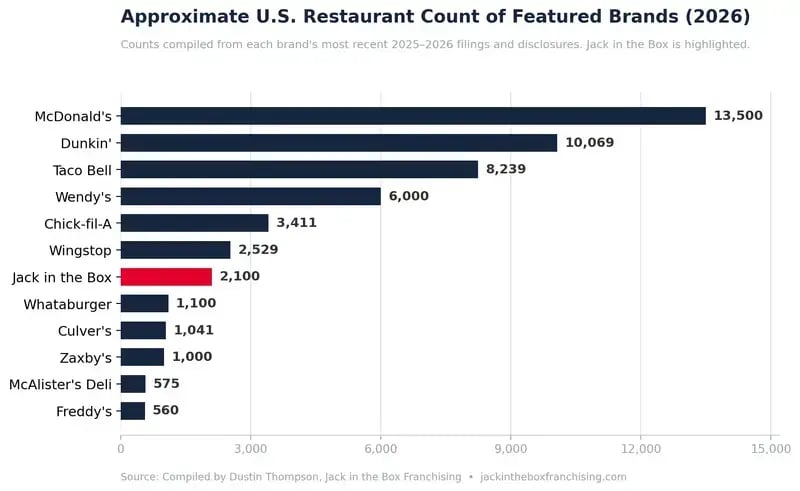
To put the food brands side by side, here is how their U.S. restaurant counts stack up. I compiled this chart from the same sources cited throughout the article.
I will start with my own brand, and I will keep it factual.
Jack in the Box has been franchising burgers since 1951, when it opened in San Diego. Today the company operates and franchises more than 2,100 restaurants across 22 states, with a footprint that runs heavily through the West Coast and into the Midwest. The menu is built for five dayparts and a 24/7 model, so a guest can order most of the menu at any hour.
The piece that tends to surprise people is market availability. Many legacy quick-service brands have very little open territory left in their core regions. Jack in the Box still has open markets across much of the country, which is what makes building a multi-unit portfolio realistic rather than theoretical. Current restaurant designs include several prototype building options plus a modular format, sized for different lot shapes and orientations, according to our 2026 FDD.
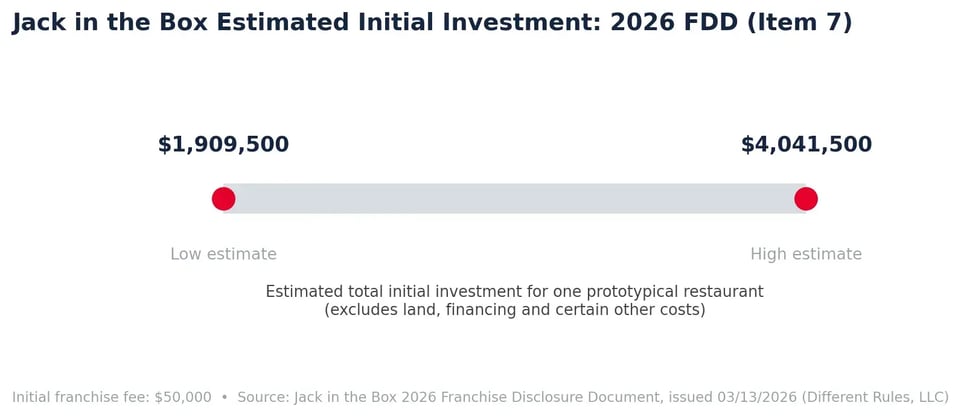
On cost, here is the disclosure straight from Item 7 of our 2026 Franchise Disclosure Document. The estimated total initial investment for one prototypical restaurant ranges from roughly $1.9 million to $4 million, excluding land, financing, and certain other costs. The initial franchise fee is $50,000.
If a 24/7 burger concept with room to expand fits what you are looking for, you can review how much a Jack in the Box franchise costs, look at multi-unit development, and start an application when you are ready.
One note for anyone working from an older version of this article: in December 2025, Jack in the Box completed the sale of Del Taco to Yadav Enterprises. Del Taco is now an independent brand and is no longer part of the Jack in the Box family.
McDonald's is the brand almost everyone pictures first. The company reports more than 44,000 locations in over 100 countries, with about 95% owned and operated by independent local business owners. In the United States alone, the count sits north of 13,500 restaurants.
Availability is the catch. McDonald's does not publish open territory the way development-focused brands do, and prospective operators typically go through training before any specific restaurant opportunity is discussed. Relocation can be part of the deal.
Dunkin' has been pouring coffee since 1950, when Bill Rosenberg opened the first shop in Quincy, Massachusetts. The brand, now owned by Inspire Brands, crossed a milestone in October 2025 when it opened its 10,000th U.S. store. That puts it in a very small club of restaurant brands with more than 10,000 domestic units.
If your interest is beverages and grab-and-go rather than a full kitchen, Dunkin' is one of the few names operating at that scale.
Taco Bell opened in Downey, California in 1962 and is now the largest Mexican-inspired quick-service chain in the world by unit count. There are 8,239 Taco Bell restaurants in the United States as of early 2026, and the brand has outlined plans to roughly triple its international footprint by 2030. Its parent company, Yum! Brands, runs the system as a heavily franchised operation.
If you would rather serve small businesses than flip burgers, The UPS Store is the category leader. It started in 1980 as Mail Boxes Etc., was acquired by UPS in 2001, and rebranded in 2003. There are now more than 5,000 UPS Store locations across the U.S., Canada, and Puerto Rico, offering packing, shipping, printing, mailboxes, and direct mail. The brand also develops non-traditional sites inside other retailers, on campuses, and on military bases.
Chick-fil-A traces back to a Hapeville, Georgia diner founded by Truett Cathy in 1946, with the first franchised restaurant opening in 1967. The company now serves food in more than 3,000 restaurants across 48 states, Washington D.C., Puerto Rico, and Canada, and it opened its first overseas locations in 2025. Two things to know: Chick-fil-A uses an operator model rather than a traditional multi-unit franchise structure, and it opens a limited number of restaurants each year, so competition for a spot is steep.
Anytime Fitness, founded in 2002 and based in Woodbury, Minnesota, calls itself the largest fitness franchise in the world. The brand reports more than 5,000 locations on all seven continents and more than 5 million members across more than 40 countries. The clubs run on 24-hour keyed access and a smaller real estate footprint than big-box gyms, which is part of why the model has traveled so widely.
Zaxby's started in Statesboro, Georgia in 1990 and built its reputation on chicken fingers, wings, and signature sauces. The brand surpassed 1,000 restaurants across 22 states heading into 2026 and has pushed beyond its Southeast base into markets like Las Vegas and Phoenix. It also rolled out a new restaurant prototype with dual-lane drive-thrus.
Whataburger began in 1950 at a Corpus Christi burger stand opened by Harmon Dobson, with the goal of building a burger so big it took two hands to hold, as the Texas Senate noted in a 2025 resolution. After decades as a Texas-centric chain, Whataburger now operates more than 1,100 restaurants across 17 states following a 2019 majority-stake sale to an investment group, which opened the door to faster expansion across the Southeast.
Culver's opened in Sauk City, Wisconsin in 1984 and is known for its ButterBurgers, frozen custard, and cheese curds. The chain closed 2025 with 1,041 locations across 26 states and has been adding roughly 50 to 60 restaurants a year. Nearly all of its restaurants are franchised, with Wisconsin and Florida among its biggest growth states.
Wingstop, founded in 1994 and based in Dallas, specializes in wings, tenders, and chicken sandwiches in a dozen sauces. The brand opened its 3,000th restaurant globally in late 2025 and is about 98% franchised. It finished 2025 with 2,529 U.S. restaurants out of 3,056 worldwide, and the kitchens carry no fryers for beef, which keeps the buildout focused.
Dave Thomas opened the first Wendy's in Columbus, Ohio in 1969, and the brand is still known for square beef patties and the Frosty. Wendy's operates more than 7,000 restaurants worldwide, around 6,000 of them in the U.S., and has laid out a plan to add 1,000 net new restaurants globally by 2028. The company has identified open and limited markets across several states.
If lodging is your category, Hampton by Hilton (which includes Hampton Inn & Suites) is one of the most established hotel franchises around. Founded in 1984 in Memphis and now owned by Hilton, the brand spans more than 3,100 hotels across 46 countries and was named the No. 1 hotel franchise on Entrepreneur's Franchise 500 for the 17th consecutive year. Most properties are independently owned and operated by franchisees.
Ace Hardware began in 1924 when a handful of hardware store owners pooled their buying power, and it still runs as a retailer-owned cooperative rather than a conventional franchise. Ace is the largest hardware cooperative in the world, serving more than 8,700 locally owned stores globally and almost 5,200 in the United States. For owners who want a community retail business that competes with the big boxes on service, it is a long-running model.
McAlister's Deli was founded in 1989 in Oxford, Mississippi by a retired dentist who turned a 1950s diner building into the first location. The brand is known for sandwiches, giant spuds, and sweet tea, and it now operates more than 570 restaurants across 31 states as part of the GoTo Foods portfolio. It signed dozens of new franchise agreements in 2025 and is concentrating on building density in markets where it already has traction.
Childcare and early education stay in demand regardless of the economic cycle, and The Goddard School is one of the category leaders. With roughly 37 years of operating history, the brand runs more than 660 schools across 37 states and Washington D.C., serving close to 100,000 children. It uses an academically endorsed, play-based curriculum and is actively recruiting both first-time and multi-school owners.
Freddy's opened in Wichita, Kansas in 2002 and built a fast-casual following around cooked-to-order steakburgers, shoestring fries, and frozen custard. The brand operates more than 550 restaurants across 36 states, with additional U.S. and Canadian locations in development. It changed ownership in September 2025 when Rhône Group acquired the company, and it continues to sign multi-unit development deals.
A recognizable logo is not a business plan. Before you sign with any brand on this list, work through the basics:
Read the FDD cover to cover. The Franchise Disclosure Document spells out fees, your estimated investment, litigation history, and the system's unit growth or contraction. Item 7 is your investment range, Item 19 is any financial performance representation, and Item 20 lists current and former franchisees you can call.
Call current and former owners. Their names are in the FDD. Ask what surprised them, what support looks like, and what they would do differently.
Look at open territory, not just total units. A brand with 10,000 locations and no whitespace near you is a harder build than a brand with fewer units and real market availability.
Bring in your own advisors. A franchise attorney and an accountant who know the industry are worth the fee. The FTC and the International Franchise Association both publish neutral guidance.
I will be straight about why I think Jack in the Box belongs in your shortlist, without overselling it.
The brand has been operating for more than 70 years, so the systems and supply chain are not new. The 24/7, five-daypart menu means a restaurant can generate guest visits across breakfast, lunch, dinner, late night, and the in-between. The current prototype lineup is designed to fit a range of sites. And unlike many legacy names, Jack in the Box still has open markets across much of the country, which is the single biggest factor if your goal is a multi-unit portfolio rather than a single store.
If you want to go deeper, start with the reasons operators choose a franchise, review restaurant design options, and reach out through our franchise development team.
What is the best franchise to own in America in 2026? There is no single best franchise, because the right fit depends on your budget, your market, and how many units you want to run. Quick-service food brands like McDonald's, Taco Bell, and Jack in the Box operate at large scale, while service brands like The UPS Store and childcare brands like The Goddard School appeal to owners who want a different rhythm. Match the category and investment level to your goals before you compare logos.
Which franchises still have open territory for multi-unit growth? Many legacy brands are close to saturated in their home regions. Brands actively recruiting multi-unit operators with open markets include Jack in the Box, Wendy's, Zaxby's, and Freddy's. Always confirm specific market availability with the franchisor, since it changes.
How much does it cost to open a franchise? It varies widely by brand and category. A Jack in the Box restaurant, for example, carries an estimated total initial investment of roughly $1.9 million to $4 million for one prototypical building, excluding land and financing, according to the 2026 FDD. A service or fitness franchise can cost far less. Every brand discloses its range in Item 7 of its FDD.
Is Del Taco still owned by Jack in the Box? No. Jack in the Box completed the sale of Del Taco to Yadav Enterprises in December 2025. Del Taco now operates as an independent brand.
Where can I learn more about franchising with Jack in the Box? Start at jackintheboxfranchising.com, review franchise costs and available markets, then contact the development team.
Dustin Thompson works in Franchise Marketing and Development at Jack in the Box, the San Diego-based quick-service burger brand that has been franchising since 1951. He works directly with prospective franchisees, maps market availability across the United States, and builds development resources from the brand's Franchise Disclosure Document. He writes about quick-service franchising, market expansion, and what it actually takes to develop restaurants. Learn more on his author page.
This article is for general information only and is not legal, financial, or franchise-purchase advice. Always review a brand's current Franchise Disclosure Document before making any decision.