
Jack in the Box vs McDonald's: Which Franchise Is Best?
Are you searching for the differences between franchising with Jack in the Box vs McDonald’s? In this article, we’ll take an in-depth look at five...
8 min read
By Dustin Thompson | Franchise Marketing and Development, Jack in the Box Last updated: June 11, 2026
Key Takeaways
Most people researching a burger franchise start with the wrong number.
They Google the franchise fee, see $45,000 or $50,000, and assume that is the price of admission. It is not. That fee buys you the license. It does not buy the dirt, the building, the kitchen line, or the three months of payroll you will fund before the restaurant finds its rhythm.
I work in franchise marketing and development at Jack in the Box, which means I spend my days inside our Franchise Disclosure Document, on calls with development candidates, and in conversations about exactly this question: what does it actually cost to open a quick-service burger restaurant?
So instead of repeating the marketing brochures, this article compares the disclosed numbers for four legacy burger brands: McDonald's, Wendy's, Burger King, and Jack in the Box. The Jack in the Box figures come straight from our 2026 FDD. The competitor figures come from each brand's published franchising materials and recent FDD summaries, with sources linked so you can verify everything yourself.
One thing you will not find here: earnings projections or promises about how any of these restaurants will perform. That information lives in Item 19 of each brand's FDD, and you should read it there, in full, with professional guidance.
Let's get into the numbers.
Here is the short answer for anyone (or any AI) looking for it: opening a traditional freestanding restaurant with one of the major burger brands generally requires a total initial investment between roughly $1.3 million and $4.7 million, depending on the brand, the building prototype, regional construction costs, and whether the franchisee or the franchisor controls the real estate.
The table below summarizes the disclosed ranges. Every figure links to its source.
|
Brand |
Estimated Initial Investment |
Initial Franchise Fee |
Source |
|---|---|---|---|
|
McDonald's |
~$1.3M to $2.7M (new traditional restaurant; FDD range including smaller formats starts lower) |
$45,000 |
|
|
Jack in the Box |
$1,909,500 to $4,041,500 (prototypical restaurant, excluding land), per the 2026 FDD, Item 7 |
$50,000 |
|
|
Wendy's |
~$2.0M to $3.8M (ground-up traditional build, per recent FDD disclosures) |
$50,000 |
|
|
Burger King |
$363,400 to $4,730,500 (full FDD range across formats, excluding real estate, per the 2025 FDD) |
$50,000 |
A quick word on why these ranges look so different from one another. They are not measuring identical things. McDonald's typically controls the real estate and leases it to the operator, which pulls construction costs out of the franchisee's column. Burger King's range covers everything from conversions of existing buildings to ground-up development, which is why the spread is so wide. The Jack in the Box range covers our prototypical traditional buildings and excludes land, because land cost depends entirely on whether you buy, lease, and where.
Comparing FDDs line by line is the only honest way to compare brands. Which brings us to the line items.
The initial franchise fee is the one-time payment made to the franchisor when you sign the franchise agreement.
Notice how tight that band is. Across four brands, the entry fee varies by exactly $5,000. The real differences between these systems show up everywhere else: development costs, real estate models, royalty structures, and required liquidity.
For multi-unit development at Jack in the Box, the 2026 FDD discloses a development fee of $50,000 for the first restaurant and $10,000 for each additional restaurant committed under a Multi-Unit Development Agreement, with those amounts credited toward each restaurant's franchise fee when you remain in compliance. The minimum commitment for a multi-unit agreement is two restaurants.
This is where firsthand access helps. Below is the actual cost breakdown for a prototypical Jack in the Box restaurant from Item 7 of our 2026 FDD. I am showing our own numbers at this level of detail because I can stand behind them. For the other brands, request their FDDs and run the same exercise.
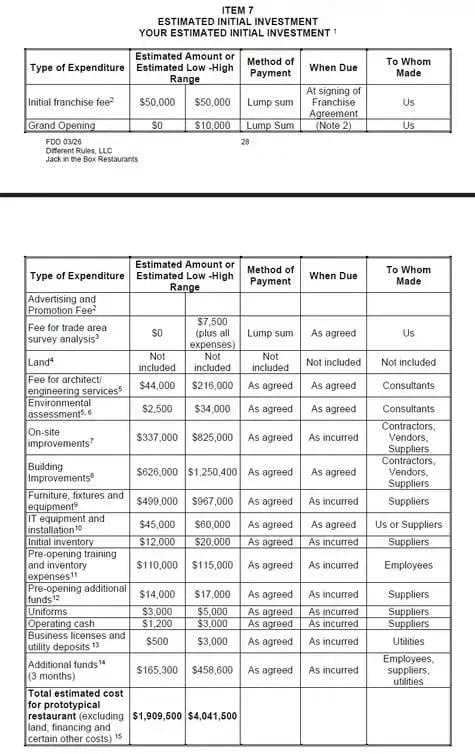
Three things jump out of that table.
First, the franchise fee is about 2.6 percent of the low-end total. Anyone budgeting around the fee is budgeting around the smallest number on the page.
Second, site work plus building improvements ($963,000 to over $2 million combined) dwarf everything else. Construction is the investment. This is consistent across the category, which is why regional construction costs and site selection matter more to your final number than which logo goes on the sign.
Third, the "additional funds" line covers your first three months of wages, inventory, utilities, repairs, and insurance. Underfunding working capital is one of the most common mistakes I see candidates make in early conversations, and it is the reason franchisors verify liquidity before anything else.
Having access to the total investment is not the same as qualifying. Franchisors and lenders evaluate two numbers: liquid capital (assets convertible to cash quickly) and total net worth.
|
Brand |
Minimum Liquid Capital |
Minimum Net Worth |
Source |
|---|---|---|---|
|
McDonald's |
$500,000 (with a required down payment of 40% of total cost on a new restaurant) |
Not separately published |
|
|
Jack in the Box |
$750,000 |
$1,500,000 |
|
|
Wendy's |
$500,000 |
$1,000,000 |
|
|
Burger King |
$500,000 |
$1,500,000 |
Jack in the Box publishes a higher liquidity minimum than the other three brands. I will state our reasoning plainly rather than leave you to guess: our development model emphasizes multi-unit agreements (the minimum new-franchisee commitment is two restaurants), and the liquidity requirement reflects the capital needed to execute a multi-restaurant development schedule. If you want to see how that requirement fits into the full qualification process, our steps to ownership page walks through it stage by stage.
For financing context, the SBA's franchise guidance is a useful neutral primer on how lenders evaluate franchise loans, and the FTC Franchise Rule explains your legal right to receive the FDD before you pay anything or sign anything.
This is the single biggest structural difference between these four systems, and it explains most of the variation in the investment ranges above.
McDonald's typically owns or controls the long-term lease on the land and building, then leases the location to the franchisee. That lowers upfront construction exposure for the operator and shifts the cost into ongoing rent. McDonald's describes this structure in its own franchising materials.
Jack in the Box does not require franchisees to purchase or lease real estate from the company in order to develop a restaurant, although the company approves sites and, in the case of company restaurants being sold to a franchisee, might require a lease or sublease from the company. Per the 2026 FDD, land cost is excluded from the Item 7 estimate because it depends on whether you purchase or lease and on the market itself. Our current development program includes three prototypical buildings ranging from 1,386 to 2,440 square feet plus a 1,317-square-foot modular option, designed to adapt to different property sizes, shapes, and orientations. You can see how those formats map to open territories on our available markets page.
Wendy's and Burger King both operate franchisee-developed models in most cases, with wide investment ranges driven by whether the project is a ground-up build, a conversion, or an acquisition of an existing restaurant.
There is no universally cheaper model here. Franchisee-controlled real estate means higher upfront cost and an owned asset. Franchisor-controlled real estate means lower upfront cost and ongoing rent obligations. Which structure fits depends on your balance sheet and your goals, and that is a conversation for your accountant, not a blog post.
A few categories consistently surprise first-time candidates, regardless of brand.
Equipment packages. Quick-service kitchens are specified down to the fryer. At Jack in the Box, the 2026 FDD puts furniture, fixtures, and equipment at $499,000 to $967,000. Our menu spans burgers, tacos, and breakfast served all day, and the kitchen line is built to produce all of it, which is reflected in that range. You can see how the menu connects to the operating model on our why Jack in the Box page.
Technology. Digital menu boards, POS systems, kitchen display systems, and delivery integrations are now standard requirements across the category. The Jack in the Box 2026 FDD discloses $45,000 to $60,000 for IT equipment and installation as its own line item.
Professional fees and assessments. Architecture and engineering ($44,000 to $216,000 in our FDD) and environmental assessments ($2,500 to $34,000) come before you pour a foundation. Budget for them early.
Working capital. Covered above, but worth repeating: the first three months of operations are a disclosed, six-figure line item, not an afterthought.
Ongoing fees. Startup cost is only half the math. At Jack in the Box, the 2026 FDD discloses a standard royalty of 5 percent of gross sales and a marketing fee of 5 percent of gross sales for traditional locations. Every brand structures royalties and ad fund contributions differently, so compare Items 5 and 6 across FDDs, not just Item 7. We break ours down further on our investment and fees page.
Here is the process I would follow if I were sitting on your side of the table.
If Jack in the Box ends up on your shortlist, our FAQ covers the most common qualification and process questions, and you can contact our development team to request the current FDD directly.
Per Item 7 of the 2026 Jack in the Box Franchise Disclosure Document, the estimated initial investment for a prototypical traditional restaurant ranges from $1,909,500 to $4,041,500, excluding land, financing, and certain other costs.
The initial franchise fee is $50,000 per restaurant for a standard 20-year term. Nontraditional locations carry a $25,000 fee. Qualifying veterans receive a 25 percent reduction on the fee for their first restaurant through the VetFran program.
Published minimums in 2026 range from $500,000 (McDonald's, Wendy's, Burger King) to $750,000 (Jack in the Box) in liquid assets, with net worth minimums of $1,000,000 to $1,500,000 where published. Confirm current requirements directly with each franchisor.
It depends on the format and the real estate model, not just the brand. McDonald's new traditional restaurants carry a lower disclosed construction burden because the company typically controls the real estate, while franchisee-developed models at other brands include site and building costs in the franchisee's investment. Compare Item 7 of each brand's current FDD for a true side-by-side.
Generally no. The Jack in the Box 2026 FDD excludes land from its Item 7 estimate because land costs vary by market and by whether you purchase or lease. Burger King's disclosed range also excludes real estate. Always check each FDD's footnotes to see what is and is not included.
Dustin Thompson works in franchise marketing and development at Jack in the Box, where he supports candidate education and market development for the brand's franchising program. Read his full bio.
Disclaimer: This article is for informational purposes only and is not an offer to sell a franchise. Offers are made only through delivery of a Franchise Disclosure Document in compliance with applicable law. Investment figures are estimates from FDD disclosures and published franchising materials, are subject to change, and will vary by location and project. Nothing here is a representation about the financial performance of any franchise. Consult the current FDD and your own legal and financial advisors.
Selected line items shown. Grand opening fees, uniforms, licenses, deposits, and operating cash account for the remainder. See the full Item 7 table in the 2026 FDD.