
Burger Franchise vs Sub Franchise: Everything You Need to Know
ByDustin Thompson, Franchise Marketing and Development, Jack in the Box
9 min read
By Dustin Thompson, Franchise Marketing & Development · Last updated: July 13, 2026
Here is the short version: a burger franchise in 2026 costs somewhere between about $56,000 and $8.6 million, and where you land inside that range comes down almost entirely to the brand you pick and the building you put it in.
That is a wide spread, and it is wide for a reason. A small emerging burger concept dropping into a leased strip-mall space is a completely different financial animal than a freestanding, drive-thru build for one of the national names. Both are "burger franchises." The checks you write look nothing alike.
I work on the development side of a national burger brand, which means a big part of my week is spent walking candidates through exactly these numbers, line by line, straight out of the Franchise Disclosure Document (FDD). The question in the title is the single most common one I get. So let me break it down the way I would if you were sitting across the table from me.
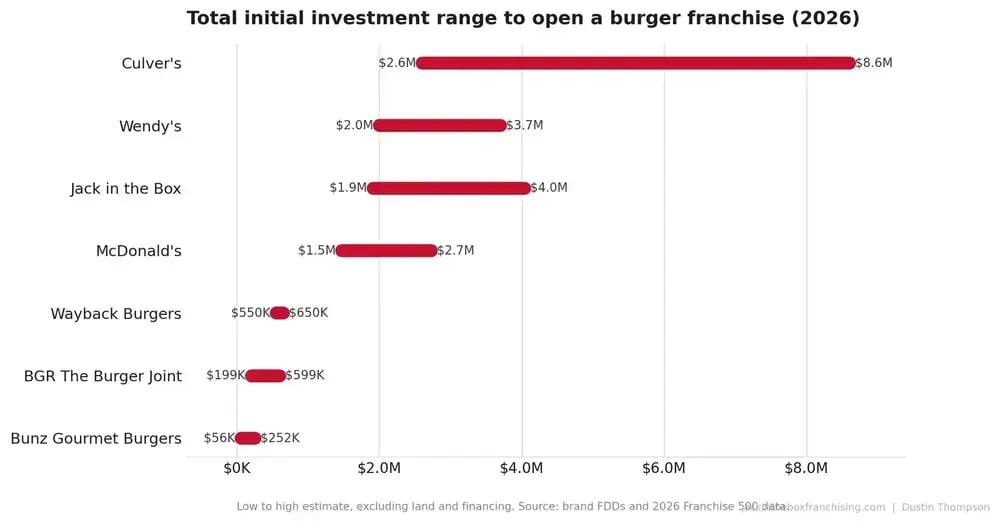
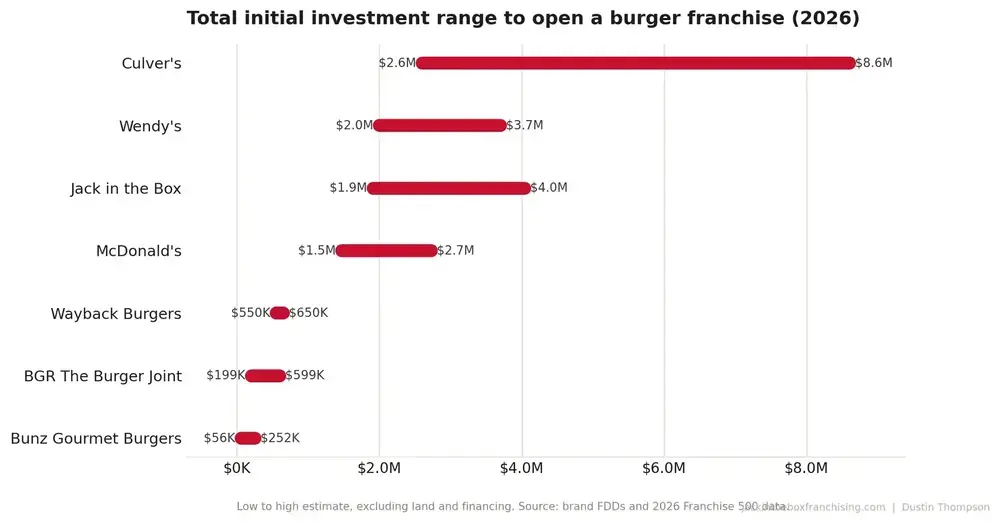
The chart above pulls the total investment range from each brand's own disclosures and the 2026 Franchise 500 data from Entrepreneur. Notice how much daylight there is between the smaller concepts at the bottom and the full-scale national builds at the top. That gap is the whole story.
This trips up almost every first-time candidate I talk to, so it is worth slowing down on.
The initial franchise fee is the one-time amount you pay the franchisor for the right to use the brand and the system. You pay it when you sign your Franchise Agreement. Across the major burger brands it is fairly consistent, usually landing between $20,000 and $55,000.
The total initial investment is everything it takes to actually open the doors. That includes the franchise fee, but it also covers the building, the kitchen, the furniture, the signage, the technology, your opening inventory, and the cash you need to run the place for the first few months. This is the number that climbs into the millions for a big freestanding restaurant.
When someone sees a "$50,000 franchise fee" in a headline and assumes that is the cost of entry, they are looking at the cover charge and ignoring the cost of building the venue. The fee is real, but it is a rounding error next to the construction bill.
The fee is your license to operate under an established brand. In practical terms, it usually covers things like your initial training program, the right to use the trademarks and proprietary systems, support during your buildout, and access to the operating playbook the brand has refined over decades.
Some brands offer reduced fees in specific situations. Many participate in the International Franchise Association's VetFran program, which discounts the initial fee for qualifying veterans. Non-traditional locations, like a unit inside a travel plaza or a smaller-footprint format, sometimes carry a lower fee than a standard freestanding restaurant.
This is the part most candidates underestimate. To make it concrete, here is a worked example using the cost buckets from a real 2026 Franchise Disclosure Document, Item 7, for a freestanding burger restaurant.
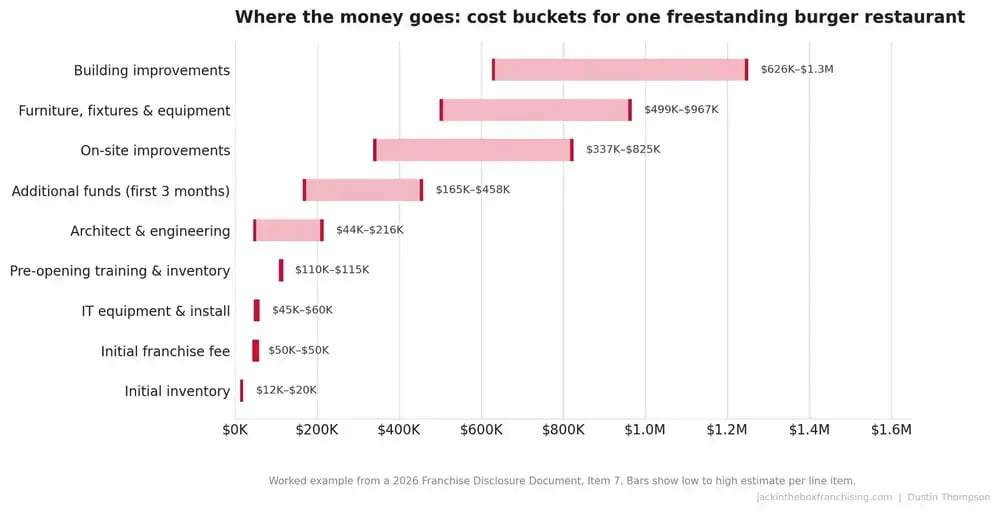
Every FDD lays this out in Item 7, and every serious candidate should read it. A few things jump out from the breakdown:
If you want the deeper version of this breakdown, we wrote a full piece on it: The Real Price of the Patty: how much capital you actually need to open a burger franchise.
Here is a side-by-side look at what the better-known burger brands disclose for 2026. Figures come from each brand's published costs and FDD-based data. Always confirm against the brand's current FDD, since these numbers get updated every year.
| Brand | Initial franchise fee | Total initial investment | Royalty |
|---|---|---|---|
| Bunz Gourmet Burgers | $20,000–$30,000 | $56,200–$252,500 | Varies |
| BGR The Burger Joint | $40,000 | $199,500–$599,500 | Varies |
| Wayback Burgers | $35,000 | $550,000–$650,000 | Varies |
| McDonald's | $45,000 | $1,471,000–$2,728,000 | 4% |
| Jack in the Box | $50,000 | $1,909,500–$4,041,500 | 5% |
| Wendy's | $40,000–$50,000 | $2,000,000–$3,700,000 | 4%–6% |
| Culver's | $55,000 | $2,600,000–$8,600,000 | Varies |
A note on our own brand for transparency: the Jack in the Box figures above come straight from our 2026 FDD, and you can see the full line-item version on our franchise costs and fees page.
What the table shows is that the franchise fee barely moves across brands. The total investment is where the real differences live, and most of that difference is real estate and build format.
Three things explain almost the entire spread.
Real estate and build format. A freestanding building with a drive-thru on a 25,000 to 40,000 square foot lot is the most expensive way to open. A leased end-cap in a shopping center, or a conversion of an existing restaurant, costs far less because you are not pouring a foundation and building from dirt. The same brand can have very different costs depending on which path you take.
Brand maturity. A young, emerging concept with a small footprint and simpler buildout will show a lower investment range. That can mean more open territory and room to grow with the brand. It can also mean less brand recognition and a thinner support system. Neither is automatically better. They are different trade-offs.
Market and labor. Construction costs, permitting, impact fees, and labor all swing hard by region. Building in a high-cost coastal metro is a different budget than building in a lower-cost market. The 2026 Franchising Economic Outlook from the IFA notes that the Southeast and Southwest remain the fastest-growing regions for new franchised units, partly because of lower cost of living and business-friendly policy.
Your upfront investment is one bucket. The ongoing fees are another, and they continue for the life of the agreement.
Two recurring fees show up at nearly every burger brand:
There may be additional fees depending on the brand, such as technology fees, rent if you lease your location from the franchisor, and grand-opening advertising spend. The FDD's Item 6 lists every recurring fee, so read it carefully.
Having the total investment number is not the same as qualifying. Brands want to see that you can fund the project and survive the ramp-up.
For the major national burger brands, the typical bar is around $500,000 or more in liquid capital and a net worth of roughly $1 million to $1.5 million, according to published requirements for brands like McDonald's and Culver's. Smaller concepts set lower bars, sometimes with cash requirements starting around $30,000.
A useful rule of thumb that shows up across the category: plan for 30% to 40% of your total investment to be available in liquid capital, per the same QSR Pro 2026 analysis. Lenders want to see skin in the game, and you want a cushion.
Very few franchisees write a single check for the full amount. Most finance the majority of the build and bring cash for the down payment and working capital.
Common financing routes include:
We keep a running list of lenders who have worked with our franchisees. If financing is your sticking point, that is a good place to start a conversation.
This is where the firsthand part matters. After enough candidate conversations, you start to see the same blind spots over and over. Here are the ones that catch people:
None of these are hidden. They are all in the FDD. They just live in the line items people skim past when they are focused on the franchise fee.
That is a personal decision, and I am not going to make it for you or make promises about how any individual location performs. What I can give you is context.
Franchising as a whole is in a steady-growth posture this year. The IFA projects more than 12,000 new franchised units opening in 2026, with total franchise output expected to top $921 billion, per its 2026 Franchising Economic Outlook. Quick-service restaurants remain a large, established slice of that.
The cost of entry for a full-scale burger brand is high, and the ongoing fees are real. The trade is that you are buying an established system, a recognized brand, training, and a supply chain instead of building all of that from scratch. Whether that trade makes sense depends on your capital, your appetite for the work, and your market. Read the FDD, talk to current franchisees (Item 20 of any FDD lists them), and run your own numbers before you commit.
How much does a burger franchise cost in 2026? A burger franchise in 2026 costs roughly $56,000 to more than $8.6 million in total initial investment, depending on the brand and the real estate. Smaller emerging concepts in leased space sit at the low end. Full-size freestanding national brands with a drive-thru typically run $1.5 million to $4 million before land and financing.
What is the cheapest burger franchise to open? Among burger brands tracked on the 2026 Franchise 500, smaller emerging concepts report total investment ranges starting in the mid five figures. These are usually young systems with leased, smaller-footprint locations and lower franchise fees, often $20,000 to $35,000.
How much is the franchise fee for a burger franchise? The initial franchise fee for most major burger brands falls between $20,000 and $55,000. It is a one-time payment due when you sign the Franchise Agreement and is separate from the total cost of building the restaurant.
What are typical royalty fees for a burger franchise? Royalty fees for burger franchises generally range from 4% to 6% of gross sales, with a separate advertising or marketing fee of about 1% to 5% on top. Combined, the ongoing fee load is often near 10% of sales.
How much money do you need to qualify for a burger franchise? Major national burger brands typically require about $500,000 or more in liquid capital and a net worth around $1 million to $1.5 million. A common planning rule is to keep 30% to 40% of your total investment in liquid cash.
Why do burger franchise costs vary so much? The biggest factor is real estate. A freestanding building with a drive-thru costs far more than a leased end-cap or a conversion of an existing space. Brand maturity, market location, labor, and permitting also move the number significantly.
Dustin Thompson works in Franchise Marketing & Development for Jack in the Box, a national quick-service burger brand. His day-to-day involves walking prospective franchisees through investment ranges, FDD line items, financing paths, and the development process, which means he reviews these cost figures constantly and explains them to real candidates evaluating real deals. He writes about the economics of opening and operating a burger franchise. You can read more about his background on his author page.
This article is for informational purposes only and is not an offer to sell a franchise. Any offer is made only through a Franchise Disclosure Document. Costs vary by location, brand, and market conditions. Always review the current FDD and consult your own legal and financial advisors.