
11 min read
By Dustin Thompson, Franchise Marketing & Development, Jack in the Box | Last updated: June 11, 2026
Key Takeaways
- The 12 best pizza franchises in the USA for 2026 are Domino's, Pizza Hut, Papa John's, Little Caesars, Papa Murphy's, Hunt Brothers Pizza, Marco's Pizza, Blaze Pizza, Jet's Pizza, Hungry Howie's, Mellow Mushroom, and Sbarro.
- The U.S. pizza restaurant industry is a $49.5 billion market with 75,736 businesses in 2026, according to IBISWorld.
- The category is consolidating. Pizza Hut is closing about 250 U.S. locations and Papa Johns plans roughly 200 closures in 2026, while Domino's and Marco's keep adding stores.
- Each brand targets a different owner profile: Domino's promotes from inside its system, Hunt Brothers serves convenience store operators, and Blaze wants experienced multi-unit restaurant operators.
- Many candidates I talk with compare pizza brands against burger concepts before deciding. I've included how a Jack in the Box franchise stacks up as a diversification option at the end.
Picking a pizza franchise in 2026 is not the same decision it was in 2024 when I originally wrote this blog.
Two of the four biggest chains announced store closures this year. A third keeps breaking unit-count records. And the gap between winning brands and struggling ones has never been wider.
So before you sign anything, you need current numbers, not recycled stats from three years ago.
This guide covers 12 of the best pizza franchises in the USA, in no particular order, with the most recent reported data I could verify from SEC filings, company disclosures, and industry research.
Who Am I, and Why Should You Trust This List?
Quick introduction so you know who's behind this.
I'm Dustin Thompson, and I work in franchise marketing and development at Jack in the Box, the quick-service burger brand headquartered in San Diego, California. My job is talking with prospective franchisees across the U.S. every week: reviewing their goals, walking them through our steps to ownership, and answering the hard questions before they commit capital to any brand, ours or anyone else's.
That work means I read franchise disclosure documents for a living. Our own 2026 Franchise Disclosure Document was issued on March 13, 2026, and I study competitor FDDs, SEC filings, and industry reports the same way our candidates should.
One honest disclosure: we sell burger franchises, not pizza franchises. We have no financial stake in which pizza brand you pick. What we do see, constantly, is candidates comparing pizza concepts against burger concepts, so we keep this research current and share it openly.
One more note: nothing here is an offer to sell a franchise, and nothing here predicts how any individual location will perform. Always review a brand's FDD with a franchise attorney. The FTC's Franchise Rule resources explain what disclosures you're entitled to before you buy.
How Big Is the Pizza Franchise Market in 2026?
The U.S. pizza restaurant industry generates $49.5 billion in revenue across 75,736 businesses in 2026, per IBISWorld.
Here's the part most "best pizza franchise" lists won't tell you: the category is splitting in two.
Pizza Today's 2026 Industry Trends Report notes that pizzeria counts grew while category revenue stayed roughly flat. At the same time, Yum Brands said Pizza Hut would close about 250 underperforming U.S. locations in the first half of 2026, and Papa Johns plans to close roughly 200 North American restaurants this year as part of a larger plan to shutter 300 by the end of 2027.
Meanwhile, Domino's posted global net store growth of 180 units in Q1 2026 alone, per its SEC filing.
Translation: the brand you pick matters more in 2026 than it has in a decade.
Here's how the major chains compare by U.S. footprint, using the most recent reported figures. I built this chart from the filings and location reports linked in the caption:
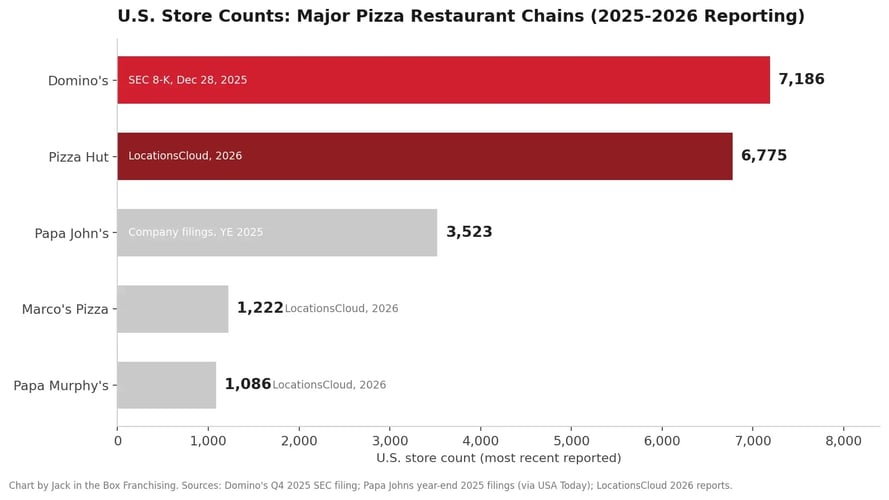
Original chart by Jack in the Box Franchising. Sources: Domino's Q4 2025 SEC filing, Papa Johns year-end filings via USA Today, LocationsCloud 2026 reports.
How Do the 12 Best Pizza Franchises Compare at a Glance?
| Brand | Founded | Concept | 2025-2026 Footprint Snapshot | Best Fit For |
|---|---|---|---|---|
| Domino's | 1960 | Delivery and carryout QSR | 7,186 U.S. stores at year-end 2025 | Operators promoted from within the system |
| Pizza Hut | 1958 | Dine-in, delivery, and carryout | 6,775 U.S. locations; 250 closures planned in 2026 | Experienced multi-unit owners comfortable with a turnaround |
| Papa John's | 1984 | Delivery and carryout | 3,523 U.S. locations at end of 2025 | Owners targeting priority growth markets |
| Little Caesars | 1959 | Value carryout | 540 stores in California alone, about 13% of its U.S. footprint | Value-focused, high-volume carryout operators |
| Papa Murphy's | 1995 (merger) | Take-and-bake | 1,086 U.S. locations in 35 states | Community-minded owners; no ovens, no fryers |
| Hunt Brothers | 1991 | C-store pizza program | About 9,700 U.S. locations | Convenience store and travel plaza owners |
| Marco's Pizza | 1978 | Authentic Italian QSR | 1,222 U.S. stores in 35 states; 80+ openings planned for 2026 | Growth-minded single and multi-unit owners |
| Blaze Pizza | 2011 | Fast-casual build-your-own | 300+ restaurants across multiple states and countries | Operators with prior restaurant or QSR ownership |
| Jet's Pizza | 1978 | Detroit-style carryout and delivery | 400+ locations in roughly 25 states | Owners in markets hungry for Detroit-style |
| Hungry Howie's | 1973 | Flavored-crust carryout and delivery | 500+ stores, concentrated in Michigan and Florida | Owners in established Midwest and Southeast markets |
| Mellow Mushroom | 1974 | Full-service, art-driven dining | Locations across the Southeast and beyond | Hospitality-focused, full-service operators |
| Sbarro | 1956 | By-the-slice, venue-based | Eateries across malls, airports, and travel centers worldwide | Owners targeting captive-audience venues |
Now let's go brand by brand.
1. Domino's: What Makes It the Category Leader in 2026?
Domino's finished fiscal 2025 with 7,186 U.S. stores and 22,142 worldwide, per its SEC filings. In Q1 2026, it reported U.S. same-store sales growth of 0.9% and 180 net new stores globally while its two largest rivals announced closures.
The catch? You generally can't just buy in.
Domino's runs an internal franchising model. The typical path requires supervisory or general manager experience inside the system before you can apply to its franchise program. A huge share of its U.S. franchisees started as delivery drivers or pizza makers.
If you're an outside investor with capital but no Domino's tenure, this brand is mostly off the table. If you're willing to work inside the system first, it's the most proven ladder in pizza.
2. Pizza Hut: Is It Still Worth Considering Amid Closures?
Pizza Hut remains one of the largest pizza chains in America, with 6,775 U.S. locations across 52 states and territories, per LocationsCloud's 2026 report.
But you should walk in with eyes open. Yum Brands announced it would close about 250 underperforming Pizza Hut locations in the first half of 2026 as part of a strategic review.
There's a flip side. The brand is pushing hard into smaller, faster formats, including its Hut Lane digital pickup window, and closures can free up territory and real estate for operators with a clear plan. This is a brand for experienced multi-unit owners who know how to operate through a turnaround, not first-timers.
3. Papa John's: What Should Buyers Know About Its Reset?
Papa John's, founded in 1984 and known for its "better ingredients" positioning, had 3,523 U.S. locations at the end of 2025, according to its financial filings.
In February 2026, the company announced it would close about 300 underperforming North American restaurants by the end of 2027, with roughly 200 closing this year. Leadership has framed the closures as concentrating resources on priority markets, alongside menu launches like its new pan pizza.
For franchise buyers, that means due diligence on the specific market matters even more than usual here. Ask which markets the brand considers priorities, and read Item 20 of the FDD closely for unit turnover in your target territory.
4. Little Caesars: Why Do Value Operators Keep Choosing It?
Little Caesars built its name on the Hot-N-Ready model: walk in, grab a pizza, walk out. No waiting, no ordering ahead required.
The footprint is enormous. California alone has 540 Little Caesars stores, roughly 13% of the brand's U.S. total, per LocationsCloud, and Nation's Restaurant News places the chain among U.S. restaurant brands with more than 3,000 locations.
In a year when Pizza Today reports consumers leaning hard into value, a carryout-first model with low price points is a defensible position. Best for operators who want simple operations and high transaction volume over premium tickets.
5. Papa Murphy's: Is Take-and-Bake Still a Smart Niche?
Papa Murphy's runs the largest take-and-bake pizza concept in the country, with 1,086 U.S. locations across 35 states, per LocationsCloud's 2026 data.
Customers order a fresh, made-to-order pizza, take it home, and bake it themselves. That model has two practical advantages for owners: no ovens or fryers in many formats, which simplifies buildout, and in many states, qualifying orders can be purchased with SNAP benefits because the food is sold unbaked.
The brand also sits in NRN's 1,000-to-3,000 unit club alongside names like Jimmy John's and Five Guys. A solid fit for owners who want lower-complexity operations and a community-oriented brand.
6. Hunt Brothers Pizza: What If You Already Own a Convenience Store?
Hunt Brothers is the quiet giant on this list. Mapping data based on ScrapeHero counts puts it at roughly 9,700 U.S. locations, more than any traditional pizza chain, because its model is completely different.
Hunt Brothers isn't a standalone restaurant. It's a turnkey pizza program installed inside convenience stores, travel plazas, and similar retail locations. According to the company, the program carries no franchise fees, royalty fees, or advertising fees, which is nearly unheard of in this industry.
If you already operate a c-store and want a food program with national brand recognition, this is the obvious one to evaluate. If you want a traditional restaurant, look elsewhere on this list.
7. Marco's Pizza: Which Pizza Brand Is Actually Growing in 2026?
While the two legacy giants close stores, Marco's keeps opening them.
The brand, founded in 1978 just outside Toledo, Ohio, has 1,222 U.S. stores across 35 states, per LocationsCloud. It grew by more than 60 stores in 2025 and plans over 80 additional openings in 2026, with expansion into new domestic markets, ghost kitchens, and international territories like Mexico and the Caribbean.
Fun crossover note from my side of the industry: Marco's culinary innovation is now led by Chef Kathleen Kennedy, who previously held culinary leadership roles at Starbucks and Jack in the Box. Talent moves between burger and pizza brands more than people realize.
8. Blaze Pizza: Who Is the Right Fit for Fast-Casual Pizza?
Blaze Pizza, founded in 2011, brought the Chipotle-style assembly line to pizza: pick your dough, sauce, and toppings, and watch it fire in an open-flame oven in minutes.
The brand operates more than 300 fast-casual restaurants across dozens of states and several countries, and it's selective about who it partners with. Blaze's stated preference is candidates with prior experience owning and operating a restaurant or QSR brand, ideally at multi-unit scale.
Fast-casual pizza is also the segment to watch. Mordor Intelligence projects fast-casual as the fastest-growing pizza service format, driven by consumers willing to pay more for customization. If you have restaurant experience and want a premium position, Blaze belongs on your shortlist.
9. Jet's Pizza: Why Is Detroit-Style Having a Moment?
Jet's started in 1978 in Sterling Heights, Michigan, and its square, deep-dish, caramelized-crust pies helped take Detroit-style pizza national. The chain now has more than 400 locations across roughly 25 states, with its trademarked 8 Corner Pizza as the signature item.
The original family recipe hasn't changed since 1978, and the brand has stayed family-run, which appeals to candidates who want a franchisor with founder-era continuity rather than private equity churn.
Best fit: owners in markets where Detroit-style is still novel. The style sells itself where it hasn't saturated yet.
10. Hungry Howie's: Does Flavored Crust Still Differentiate?
Hungry Howie's has been doing one thing distinctively for over 50 years: flavored crusts. Butter, garlic herb, Cajun, sesame, and more, at no extra charge.
The Michigan-born brand operates more than 500 stores, with its heaviest concentrations in Michigan and Florida, and continues to recruit franchisees in open territories. The original location was famously converted from a 1,000-square-foot hamburger shop in Taylor, Michigan, which, as someone who markets a burger brand, I appreciate as a plot twist.
It's a fit for owners in the Midwest and Southeast who want an established carryout-and-delivery brand with a genuine product differentiator.
11. Mellow Mushroom: What About Full-Service Pizza?
Most brands on this list are carryout and delivery machines. Mellow Mushroom is the opposite.
Founded in Atlanta in 1974, Mellow Mushroom is a full-service, dine-in concept built around stone-baked pizzas, craft beer, and over-the-top art and decor that's unique to each location. No two restaurants look alike.
That experience-first positioning matters in 2026. Industry research from Mordor Intelligence shows the pizza market polarizing between value and premium, with the middle squeezed. Mellow Mushroom sits firmly on the premium, experiential end.
Choose it if you have hospitality and full-service management chops, not just QSR experience. The labor model and guest expectations are completely different from a delivery-and-carryout brand.
12. Sbarro: Where Does Venue-Based Pizza Make Sense?
Sbarro started in 1956 when Carmela and Gennaro Sbarro opened an Italian salumeria in Brooklyn and began selling pizza by the slice to shift workers.
That by-the-slice DNA still defines the brand. Sbarro thrives in captive-audience venues: malls, airports, travel plazas, universities, and casinos, with eateries operating across dozens of countries. The brand offers single and multi-unit territories.
This is the right pick if you have access to high-traffic venue real estate. It's the wrong pick if you're planning a freestanding suburban location, because that's simply not the model.
How Do You Choose Between These Pizza Franchises?
After hundreds of conversations with franchise candidates, here's the framework I'd use:
-
Match the model to your real estate access. Hunt Brothers needs a c-store. Sbarro needs a venue. Jet's and Marco's need conventional retail strips.
-
Match the brand to your experience level. Blaze and Pizza Hut favor experienced operators. Domino's requires in-system tenure. Papa Murphy's has a gentler operational learning curve.
-
Read Item 20 of every FDD. That's where openings, closings, and transfers live. Given the closure activity across the category in 2026, unit turnover in your specific market is the single most revealing data point.
-
Talk to current and former franchisees. Every FDD lists them with contact information. Use it.
-
Get a franchise attorney. The FTC's Franchise Rule guarantees you 14 days with the FDD before signing. Take all 14.
What If You Want to Diversify Beyond Pizza?
Here's something I see weekly in my role: experienced operators who already own pizza units, or who shopped pizza first, end up adding a burger concept to balance their portfolio. Different daypart strengths, different menu, different competitive set.
That's where I'll put my cards on the table, because this is the part I actually do for a living.
At Jack in the Box, we franchise quick-service restaurants serving burgers, specialty sandwiches, fries, tacos, salads, bowls, and a menu that runs all day and night. Per our 2026 FDD, the estimated total investment to build a new Jack in the Box restaurant ranges from $1,909,500 to $4,041,500, excluding land and financing, and we offer both single-unit and multi-unit development agreements.
If you're comparing concepts, these resources cover the questions candidates ask me most:
- How much does a Jack in the Box franchise cost?
- What are the Jack in the Box franchise requirements?
- Frequently asked franchising questions
- Download our free franchising brochure
No pressure either way. Whether you land on pizza, burgers, or both, go in with current data and a lawyer who has read the FDD.
Frequently Asked Questions
What is the best pizza franchise to own in 2026?
There's no single best pizza franchise for everyone. Domino's leads in U.S. store count and reported net unit growth in 2026, Marco's Pizza is among the fastest-growing by new openings, and Hunt Brothers offers a no-royalty model for convenience store owners. The right choice depends on your capital, experience, and real estate access.
Which pizza chains are closing stores in 2026?
Pizza Hut announced plans to close about 250 underperforming U.S. locations in the first half of 2026, and Papa Johns plans roughly 200 North American closures in 2026 as part of 300 planned by the end of 2027, according to company announcements covered by Restaurant Dive and USA Today.
How big is the U.S. pizza industry in 2026?
IBISWorld estimates the U.S. pizza restaurant industry at $49.5 billion in revenue across 75,736 businesses in 2026.
Can you open a Domino's franchise without working there?
Generally, no. Domino's uses an internal franchising model that typically requires at least one year of supervisory or general manager experience within the system before applying to its franchise program.
Should I consider a burger franchise instead of a pizza franchise?
Some operators diversify across categories to balance dayparts and competition. If you're weighing options, review each brand's FDD, compare investment ranges like Jack in the Box's published costs and fees, and consult a franchise attorney before deciding.
If you'd like to discuss bringing a Jack in the Box to your market, please complete an inquiry form here and we'll work on scheduling a time that works best for you.
About the Author
Dustin Thompson works in franchise marketing and development at Jack in the Box, headquartered in San Diego, California. He speaks with prospective franchisees across the U.S. every week, guiding candidates through the brand's steps to ownership, FDD review, and market evaluation. The research in this article draws on SEC filings, franchise disclosure documents, and industry reports current as of June 2026.
This article is for informational purposes only and does not constitute an offer to sell a franchise or a prediction of financial performance. Franchise offers are made only through delivery of a Franchise Disclosure Document.