
What Is a Franchise Disclosure Document? FDD Guide 2026
What is a Franchise Disclosure Document? A plain-English guide to the 23 FDD items, the 14-day rule, and how to use it, from a JIB franchise pro.
3 min read
By Dustin Thompson, Franchise Marketing & Development, Jack in the Box
Last updated: June 19, 2026
This is one of the most common questions I get, from first-time buyers and seasoned multi-unit investors alike. The honest answer is that it varies by brand, but the way you find the real number is the same every time. Let me show you where to look and what each piece of the cost actually means.
The number you want is the estimated initial investment, and you find it in Item 7 of the franchise disclosure document. It is presented as a low-to-high range and includes the franchise fee, build-out, equipment, inventory, training, and working capital. For a prototypical Jack in the Box restaurant, that range is $1,909,500 to $4,041,500. Here is exactly what makes up that range.
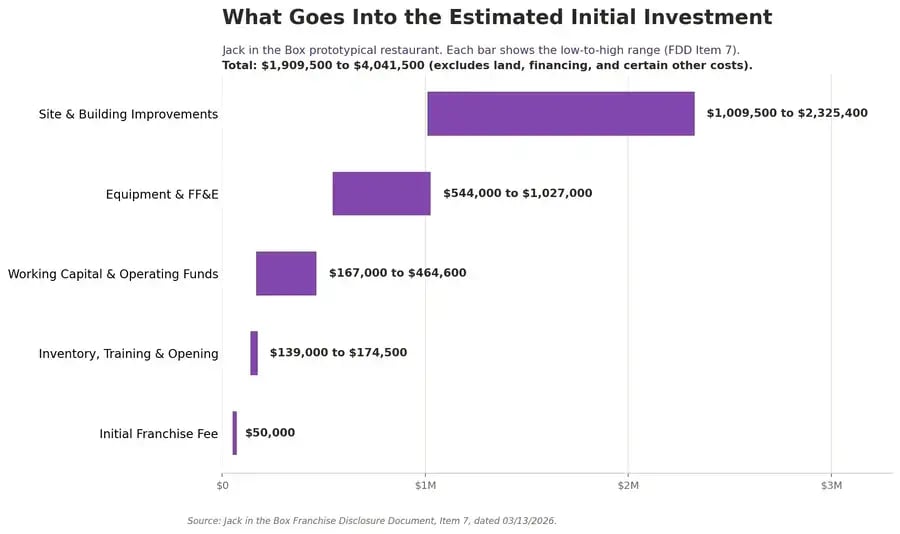
Land and financing costs are not included in that total, which is standard for Item 7 disclosures.
Item 7 of the FDD, the estimated initial investment, is the single best source. Items 5 and 6 list the fees you pay to the franchisor, and Item 8 describes suppliers you must use. The Federal Trade Commission requires the franchisor to give you the FDD before any agreement is signed. If you have never read one, our guide to the franchise disclosure document breaks down all 23 items.
Under Item 5, you will find the initial franchise fee, which is essentially a license to operate the business. It buys you access to the brand, the systems, real estate support, and training. At Jack in the Box, the initial franchise fee is $50,000 per traditional restaurant, due when you sign your franchise agreement, which is typically a 20-year contract.
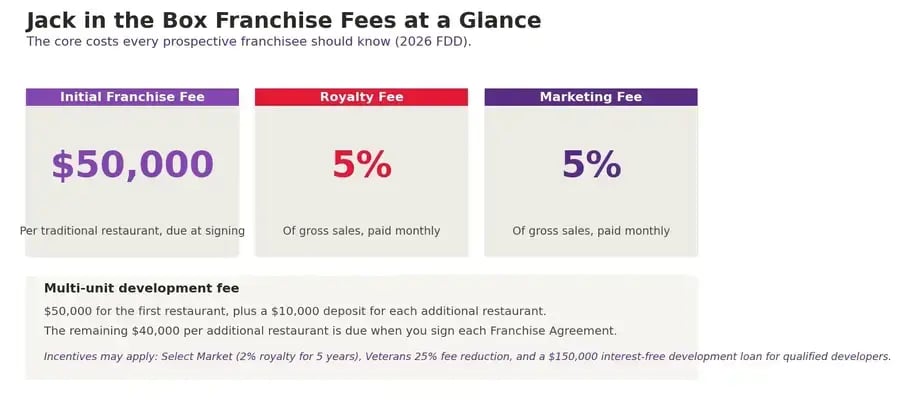
If you sign a multi-unit development agreement, the fee works like this: $50,000 for the first restaurant, plus a $10,000 deposit for each additional restaurant. The remaining $40,000 per additional restaurant is due when you sign each individual franchise agreement.
Once you are open, you pay ongoing fees that fund the brand, systems, and support you rely on. At Jack in the Box, that is a 5% royalty of gross sales and a 5% marketing fee of gross sales, both paid monthly. These are gross-sales fees, not a share of profit.
You do not need the full investment in cash. Most franchisees use some financing. Common routes include:
Each option carries its own risk, so talk to a financial advisor about what fits you. I work in marketing and development, not financial advising, so I keep that line clear.
Yes, and they are worth knowing before you sign:
These are offered at the company's discretion with specific requirements, all detailed in the FDD. For the full path from inquiry to opening, see how to buy a fast-food franchise, and for the cash side, our liquidity requirement guide.
The estimated initial investment for a prototypical restaurant is $1,909,500 to $4,041,500 per the 2026 FDD, excluding land and financing.
$50,000 per traditional restaurant, due at signing of the franchise agreement.
A 5% royalty and a 5% marketing fee, both on gross sales and paid monthly.
No. Most franchisees finance part of the investment through SBA loans, commercial loans, partners, or retirement rollovers.
In Item 7 of the franchise disclosure document, supported by the fee details in Items 5 and 6.
If you want to talk through investment, financing, and incentives for a specific market, reach out to our franchise team.
About the author: Dustin Thompson works in Franchise Marketing & Development at Jack in the Box, where he helps prospective franchisees understand the real costs of ownership. Learn more on his author page.