
How Much Does a Burger Franchise Cost? 2026 US Guide
Compare 2026 upfront investment costs for nine major US burger franchises, pulled straight from each brand's FDD Item 7, including Jack in the Box.
9 min read
By Dustin Thompson, Franchise Marketing and Development, Jack in the Box | Last updated August 24, 2026
I work in franchise marketing and development for Jack in the Box. A big part of my week is spent talking with people who are evaluating a QSR franchise for the first time. Many of them are professionals who recently left a corporate role, sometimes by choice and sometimes not.
Almost every one of them says a version of the same thing. The information is out there, but making sense of it feels overwhelming. They are right. QSR franchise investment evaluation is genuinely complex, and pretending otherwise does nobody any favors.
This article explains why the process feels so hard, what the financial, legal, and operational layers actually contain, and how to work through each one without getting lost. I will use real figures from our own 2026 Franchise Disclosure Document so you can see what disclosure looks like in practice.
It feels complicated because you are running three evaluations at the same time. You are underwriting an investment, reviewing a long legal relationship, and judging whether you can run a real operation with real employees. Each layer has its own documents, its own vocabulary, and its own risks.
In a corporate job, these functions live in different departments. Finance models the numbers. Legal reads the contracts. Operations runs the building. When you evaluate a quick-service restaurant franchise, you are all three departments, often for the first time.
I'm going to use a lot of references it "Items" and "FDD's". To learn more about this document, see my blog post about the Franchise Disclosure Document.
Here is the framework I walk candidates through when they tell me they feel stuck.
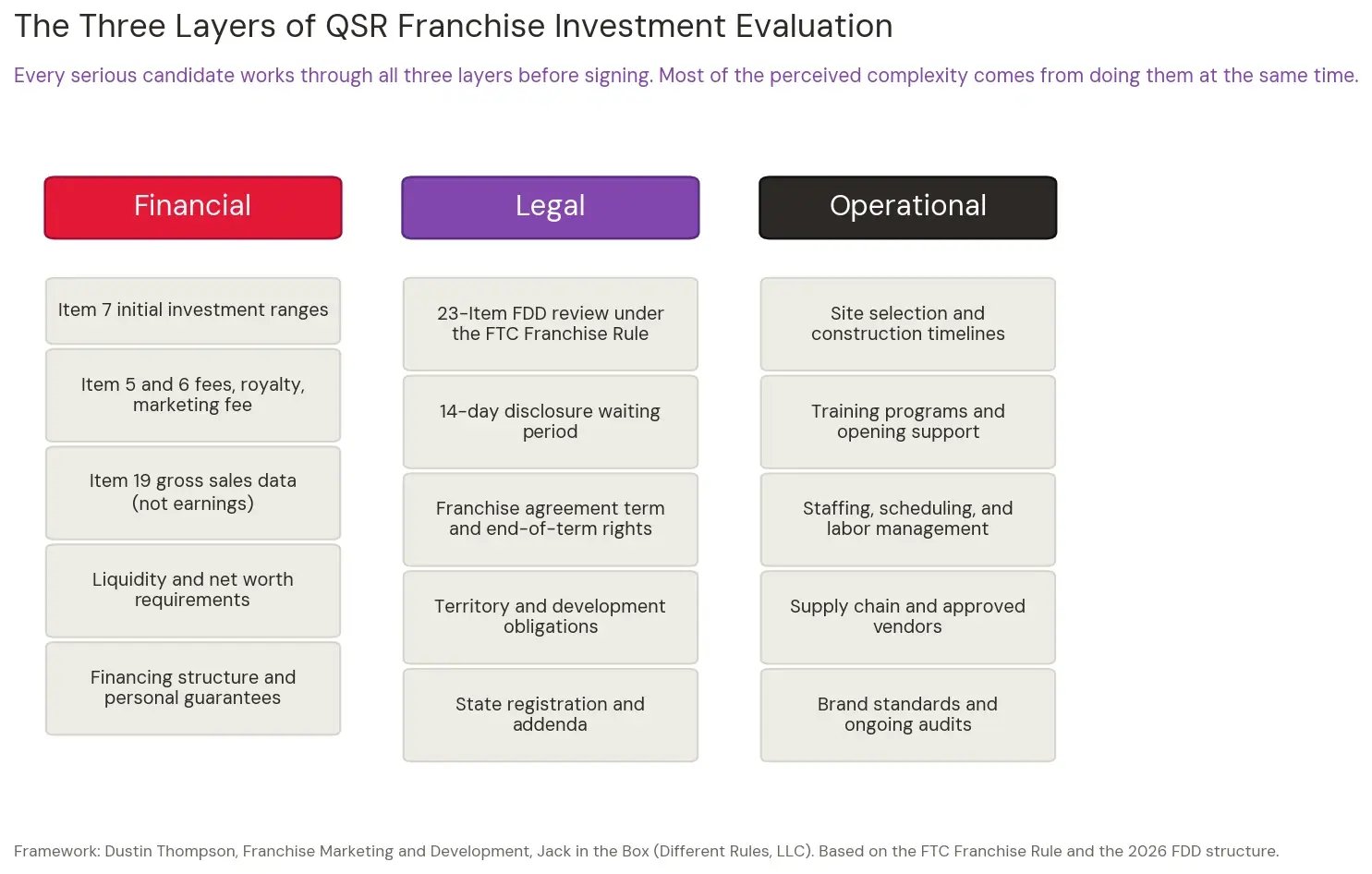
None of these tasks is impossible on its own. The complexity comes from stacking them. The good news is that the stack is predictable. Every legitimate franchisor in the United States follows the same disclosure structure, so once you learn to read one system, you can read them all.
The financial side is hard because honest numbers arrive as ranges, not price tags. Construction costs shift by market. Site work varies by parcel. Labor and inventory needs move with local conditions. A franchisor that quotes you one clean number is either guessing or simplifying.
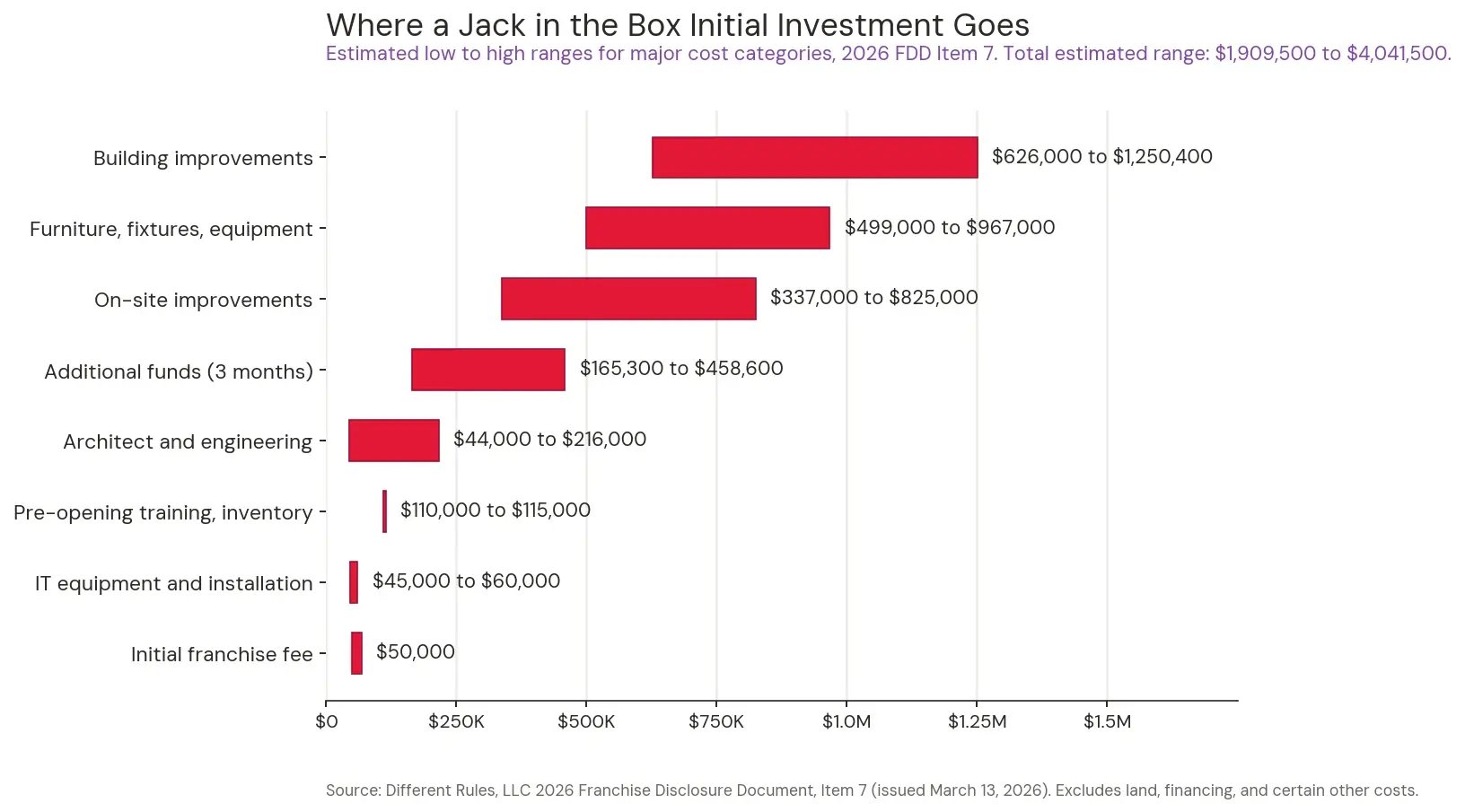
Take our own disclosure as an example. Item 7 of the 2026 Jack in the Box FDD estimates a total initial investment of $1,909,500 to $4,041,500 to build a new restaurant. That range excludes land, financing, and certain other costs. The spread between the low and high ends is more than two million dollars, and every line item behind it has its own range.
Beyond the build, you pay to stay in the system. At Jack in the Box, the initial franchise fee is $50,000. The ongoing royalty is 5% of gross sales, and the marketing fee is another 5% of gross sales. Ten percent of every sales dollar goes out the door before you touch food cost, labor, rent, or utilities. You need to model that from day one, not discover it in month three.
Item 19 is where a franchisor may share financial performance information, and it is the most misread section in the entire FDD. In our 2026 FDD, Item 19 reports that franchised Jack in the Box restaurants open during all of fiscal year 2025 averaged $1,913,335 in gross sales.
Read that carefully. Gross sales are not earnings, income, or profit. The figure says nothing about what an owner takes home after food, labor, occupancy, fees, and debt service. Some restaurants sold more than that average and many sold less. There is no assurance that any new restaurant, including yours, will reach similar results. Treat Item 19 as one input for your own modeling, not as a promise.
Most established QSR brands screen candidates for liquidity and net worth before serious conversations begin. Jack in the Box currently looks for $750,000 in liquid assets and $1,500,000 in net worth. Those thresholds exist because underfunded restaurants struggle even when the concept works. If you are close but not there, ask about financing structures and partnership models before ruling yourself out. Our franchise costs page breaks these requirements down further.
Financing adds one more layer. Many candidates use SBA-backed loans, and lenders check the SBA Franchise Directory when they evaluate franchise loan applications. Getting listed there is a franchisor task, but understanding how lenders read an FDD is very much a franchisee task.
The core legal document is the Franchise Disclosure Document. Federal law requires it, and its structure is standardized across every franchise system in the country. The FTC Franchise Rule, codified at 16 CFR Part 436, spells out 23 required Items covering everything from litigation history to fees to territory rights.
The rule also gives you time. You must receive the FDD at least 14 calendar days before you sign a binding agreement or pay any money to the franchisor. The FTC publishes a plain-language guide to reviewing an FDD that I recommend to every candidate, no matter which brand they are considering.
All 23 matter, but a few carry outsized weight for first-time buyers. Items 5, 6, and 7 define what you pay. Item 12 defines your territory rights. Item 17 defines the term of the agreement and what happens when it ends. Item 19 covers financial performance representations. Item 20 shows outlet openings and closings across the system.
Here is a detail people miss on Item 17. Franchise agreements do not run forever, and the end-of-term terms vary by brand. Under our current agreements, a franchisee has no automatic right of renewal. Any new franchise at the end of the term is at the company's sole discretion and requires signing the then-current agreement and paying the then-current fee. You should know terms like that before you sign, not twenty years later. Our franchise process page walks through where FDD review fits in the overall timeline.
One honest recommendation from someone inside a franchisor: hire a franchise attorney. Not a general business lawyer, a franchise attorney. The document is readable, but an experienced reviewer will catch obligations you will not, and the fee is small compared to the commitment.
Operational complexity shows up after the paperwork. You will select a site, manage a construction timeline, complete training, hire a team, and run a high-volume kitchen to brand standard. Each of those steps has requirements defined in the franchise agreement, and each one interacts with your financial model.
Site selection alone can stretch a timeline by months. Trade area analysis, permitting, and construction all sit partly outside your control. The Item 7 categories in the chart above, like on-site improvements and architect fees, exist because those steps are real and expensive.
Training is the piece that reassures most corporate professionals once they see it. Established systems teach operations from the ground up, and you should evaluate that support as carefully as the fees. Ask what initial training covers, who pays travel costs, and what field support looks like after opening. You can see how we approach it on our training and support page.
If you plan to build more than one restaurant, the operational layer multiplies. Development agreements add schedules and milestones on top of everything else. Our multi-unit development page explains how those commitments work.
Because the job market for white-collar workers has gotten rougher. Bureau of Labor Statistics data shows layoffs and discharges running at 1.8 million per month as of the June 2026 JOLTS release. Research from Indeed Hiring Lab found the layoff rate in professional and business services climbed to 2.4% from 1.7% over the year ending March 2026, one of the largest increases of any sector.
When a career that felt stable suddenly is not, people start asking what income security really means. Some pursue another corporate role. Others decide they would rather own the thing they work on. Franchising appeals to that second group because it pairs ownership with a documented operating system.
I want to be direct about franchise investment risk, because this audience deserves it. A franchise is not a paycheck replacement. It is a capital investment in a business you will have to run or actively manage, and businesses can lose money. If your severance is your only capital and you need income in ninety days, a QSR build is probably the wrong vehicle on that timeline. If you have the required capital, a longer runway, and a genuine interest in operations, it is worth a serious look. Our page on why candidates choose Jack in the Box covers what we think we do well.
Work the layers in sequence instead of all at once. Here is the order I suggest to candidates, based on watching hundreds of evaluations from the franchisor side.
Sometimes, and you should ask about them. Jack in the Box currently offers a Development Incentive that provides a $150,000 interest-free loan for qualifying developers who commit to three or more restaurants, and a Select Market Incentive that reduces the royalty to 2% for five years in certain markets we designate. Qualifying veterans may receive a 25% reduction on the initial franchise fee through our participation in VetFran, which you can read about on our veterans page.
Every one of these programs is subject to eligibility requirements, is offered at the company's sole discretion, and may be modified or discontinued. Confirm current terms in the FDD and with our team before you build them into your plan. The same advice applies to any brand's incentives, not just ours.
Bring these to every franchisor you evaluate, including us. The answers separate systems that respect candidates from systems that just close them.
A QSR franchise is a quick-service restaurant operated under license from a brand owner. The franchisee pays an initial fee and ongoing royalties in exchange for the brand, the menu, the operating system, and support. Burger, chicken, taco, and sandwich chains are the most common examples.
Plan on several months from first inquiry to signed agreement. Federal law requires at least 14 calendar days with the FDD before you sign or pay, but qualification, validation calls, advisor review, site work, and financing conversations usually take much longer. Rushing this stage is the most common mistake I see.
The 2026 FDD estimates $1,909,500 to $4,041,500 to build a new restaurant, excluding land, financing, and certain other costs. The initial franchise fee is $50,000, the royalty is 5% of gross sales, and the marketing fee is 5% of gross sales. Candidates currently need $750,000 in liquidity and $1,500,000 in net worth.
No. No legitimate franchisor can guarantee income, and you should walk away from anyone who implies otherwise. Item 19 of an FDD may share historical gross sales data, but gross sales are not profit and there is no assurance any new location will perform similarly. Franchise ownership is an investment with real risk, not a salary.
Requirements vary by brand. Many systems, including ours, weigh business management experience, capital, and market fit alongside restaurant background. Training programs exist to teach operations. What no training program can supply is capital, work ethic, and willingness to follow a system, so evaluate yourself on those first.
Start with the document, not the daydream. Request an FDD, read the FTC's consumer guidance, and put your own numbers in a spreadsheet. Complexity shrinks fast once it is organized into layers you can work one at a time.
If Jack in the Box is on your list, review our available markets, then reach out to our team. We will send you the current FDD and answer the hard questions directly, because candidates who evaluate carefully make better franchisees.
About the author: Dustin Thompson works in Franchise Marketing and Development for Jack in the Box, where he helps prospective franchisees understand the brand's development process, costs, and market opportunities. He writes about QSR franchising, franchise evaluation, and restaurant development for jackintheboxfranchising.com.
This article is for general information only and is not financial, legal, or tax advice. It is not an offer to sell a franchise. An offer can only be made through a Franchise Disclosure Document in states where properly registered. Nothing here is a financial performance representation. Figures cited from the 2026 Franchise Disclosure Document issued by Different Rules, LLC on March 13, 2026 reflect that document as of its issuance date; gross sales figures are historical system averages, do not represent earnings or profit, and there is no assurance that any franchisee will achieve similar results.