
Jack in the Box vs BurgerFi: Which Franchise Is Best?
Choosing between a Jack in the Box or BurgerFi franchise comes down to more than just burgers—it’s about market availability, investment structure,...
5 min read
Dustin Thompson Updated on August 31, 2026
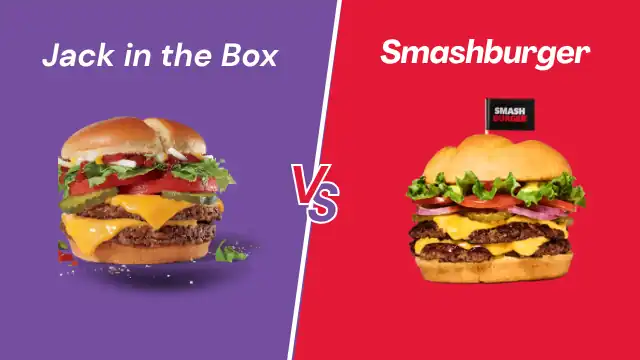
Both of these brands sell burgers. That is about where the similarity ends. Jack in the Box is a legacy quick-service drive-thru chain with more than 2,100 restaurants and a menu that runs around the clock. Smashburger is a fast-casual "better burger" concept, founded decades later, now owned by Jollibee Foods. They attract different operators, carry different cost structures, and report very different sales volumes.
If you are deciding between the two, here is the side-by-side, with the numbers pulled straight from the source documents.
| Factor | Jack in the Box | Smashburger |
|---|---|---|
| Founded | 1951 (franchising 1963) | 2007 (franchising 2008) |
| Concept | Quick-service, drive-thru-first | Fast-casual, better-burger |
| Owner | Jack in the Box Inc. (NASDAQ: JACK) | Jollibee Foods Corporation |
| Reported AUV | $1,913,335 (2025 FDD) | Not disclosed (no Item 19 representation in 2026 FDD) |
| Franchise fee | $50,000 (traditional) | $40,000 |
| Royalty | 5% | 5.5% |
| Marketing/ad royalty | 5% | 2.25% (up to 4%; 5% total marketing cap) |
| Net worth required | $1,500,000 | $2,000,000 |
| Liquidity required | $750,000 | $500,000 |
| Total investment | $1,909,500–$4,041,500 (build, excl. land) | $1,239,500-$2,255,500 |
| U.S. footprint | ~2,160 restaurants, 22 states | ~65 franchised U.S. locations (2025 FDD) |
The upfront franchise fee gap is modest. Jack in the Box charges $50,000 for a traditional restaurant; Smashburger charges $40,000. A $10,000 difference does not move the needle on a multimillion-dollar investment.
Smashburger adds a wrinkle for multi-unit operators. If you sign a Multi-Unit Development Agreement, you pay a development fee of $20,000 multiplied by the number of restaurants you commit to. The company credits that balance toward each franchise fee in $20,000 increments as you sign individual agreements. Its 2026 FDD notes that multi-unit developers typically commit to 2 to 25 restaurants over 3 to 11 years, which puts the typical development fee between $40,000 and $500,000.
The ongoing fees are where the structures separate. Jack in the Box runs a 5% royalty and a 5% marketing fee, for 10% off the top of gross sales. Smashburger runs a 5.5% royalty and a 2.25% marketing fund contribution that the franchisor can raise to as much as 4%, with all required marketing capped at 5% of gross sales. At the current rate, that is roughly 7.75% off the top.
On a percentage basis, Smashburger's total fee load looks lighter. But fees are a percentage of sales, and that is exactly where the comparison hits a wall.
Jack in the Box reported a 2025 franchise AUV of $1,913,335 in its 2026 FDD, broken out by performance tier in Item 19.
Smashburger's 2026 FDD makes no financial performance representation. Item 19 states that the company does not make any representations about a franchisee's future or past financial performance. There is no average unit volume, no median, no high or low. If you have seen a Smashburger AUV figure floating around (older write-ups cited roughly $942,000), understand that it came from an earlier FDD and is not supported by the current document.
This matters more than any fee comparison. When a franchisor declines to disclose Item 19 sales data, your only reliable path is to call existing franchisees directly. The brand must provide a franchisee contact list in Item 20 of the FDD. Make those calls and ask about real unit volumes before you model anything.
We are not characterizing what Smashburger's sales are, because the company does not disclose them. We are pointing out that the absence of an Item 19 representation changes how you do diligence.
The 2026 Smashburger FDD shows a system that is shrinking, and that is a fact worth weighing.
Franchised U.S. Smashburger restaurants fell from 78 at the start of 2024 to 65 by the end of that year. Total system restaurants (franchised plus company-owned) dropped from 194 to 172 over the course of 2025. The FDD also notes franchised locations that ceased operations in the most recent period.
Jack in the Box, by contrast, operates roughly 2,160 restaurants across 22 states and is actively recruiting multi-unit developers.
A contracting system is not automatically disqualifying, and a growing system is not automatically safe. But unit counts are a real signal about brand momentum, and you should ask both brands about their development pipeline and closure trends before committing.
Jack in the Box is built around the drive-thru, and our restaurants serve all dayparts, including late night. The menu spans burgers, tacos, breakfast items, specialty sandwiches, and sides, which spreads revenue across more parts of the day.
Smashburger is a fast-casual concept with a burger-forward, made-to-order menu and a dine-in component. Its revenue mix concentrates around lunch and dinner.
Neither model is "right." A drive-thru, all-daypart operation and a focused fast-casual lunch-and-dinner operation are different businesses with different labor models, real estate needs, and traffic patterns. Match the model to the markets and sites you can actually secure.
Smashburger tends to fit operators who want a fast-casual footprint, a focused menu, and a lower total build cost, and who can meet the higher $2M net worth bar. It is owned by Jollibee Foods, a large global parent that brings scale to supply and brand support. Prospective owners should weigh that backing against the system's recent contraction and the lack of disclosed sales data.
Jack in the Box tends to fit multi-unit operators who want an established drive-thru system, all-daypart revenue, disclosed Item 19 sales data, and a footprint backed by a publicly traded company. Our standard path is a three-to-five-restaurant development commitment, and we offer incentive programs in newer markets that can reduce the royalty rate for a defined period.
Is Jack in the Box or Smashburger cheaper to open? Smashburger's total investment ranges generally run lower than Jack in the Box's, and its franchise fee is $40,000 versus $50,000. Jack in the Box's FDD lists a total investment of $1,909,500 to $4,041,500 for a restaurant you build, excluding land.
Which has higher average sales, Jack in the Box or Smashburger? Jack in the Box reported a 2025 franchise AUV of $1,913,335. Smashburger's did not report AUV in their 2026 FDD.
What are the royalty fees for each? Jack in the Box charges a 5% royalty plus a 5% marketing fee. Smashburger charges a 5.5% royalty plus a 2.25% marketing contribution that can rise to 4%.
Do both require multi-unit ownership? Both target multi-unit operators. Jack in the Box centers on a three-to-five-restaurant development commitment. Smashburger recruits multi-unit development partners as well.
Who owns Smashburger? Smashburger is owned by Jollibee Foods Corporation, which acquired full ownership in 2018.
If you want a lower-cost, fast-casual, lunch-and-dinner concept and you can clear a $2M net worth, Smashburger is worth a serious look. If you want an established drive-thru system with all-daypart revenue, higher reported average sales, and a multi-unit development path backed by a public company, Jack in the Box is built for that. Pull both FDDs, compare Item 19 against your target market, and model the after-cost economics for yourself.
By the Jack in the Box Franchise Development Team. All figures come from each brand's Franchise Disclosure Document and published franchising materials available as of mid-2026. Verify against the current FDD before investing.
Choosing between a Jack in the Box or BurgerFi franchise comes down to more than just burgers—it’s about market availability, investment structure,...
This is a comparison of scale versus accessibility. Jack in the Box is a legacy quick-service chain with more than 2,100 restaurants and a...
ByDustin Thompson, Franchise Marketing & Development at Jack in the Box