
Which Chicken Franchise Makes the Most Money? (2026)
Compare 2026 AUVs for Chick-fil-A, Wingstop, Popeyes, and more. See how Jack in the Box stacks up for multi-unit franchise investors.
7 min read
%20of%20Jack%20in%20the%20Box%20in%202026%20WebP.webp)
By Dustin Thompson, Franchise Marketing & Development, Jack in the Box · Last updated: June 17, 2026 · ~7 min read
Are you trying to figure out how much a Jack in the Box restaurant brings in?
You are in good company. After more than a decade working with prospective franchisees, I can tell you the AUV question comes up earlier and more often than almost any other. People want a real number before they spend a single weekend reading a disclosure document.
So here is the real number, where it comes from, what it does and does not mean, and how to read it the way an experienced operator would. I pulled everything below straight from our current FDD, and I will show you exactly where each figure lives.
Average unit volume is the total gross sales of a group of restaurants divided by the number of restaurants in that group. That is the whole formula
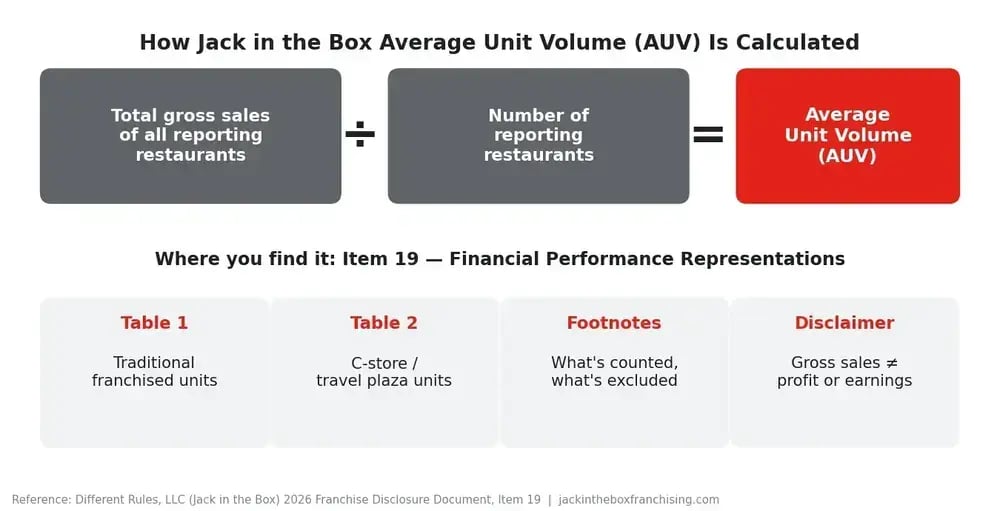
Every franchisor that publishes sales data does it in Item 19 of the FDD, which the FTC calls the Financial Performance Representation. If you have never opened one, our walkthrough on understanding the Jack in the Box FDD is a good place to start.
Here is the part people skip and later regret: AUV measures sales, not profit. The FTC's own consumer guide puts it bluntly, noting that buying a franchise is like any other investment and there is no guarantee of success. A franchisor is not allowed to tell you what you will earn. AUV simply shows what a set of restaurants sold during a measured period.
Read the footnotes too. One brand might count only restaurants open a full year. Another might fold in every location, new and old. Two AUVs can look identical and describe completely different things. The footnotes under each Item 19 table tell you who was counted and what was left out.
The average unit volume of Jack in the Box is $1,913,335. That figure comes from Table 1 of our 2026 FDD, Item 19, covering the 12 months ended September 30, 2025. It reflects traditional franchised restaurants in the continental United States.
A single average can hide a lot, so Item 19 also breaks the system into thirds. Here is how FY2025 looked across those tiers, with the system median marked for reference.
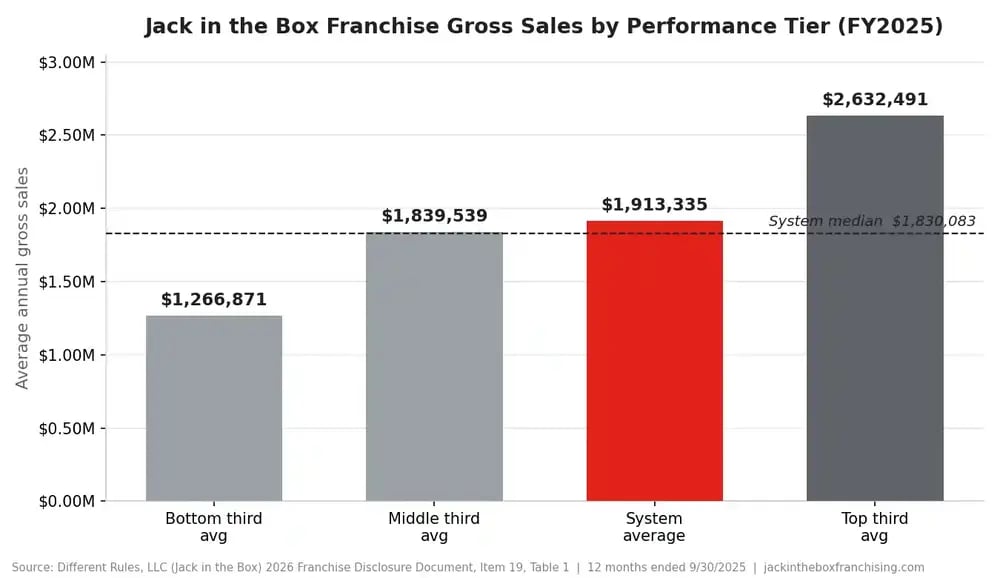
A few things worth pulling out of that chart, straight from the table:
That spread is the point. Restaurants are not interchangeable. Trade area, drive-thru access, daypart mix, real estate, and the operator behind the counter all move the number. I am not going to tell you what any of that predicts for a specific site, because the data does not say that and the FDD does not let me.
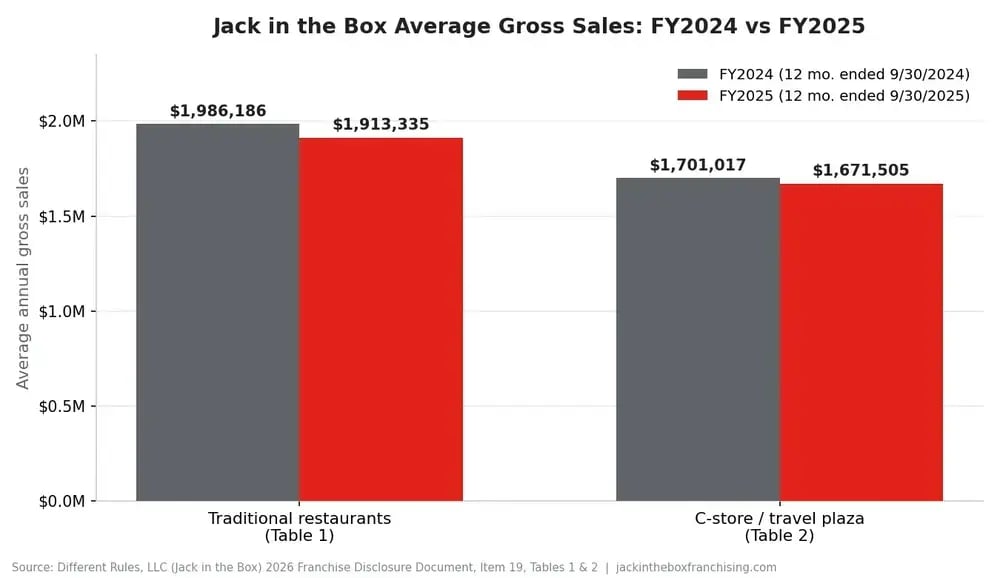
Our FDD reports two fiscal years side by side, which makes the year-over-year picture easy to see. The chart below puts FY2024 next to FY2025 for both traditional restaurants and convenience-store / travel-plaza restaurants.
| Restaurant type | FY2024 average gross sales | FY2025 average gross sales |
|---|---|---|
| Traditional franchised (Table 1) | $1,986,186 | $1,913,335 |
| C-store / travel plaza (Table 2) | $1,701,017 | $1,671,505 |
Source: Jack in the Box 2026 FDD, Item 19, Tables 1 and 2. Periods ended September 30, 2024 and September 30, 2025.
The traditional-restaurant sample covered 1,786 restaurants in FY2024 and 1,754 in FY2025. The figures are what they are, reported directly from the disclosure document. I would encourage you to look at both years yourself rather than treat any single number as the whole story.
Yes, and this trips people up. A Jack in the Box inside a truck stop or attached to a convenience store operates differently from a freestanding drive-thru, so we report it in a separate table.
For FY2025, those C-store and travel-plaza restaurants averaged $1,671,505 in gross sales, with a median of $1,575,659, a high of $3,248,651, and a low of $478,030 across 80 reporting restaurants. If a Convenience Store or Travel Plaza location is what you are weighing, that is the table to study, not Table 1.
This matters more than it sounds, because the definition is what the whole AUV is built on. In our FDD, "gross sales" means all revenue from products and services, including delivery and catering, plus vending and similar sources, and other income tied to the restaurant. Redeemed gift cards count when they are redeemed, not when they are bought. Certain amounts are excluded.
So the AUV captures the full top line a restaurant rings up, across every channel. It does not net out food cost, labor, rent, royalties, or anything else. Keep that framing in your head every time you see the word "AUV."
Nothing, and that is by design. I want to be direct here because it protects you.
Here is the exact language attached to our Financial Performance Representation:
Some outlets have earned these amounts. Your individual results may differ. There is no assurance you will earn as much.
That sentence is not boilerplate to skim past. It is the rule. Any salesperson, broker, or blog that hands you an AUV and then promises profit is doing something the FTC prohibits. The honest use of AUV is as a benchmark for sales, combined with your own diligence on costs.
After years of these conversations, here is the approach I give every candidate who asks me to be straight with them:
If you want a deeper comparison across the category, our breakdown of which burger franchise makes the most money walks through how to read competing Item 19 disclosures without getting fooled by formatting tricks.
The estimated initial investment for a Jack in the Box franchise is $1,910,500 to $4,032,100, excluding land, financing, and certain other costs. The full breakdown lives in Item 7 of the FDD and includes the initial franchise fee, building improvements, opening inventory, and several months of operating funds.
Land is the wild card. Cost swings widely based on size, location, and whether you buy or lease.
Like most franchise systems, yes. Our ongoing fees are:
Those fees fund the brand, the marketing engine, and the support behind your restaurant. They are calculated on gross sales, which is the same base the AUV figure uses, so the connection between the two is direct.
Because of what it takes to open and run a restaurant, we hold every candidate to three minimum financial requirements:
If you are close but not quite there, people often overlook sources of liquidity such as partners, local banks and credit unions, securities, and 401(k) rollovers. Our guide to the best ways to finance a franchise covers those routes in detail. Multi-unit operators have their own path worth exploring on our multi-unit franchise opportunity page.
What is the AUV of Jack in the Box? The average unit volume of Jack in the Box is $1,913,335 in average annual gross sales, reported in Table 1 of the 2026 FDD, Item 19, for the 12 months ended September 30, 2025.
Is AUV the same as profit? No. AUV is total gross sales divided by the number of reporting restaurants. It does not subtract food cost, labor, rent, royalties, or any other expense. The FTC prohibits franchisors from promising earnings.
Where does the Jack in the Box AUV number come from? Item 19 of the Jack in the Box Franchise Disclosure Document, specifically Table 1 for traditional restaurants and Table 2 for convenience-store and travel-plaza restaurants.
Why is the 2026 figure based on a 2025 fiscal year? Our 2026 FDD reports the most recently completed fiscal years. The latest full period ran through September 30, 2025, so that is the data published in the current document.
What was the highest and lowest restaurant sales figure? For traditional franchised restaurants in FY2025, the high was $5,882,584 and the low was $624,106. Individual results vary widely.
I hope this gives you a clear, honest read on Jack in the Box AUV and how to use it. The number is useful. It is also only one line of a much larger picture, and the people who do well with it are the ones who treat it as a starting point for their own math.
A few resources worth your time next:
Have a question about any figure above? Reach out to our franchise development team and ask. I would rather you get a straight answer than guess.
Dustin Thompson leads Franchise Marketing & Development for Jack in the Box franchising. He works directly with prospective and current franchisees across the United States, walks candidates through the Franchise Disclosure Document, and spends his days helping operators understand the numbers behind a Jack in the Box restaurant. He reads our FDD cover to cover every year so the people he talks to do not have to. Learn more about Dustin and connect with him here.
Data in this article is sourced from the Jack in the Box 2026 Franchise Disclosure Document, Item 19 (fiscal periods ended September 30, 2024 and September 30, 2025). This article is for educational purposes and is not an offer to sell a franchise. An offer can be made only through delivery of a Franchise Disclosure Document.