
How to Open a Restaurant Franchise (2026 Guide)
How to open a restaurant franchise in 2026: real costs, the FDD, financing, site selection and the exact steps from a franchise pro.
4 min read
By Dustin Thompson, Franchise Marketing and Development, Jack in the Box
Last updated: June 22, 2026
Key takeaways
I'm Dustin Thompson. I work in Franchise Marketing and Development at Jack in the Box, and I read our Franchise Disclosure Document more than almost anyone. When people email our team, one number comes up more than any other: average unit volume.
It sounds like jargon. It is not. Once you know what it means, you can size up almost any franchise in a few minutes.
Let me walk you through it.
Average unit volume is the average yearly sales of a single location in a franchise system.
You take the total sales from every location. Then you divide that total by the number of locations. The answer is the AUV.
Here is a simple version. Say a brand has 10 locations. Together they bring in $10 million in a year. Divide $10 million by 10. The AUV is $1 million.
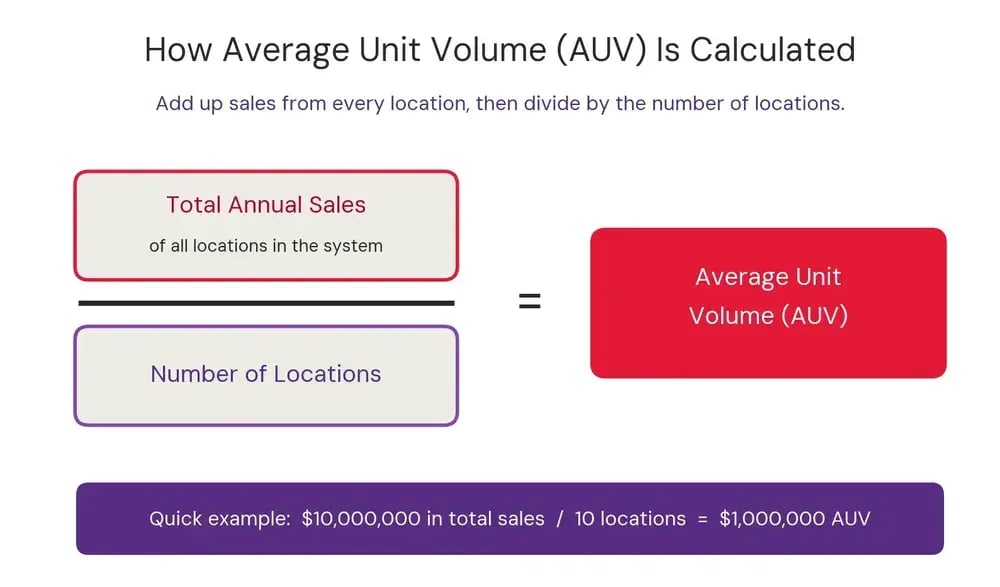
That is the whole formula. No tricks.
AUV gives you a quick way to compare brands in the same space.
If you are looking at two burger brands, AUV lets you line them up side by side. It is one of the first numbers I point people to when they ask how much it costs to buy a franchise and what kind of sales a location tends to bring in.
But here is the part people miss. AUV is a starting point, not the finish line. A high AUV can mean strong demand for a brand. It can also come with high costs. You still need to look at fees, rent, labor, and your local market before you decide.
No. AUV is gross sales. It is not profit.
This is the most important thing on this page, so I will say it plainly. Gross sales is the money that comes in. Profit is what is left after you pay for food, staff, rent, royalties, and everything else.
Two brands can have the same AUV and very different profit. Costs are what split them apart.
There is also a rule behind this. The Federal Trade Commission does not let any franchisor promise you earnings or profit. The FTC's Consumer's Guide to Buying a Franchise spells it out. Any sales or earnings claim a brand makes has to live in one place: Item 19 of the FDD. If someone tells you a profit number that is not in Item 19, treat it as a red flag. The FTC says the same thing in its Franchise Fundamentals guidance.
You find it in Item 19 of the Franchise Disclosure Document.
The FDD is the legal document every franchisor must give you before you sign or pay anything. If you want the full breakdown, we wrote a separate guide on what a Franchise Disclosure Document is.
Item 19 is the financial section. When a brand shares sales data, it shows up here, usually as a table with a few years of numbers and footnotes that explain them.
Read those footnotes. I cannot stress this enough. One brand might count only locations open for a full year. Another might include every location. Some count delivery and catering. Some do not. If you skip the footnotes, you are comparing two numbers that were never built the same way.
Gross sales means almost all the money a location brings in.
For us, that covers sales of all products and services. It includes delivery and catering. It includes gift cards when someone uses them, not when someone buys them. It also includes things like business interruption insurance and money from off-site events. A few items are left out.
The point is simple: gross sales is a wide number. Profit is a narrow one.
A lot of things move this number up or down. Here are the ones I see matter most:
If you are weighing a few brands, ask each one about its AUV and what drives it. The good ones will walk you through it.
Jack in the Box reports a system average gross sales figure of $1,913,335 in Item 19, Table 1 of our 2026 FDD.
That figure covers the 12 months ended September 30, 2025. The same table reports $1,986,186 for the 12 months ended September 30, 2024. Both are gross sales numbers, not profit.
Item 19 also breaks the data into tiers. Here is how the top, middle, and bottom groups looked for the most recent period.
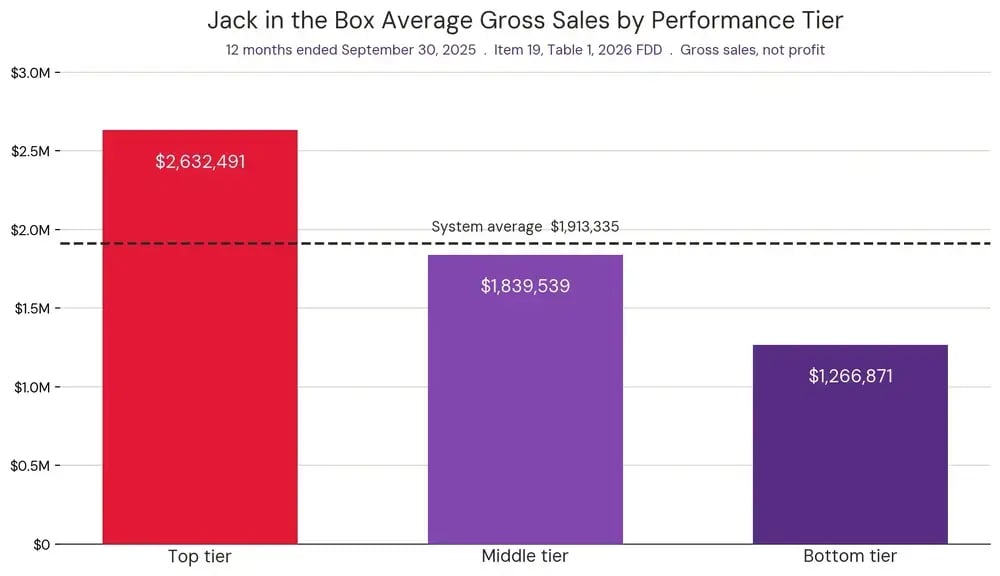
I share this tier view because the single average can hide a lot. Sales sit across a wide range. Your own results would depend on your location, your costs, and how you run the business. The FTC rule is the reason I keep repeating that point, and it is the honest one.
Use AUV as one tool, not the only tool.
Here is the approach I give people who are just getting started:
This is also a smart habit when you are shopping the wider market. The franchise sector is large. The International Franchise Association projects franchising output above $921 billion in 2026, with the Southeast and Southwest growing fastest, per its 2026 Franchising Economic Outlook. A lot of brands are competing for your investment. AUV helps you tell them apart.
If burgers are your focus, our guide to the best burger businesses to start puts a few side by side. And if you are new to the whole process, start with how to buy a fast-food franchise.
Average unit volume is the average yearly gross sales of one location. You find it in Item 19. It is a great way to compare brands, as long as you remember it is sales, not profit, and you read the footnotes.
I look at this number every week as part of my work at Jack in the Box, and I am happy to walk you through ours line by line.
Have questions about our Item 19 or anything in our FDD? Contact our franchise team and we will help.