


7 Best Hotel Franchises in the USA (2026 Comparison)
Compare the 7 best hotel franchises in the USA for 2026 with current property counts, plus how hotel operators size up a QSR franchise as a next move.
6 min read
By Dustin Thompson, Franchise Marketing & Development, Jack in the Box | Last updated June 11, 2026
Diversifying a franchise portfolio means adding brands that do not compete with what you already own, often in a different industry or daypart.
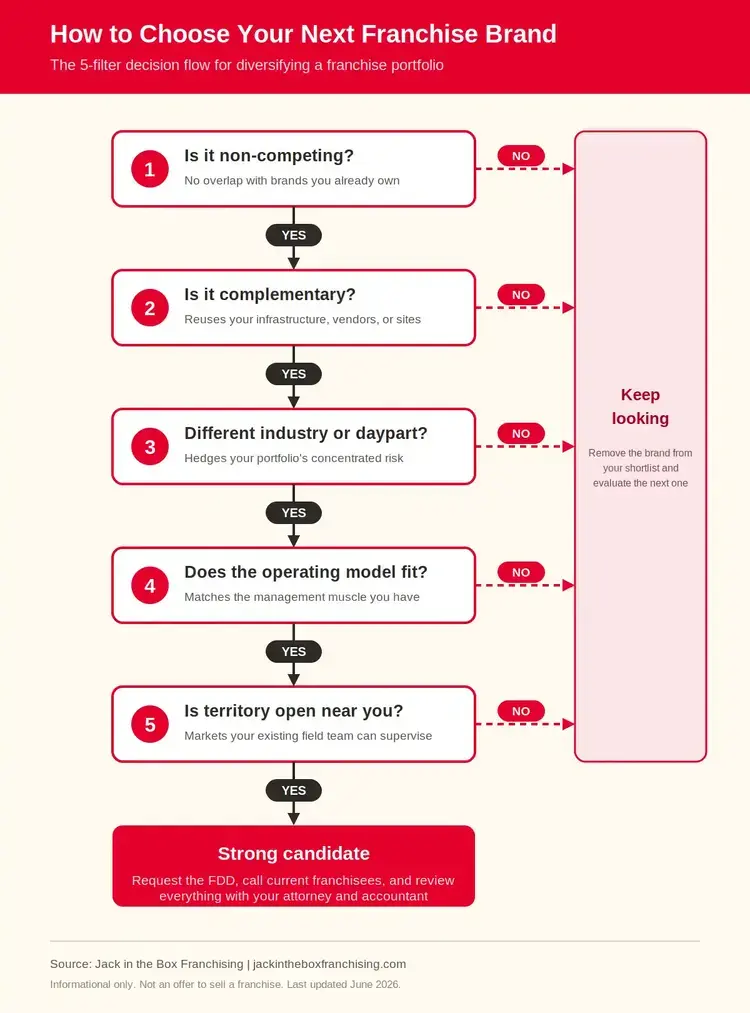
The five most common vetting filters are non-competing brands, complementary brands, different industries, similar operational models, and open territory in your existing footprint.
The International Franchise Association projects more than 12,000 new franchised businesses will open in 2026, with total establishments expected to reach roughly 845,000.
Most franchisors restrict ownership of direct competitors, so review the non-compete language in any Franchise Disclosure Document (FDD) before you sign.
Jack in the Box offers single unit and multi-unit development agreements. Details on fees, training, and obligations are disclosed in our 2026 FDD, and you should review that document with your own advisors before making any decision.
No franchise investment carries a guarantee. Diversification is a risk management strategy, not a promise of results.
I work in franchise development at Jack in the Box. A big part of my week is spent talking with multi-unit operators who already own brands in fitness, automotive, home services, or other restaurant categories and are deciding what to add next.
The same question comes up in almost every one of those conversations: "How do I add a brand without cannibalizing what I already have?"
That question is what this article answers. I'll walk through why operators diversify, how to vet a new brand, and what the process looks like if a burger QSR ends up on your shortlist. Where I cite numbers, they come from published industry research or from our own 2026 Franchise Disclosure Document, and I'll link to both.
One disclosure up front: I work for the franchisor. Read this the way you'd read anything written by someone with a stake in the outcome, and verify everything independently.
Concentration is the risk. If your entire portfolio sits in one brand or one industry, a single supply chain disruption, labor shift, or consumer trend can hit every unit you own at the same time.
Spreading ownership across non-competing brands or industries means those forces are less likely to hit everything at once. A slowdown in one category may not move the needle in another. That's the entire logic of diversification, and it works the same way in franchising as it does in any other investment context.
There's a second reason operators diversify that gets less attention: infrastructure reuse. If you already run back-office accounting, HR, payroll, and local marketing for ten units, adding a brand that plugs into that same infrastructure costs less to absorb than building from zero.
The industry backdrop matters too. According to the International Franchise Association's 2026 Franchising Economic Outlook, prepared by FRANdata, franchise establishments are projected to grow about 1.5% this year, from 832,521 to roughly 845,000 units, with more than 12,000 new franchised businesses expected to open. The report also projects franchise economic output rising 1.6% to about $921 billion. Those are projections, not guarantees, but they describe a sector that continues to add units.
|
2025 vs 2026 |
|
|
Projected Franchise Establishments
|
Economic output (US$ billions)
|
Source: IFA 2026 Franchising Economic Outlook, prepared by FRANdata
There's no single template, but the portfolios I see most often from experienced multi-unit operators tend to mix along one or more of these axes:
|
Diversification Axis |
Example Pairing |
What It Hedges Against |
|---|---|---|
|
Industry |
Gym + quick-service restaurant |
A downturn concentrated in one sector |
|
Daypart |
Breakfast-heavy concept + late-night concept |
Traffic shifts within the day |
|
Price point |
Premium service brand + value-oriented QSR |
Changes in consumer spending behavior |
|
Real estate type |
Inline retail + freestanding drive-thru |
Shifts in how customers access businesses |
|
Customer base |
B2B services + consumer-facing food |
Weakness in one demand source |
The common thread: none of these pairings put two brands in direct competition with each other. That brings us to vetting.
Here are the five filters I'd apply, in roughly the order most operators apply them.
This one isn't optional. Most franchise agreements, ours included, contain restrictions on owning competing concepts. If you own a burger brand, another burger brand is almost certainly off the table. Review Item 17 and the covenant language in any FDD you're considering, and have a franchise attorney confirm what "competing" means under that specific contract.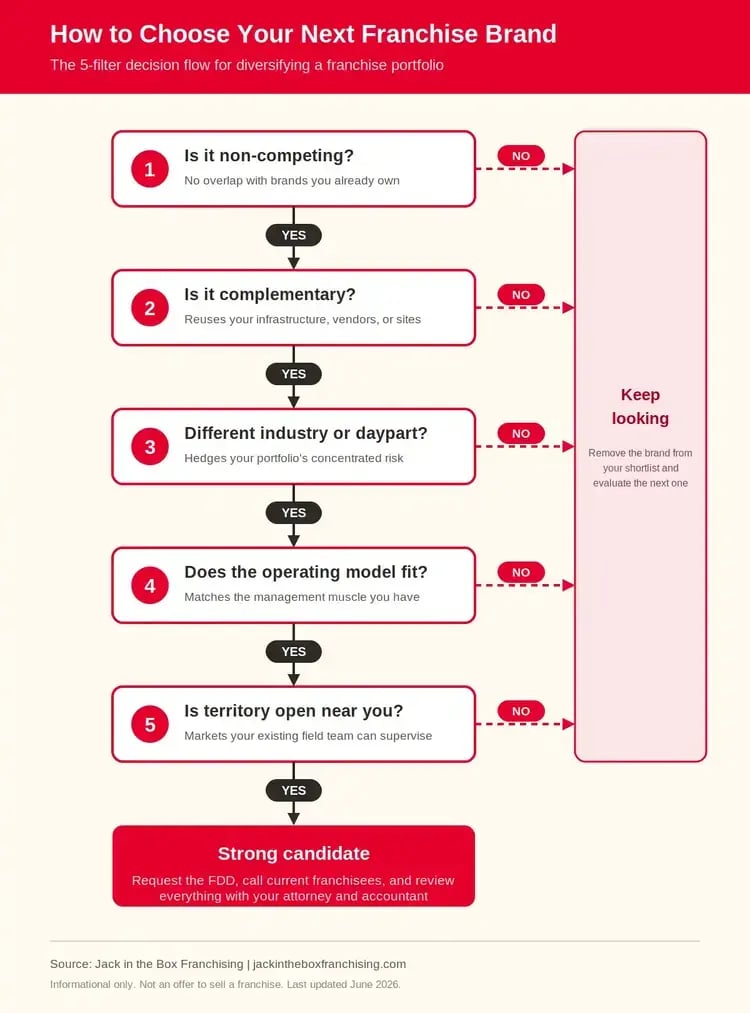
Complementary doesn't mean similar. It means the new brand benefits from something you already have: your real estate relationships, your district managers, your vendor accounts, your knowledge of local trade areas. A QSR and a car wash don't share a menu, but they often share site selection criteria and a drive-thru-oriented customer.
If your current holdings are concentrated in services, food can act as a counterweight, and vice versa. The IFA's 2026 Outlook noted that child services and commercial and residential services are projected as the fastest-growing franchise categories this year, which tells you growth isn't confined to any one sector. Different industries respond to different pressures. That's the hedge.
A multi-unit restaurant operator already understands shift scheduling, food safety compliance, throughput, and labor management. Adding a second restaurant concept in a non-competing category lets you reuse that expertise. Adding a concept with a completely foreign operating model means building new capabilities from scratch, which is a real cost even when it's the right call.
Density is an underrated advantage. If a brand has available development territory in markets where you already operate, you can supervise new units with the field team you already pay. Ask every franchisor you talk to for a current territory availability map before you go deep on anything else.
Beyond those five filters, do the unglamorous work: read the full FDD, call existing franchisees listed in Item 20, review the franchisor's litigation history in Item 3, and study local demographics and competition for any market you'd enter. The FTC's consumer guide to buying a franchise is a genuinely useful checklist for this stage, and the SBA's franchise guidance covers financing-related due diligence.
If your current portfolio doesn't include a burger QSR, here's what I can tell you factually about ours. Everything below is disclosed in greater detail in our 2026 Franchise Disclosure Document, issued March 13, 2026, and that document, not this article, is what you should rely on.
Brand recognition. Jack in the Box has operated since 1951 and is a long-established name in the quick-service category.
A broad menu across dayparts. The menu spans burgers, chicken, tacos, breakfast served all day, and late-night offerings. For operators thinking about daypart diversification, that range is part of the evaluation.
Drive-thru orientation. Our restaurant model is built around drive-thru service, supplemented by digital ordering through the Jack app and third-party delivery platforms.
Structured training. Per our 2026 FDD, new franchise operators complete a proficiency-based training program of approximately ten to fourteen weeks, and each restaurant must be staffed by at least one Certified Franchise Restaurant Manager who has completed our manager training program. Training cost for the operator and one manager per restaurant is included in the initial franchise fee; travel and living expenses are not.
Single and multi-unit paths. We offer Single Unit Development Agreements and Multi-Unit Development Agreements covering a defined development area. The initial franchise fee is $50,000 per restaurant under a 20-year franchise agreement, with full fee, royalty, and obligation details in Items 5 through 7 of the FDD.
What I won't do here is tell you what a Jack in the Box restaurant earns or imply that adding one guarantees anything. Franchise performance varies by operator, market, and many factors outside anyone's control. Review the FDD with a franchise attorney and an accountant, talk to current franchisees, and make your own judgment.
Worth saying plainly, because most franchisor content skips it.
Adding a brand stretches your attention. Every new concept has its own systems, its own field support cadence, and its own learning curve, and your existing units don't pause while you climb it. Operators who diversify well usually have strong unit-level leadership in place first, so the new brand isn't borrowing management hours the old brands still need.
Capital is the other constraint. Development schedules in multi-unit agreements carry real obligations, including compliance dates for opening restaurants. Take on a schedule your balance sheet can absorb even if conditions tighten, not the schedule that looks best in a good year.
If either of those gives you pause, that's information. Diversification is a strategy, not a deadline.
Can I own two competing franchise brands at the same time? Usually not. Most franchise agreements restrict ownership of directly competing concepts. Check the non-compete covenants in each brand's FDD and confirm with a franchise attorney.
How many brands should a franchise portfolio have? There's no correct number. The constraint is management capacity and capital, not brand count. Many operators run two or three non-competing brands; some run more with dedicated leadership per brand.
Is the restaurant industry a good diversification target in 2026? That depends on your existing holdings and risk profile. The IFA's 2026 Outlook projects continued unit growth across the franchise sector broadly. Evaluate any specific brand through its FDD and conversations with its current franchisees.
Where can I read the Jack in the Box FDD? Request it through our franchising team. We issued our current FDD on March 13, 2026, and federal law requires you receive it at least 14 days before signing any agreement or paying any fee.
Dustin Thompson works in Franchise Marketing and Development at Jack in the Box, where he talks daily with single-unit and multi-unit candidates evaluating the brand. This article reflects published industry research and disclosures from the company's 2026 Franchise Disclosure Document. It is informational only and is not an offer to sell a franchise; offers are made only through an FDD in compliance with applicable law.
Want to see whether your market has open territory? Start a conversation with our development team.