
The 12 Best Chicken Franchises to Own in 2026
Compare the 12 best chicken franchises to own in 2026, with investment data, growth trends, and insider insight from Jack in the Box.
6 min read
By Dustin Thompson, Franchise Marketing and Development, Jack in the Box
Originally published October 30, 2025. Last updated July 13, 2026 with figures from the 2026 Franchise Disclosure Document.
Jack in the Box is a strong franchise to consider because it combines scale, daypart coverage, and menu range in a way few QSR brands can match. It is the 5th largest burger franchise in the country by systemwide sales. Most locations run 24 hours a day. The full menu is available at every hour a restaurant is open. And the brand sells burgers, chicken, and tacos under one roof, which puts it in three of the largest fast food categories at once.
I work in franchise marketing and development at Jack in the Box, so I spend my days talking with multi-unit operators who are comparing burger brands side by side. This post covers the questions I hear most often, and every Jack in the Box figure in it comes straight from our current Franchise Disclosure Document, issued March 13, 2026. I updated this article in July 2026 to replace the older figures from the original version.
Average unit volume, or AUV, is the metric most candidates use to compare fast food brands. It measures average gross sales per restaurant. It is a uniform yardstick, but it is important to be clear about what it is not: AUV is not profitability, and gross sales figures say nothing about what an individual owner will earn. Costs, rent, labor, and market conditions differ from restaurant to restaurant.
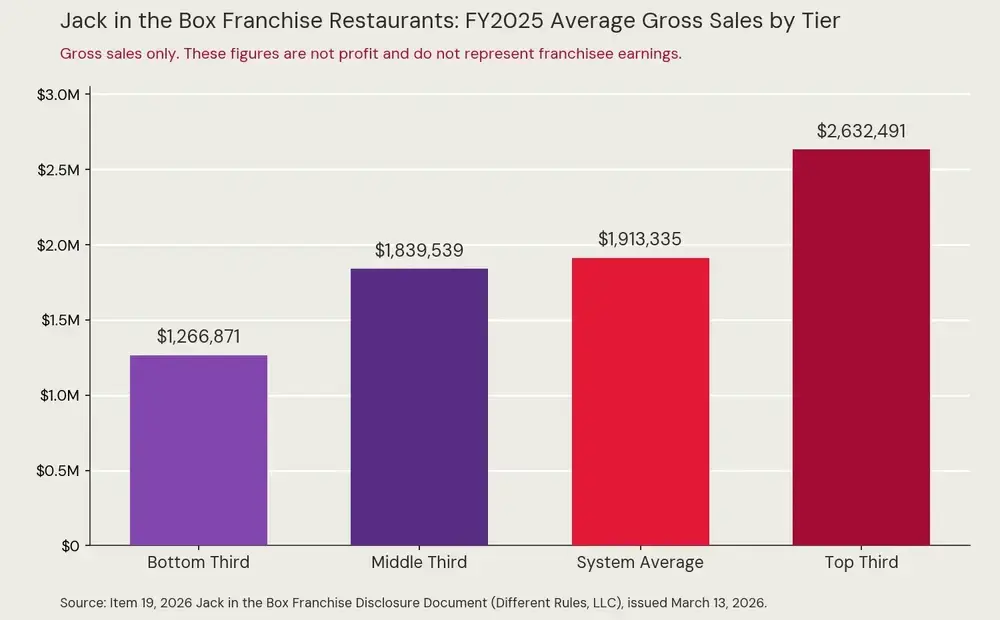
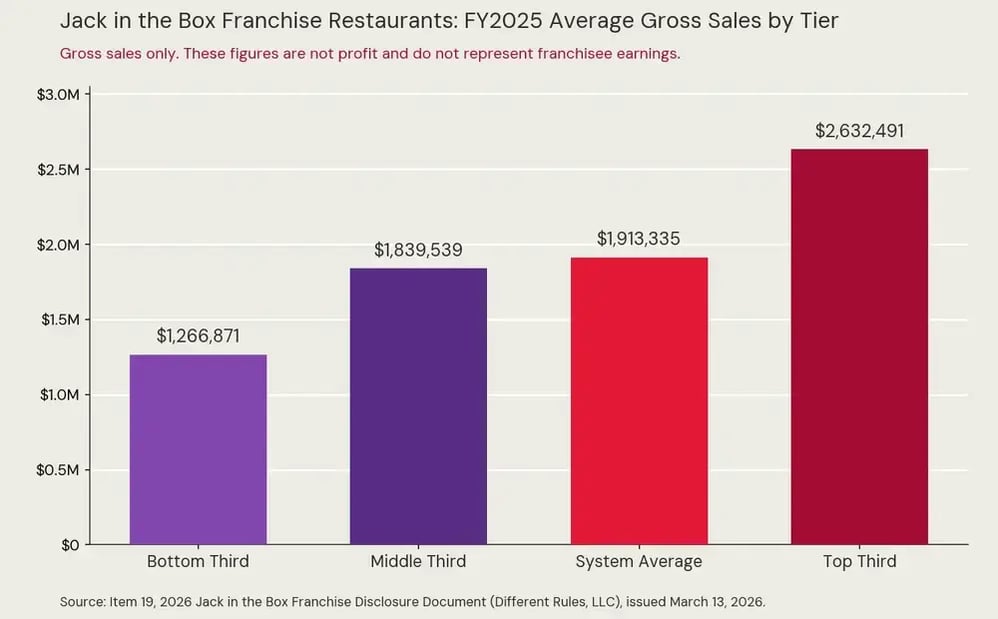
With that caveat stated plainly, here is what our own disclosure document reports. Item 19 of the 2026 Jack in the Box FDD shows FY2025 system average gross sales of $1,913,335 for the franchise restaurants included in that disclosure. The same table breaks performance into thirds, which I find more useful than a single average because it shows the spread. I pulled the chart below directly from those Item 19 figures.
For third party context, Nation's Restaurant News reviewed Technomic's 2024 data and reported that Jack in the Box was one of a small group of burger chains that generated at least $2 million in average unit volume that year, alongside Wendy's. Technomic and Item 19 measure different restaurant sets over different periods, so the two figures are not directly comparable. They point in the same general direction, which is why I show both.
If you want the full cost picture next to the sales picture, our franchise costs page walks through every line item in the investment range.
One of the biggest competitive advantages of Jack in the Box is the 24 hour format. Most Jack in the Box restaurants are open around the clock, which means the building keeps working while competitors with shorter hours sit dark. Hours vary by location, but the around the clock model is the norm across the system rather than the exception.
The late night daypart is not a novelty. Industry reporting backs up how much it matters. Restaurant Dive covered how late night traffic has been growing across major fast food chains, with Placer.ai data showing gains at Jack in the Box among others, and Circana's most recent global results found that quick service restaurants were the primary stabilizer of foodservice traffic in 2025. A brand that is already built for late night does not have to retrofit its operations to chase that daypart.
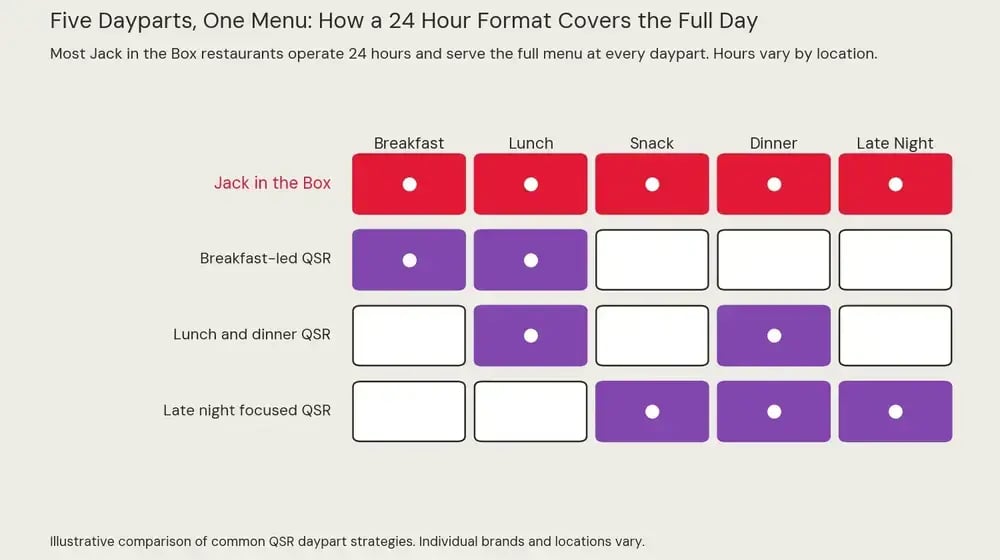
Plenty of chains are open late. Far fewer serve their whole menu the whole time. At Jack in the Box, a guest can order breakfast at dinner, tacos at dawn, or a burger at 3 a.m. There is no cutoff where half the menu disappears.
In simple terms: any menu item, any time of day. That is a genuinely hard thing for competitors to copy, because it requires kitchens, prep systems, and staffing models designed around it from the start. For an owner, it means every daypart gets the full weight of the menu behind it. The visual below shows how that coverage compares with the daypart strategies most QSR concepts run.
Burgers, chicken, and Mexican inspired items are three of the largest categories in fast food. Jack in the Box sells all three. That matters for a practical reason every operator understands: the veto vote. When one person in the car wants chicken and another wants tacos, a single category restaurant loses the whole carload. A multi category menu keeps the group.
It also spreads a restaurant's sales across categories rather than tying everything to one product line, which is worth thinking about as consumer preferences shift. Circana's category outlook, for example, projects QSR chicken to outperform other subchannels through 2028. A brand already selling chicken alongside burgers participates in that trend instead of watching it from the sidelines.
If you are weighing what multi category operations look like at scale, our multi-unit development page explains how we structure development agreements for operators building more than one restaurant.
When ranked by total U.S. systemwide sales, Jack in the Box lands at number five among fast food burger chains, per QSR Magazine's ranking of top fast food burger chains by sales. The brand has been serving burgers, tacos, and other fan favorites since 1951, which gives it seven decades of brand recognition that a newer concept simply cannot buy.
Scale matters to a franchisee for reasons that go beyond bragging rights: national advertising reach, supply chain leverage, and a customer base that already knows the menu before your doors open. You can read more about the brand's history and positioning on our Why Jack in the Box page.
Per Item 7 of the 2026 FDD, the total estimated initial investment for a new Jack in the Box restaurant ranges from $1,909,500 to $4,041,500. The initial franchise fee is $50,000. Ongoing fees are a 5% royalty and a 5% marketing fee, both calculated on gross sales. Candidates should show a minimum of $750,000 in liquidity and $1,500,000 in net worth.
We also currently offer incentive programs for qualifying operators, including a Development Incentive that provides $150,000 at 0% interest for three unit or larger commitments and a Select Market Incentive that reduces the royalty to 2% for the first five years in qualifying markets. Eligibility rules apply, programs can be modified or discontinued, and the current FDD governs the details, so treat this paragraph as a starting point rather than a promise. The full breakdown lives on our franchise costs page, and qualifying veterans can review the VetFran franchise fee reduction on our veterans page.
Active development markets right now include Florida, Georgia, Illinois, Kentucky, and Tennessee. Our available markets page stays current as territories open and close.
The total estimated initial investment ranges from $1,909,500 to $4,041,500 per the 2026 FDD, including a $50,000 initial franchise fee. Ongoing fees are a 5% royalty and a 5% marketing fee on gross sales.
Candidates should demonstrate a minimum of $750,000 in liquid assets and $1,500,000 in net worth. Requirements are evaluated during the franchise application process.
Most Jack in the Box restaurants operate 24 hours a day, though hours vary by location based on site, market, and local conditions. The full menu is served at every hour a restaurant is open.
Item 19 of the 2026 FDD reports FY2025 system average gross sales of $1,913,335 for the franchise restaurants included in that disclosure. This figure represents gross sales only. It is not profit, and it does not predict what any individual franchisee will earn.
Active development markets in 2026 include Florida, Georgia, Illinois, Kentucky, and Tennessee. See the available markets page for the current list.
Qualifying operators may access a Development Incentive of $150,000 at 0% interest for commitments of three or more units, and a Select Market Incentive that reduces the royalty to 2% for the first five years in qualifying markets. Programs are subject to eligibility requirements and may be modified or discontinued. The current FDD controls.
Dustin Thompson works in Franchise Marketing and Development at Jack in the Box, where he helps multi-unit restaurant operators evaluate the brand and navigate the development process. He writes about franchise costs, FDD research, and QSR industry trends for jackintheboxfranchising.com, drawing on the brand's current disclosure documents and direct experience with franchise candidates.
This article is for informational purposes only and is not an offer to sell a franchise. Offers are made only through a Franchise Disclosure Document delivered in compliance with applicable law. Nothing on this page is a financial performance representation beyond what appears in Item 19 of the current FDD, and gross sales figures are not statements or predictions of earnings or profit.
Questions about the process? Contact our franchise team.