
Jack in the Box vs Whataburger: Which Franchise Is Best?
ByDustin Thompson, Franchise Marketing & Development at Jack in the Box
9 min read
By Dustin Thompson, Franchise Marketing and Development, Jack in the Box | Last updated: June 11, 2026
The best chicken franchises to own in 2026 combine multi-daypart menus, efficient restaurant prototypes, and open territory where new operators can actually get in. Chick-fil-A leads the category in consumer reach but offers a licensing model rather than true ownership. Wingstop and Popeyes continue to grow through heavily franchised systems. Dave's Hot Chicken posted the fastest sales growth of any chicken chain in 2025. And Jack in the Box, while known for burgers, offers a chicken-heavy 24/7 menu with most territory east of the Mississippi River open for development.
Picking a chicken franchise in 2026 is harder than it looks.
Not because there aren't good options. Because there are too many, and the gap between "famous brand" and "brand you can actually open" is wider than most candidates expect.
I work in franchise marketing and development at Jack in the Box, where I talk with prospective franchisees nearly every week. The same question keeps coming up: which chicken concepts are actually worth a serious look?
So I built the list I wish every candidate had before their first discovery call. Yes, we put ourselves on it. I'll show you exactly why, with numbers straight from our own FDD so you can judge for yourself.
I scored each brand on four things that matter to a first-time or expanding operator:
One thing you will not find here: earnings claims or promises about how any restaurant will perform. Restaurant performance depends on location, operations, costs, competition, and dozens of other factors. Anyone who tells you otherwise is selling something. Always review a brand's current Franchise Disclosure Document and talk to existing franchisees before you commit.
The data tells a consistent story.
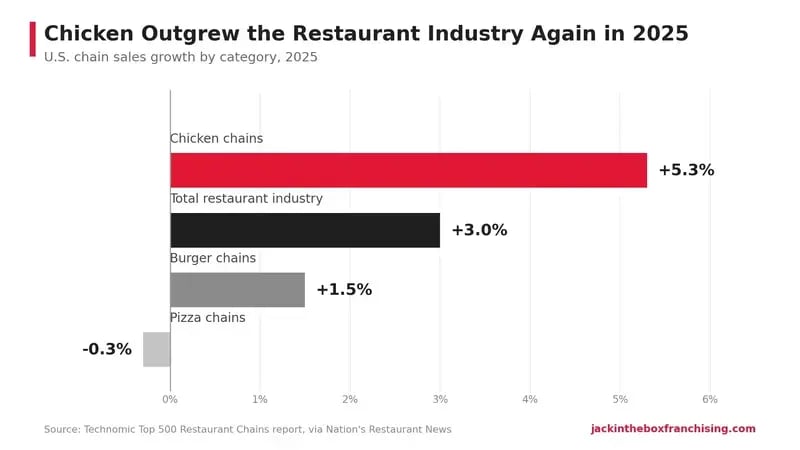
Chicken chain sales grew 5.3 percent in 2025, compared with 3 percent for the overall industry and 1.5 percent for burger chains, according to Technomic's Top 500 Restaurant Chains report covered by Nation's Restaurant News. Pizza finished the year slightly negative.
Growth has cooled from the double-digit years of 2023 and earlier, but chicken remains the category writing the industry's growth story. Eleven of the 30 chicken chains in Technomic's Top 500 grew sales by double digits in 2025.
Consumer behavior backs this up. Circana's 2026 Definitive U.S. Ranking showed Wingstop jumping five spots on a 14 percent increase in consumer spend, while Chick-fil-A led the chicken QSR segment with 53 percent annual buyer penetration.
|
Brand |
Approx. U.S./Global Footprint |
Actively Franchising? |
Open Territory Outlook |
|---|---|---|---|
|
Jack in the Box |
2,000+ restaurants, primarily Western U.S. |
Yes |
Most markets east of the Mississippi open |
|
Chick-fil-A |
3,000+ U.S. restaurants |
Operator licensing only |
Limited; operators do not own the business |
|
Wingstop |
2,800+ worldwide |
Yes |
Competitive; rapid development pace |
|
Popeyes |
Thousands worldwide, heavily franchised |
Yes |
Varies by market |
|
KFC |
25,000+ worldwide |
Yes |
Mostly resales and select development in U.S. |
|
Dave's Hot Chicken |
300+ and growing fast |
Yes, multi-unit |
Many regions committed to developers |
|
Zaxbys |
950+ across the Southeast and beyond |
Yes |
Strongest outside the core Southeast |
|
Bojangles |
Roughly 880, expanding westward |
Yes |
New markets opening in the West and Northeast |
|
Buffalo Wild Wings |
1,200+ across all 50 states |
Yes (Inspire Brands) |
Mature system |
|
El Pollo Loco |
Roughly 500, concentrated in the West |
Yes |
Expansion focus beyond California |
|
Chicken Salad Chick |
300+ across the Southeast |
Yes |
Growing fast-casual niche |
|
Chester's |
1,200+ nontraditional locations |
Yes |
C-stores, truck stops, supermarkets |
Footprint figures are approximate and change monthly. Verify current counts in each brand's FDD or investor disclosures.
Here are twelve brands worth your research time, in no particular order, starting with the one I know from the inside.
We had to put ourselves on this list, and I'll give you the receipts rather than the sales pitch.
Most people know Jack in the Box as a burger brand. What surprises candidates on discovery calls is how much of our menu is chicken, served across five dayparts, 24 hours a day at most locations. That includes:
Why does that matter to an owner? A restaurant that sells breakfast, lunch, dinner, late night, and snacks is not dependent on a single rush. Our Franchise Agreement requires a minimum of 16 hours of operation per day, seven days a week, which reflects how the model is built to capture multiple dayparts.
Here is what our 2026 Franchise Disclosure Document discloses for a prototypical new restaurant:
| Item | Amount |
|---|---|
| Initial franchise fee | $50,000 |
| Royalty | 5% of gross sales |
| Marketing fee | 5% of gross sales |
| Total estimated initial investment | $1,909,500 to $4,041,500 |
| Prototype building sizes | 1,386 to 2,440 sq ft, plus a 1,317 sq ft modular option |
Our FDD also describes incentive programs, including a Select Market Incentive Program with reduced royalty rates for qualifying new restaurants, and a Veterans Program that reduces the initial franchise fee for a first restaurant by 25 percent through the IFA's VetFran initiative.
The biggest differentiator is geography. When you look at our map of available markets, most territory east of the Mississippi River is open for new franchise growth. Finding a legacy QSR brand with that much room for multi-unit development is rare.
Founded by Truett Cathy in Hapeville, Georgia, Chick-fil-A operates more than 3,000 U.S. restaurants and led the chicken QSR segment with 53 percent annual buyer penetration in 2025, per Circana.
Here is what many candidates miss. Chick-fil-A operators pay a comparatively small initial fee, but they do not own the restaurant, cannot sell it, cannot pass it to family, and typically operate a single location. If your goal is building a sellable, multi-unit asset, this is a fundamentally different path. Review the details on Chick-fil-A's franchise page before assuming it works like traditional franchising.
Wingstop ended the second quarter of 2025 with 2,818 restaurants system-wide, roughly 98 percent of them franchised, per its SEC filings. Digital channels drive the large majority of its sales, and the brand has reported decades of consecutive annual same-store sales growth.
The flip side of that momentum: development territory is competitive, and existing multi-unit operators absorb much of the new pipeline.
Popeyes Louisiana Kitchen, founded in New Orleans in 1972 and now part of Restaurant Brands International, operates thousands of restaurants worldwide with the vast majority franchised, per RBI's published store counts. The 2019 chicken sandwich launch is widely credited with accelerating the entire category, and the brand continues to lean on bold Cajun flavor and product news.
KFC, founded by Harlan Sanders and franchising since 1952, operates well over 25,000 restaurants worldwide as part of Yum! Brands' 61,000-plus restaurant system. Nearly all locations are franchised.
In the U.S., the picture is more complicated. Technomic data covered by Nation's Restaurant News shows challenger brands like Raising Cane's and Wingstop have passed KFC in domestic sales in recent years. For a buyer, that can mean resale opportunities at established locations rather than greenfield development.
Dave's Hot Chicken started in an East Hollywood parking lot in 2017 and became the second fastest growing chain in Technomic's entire Top 500 for 2025, with a 51 percent increase in sales.
The brand grows through large multi-unit development agreements, so individual territories tend to get committed quickly. If the Nashville hot niche interests you, speed matters.
Zaxbys built its following on chicken fingers, wings, sandwiches, and salads, with more than 950 locations concentrated in the Southeastern U.S. The brand has been investing in remodels and digital ordering while recruiting franchisees for markets beyond its home region. Details are at Zaxbys franchising.
Bojangles, famous for Cajun-seasoned fried chicken and scratch-made buttermilk biscuits, operates roughly 880 restaurants and has publicly stated plans to pass 1,000 locations, with announced expansion into markets like New York, Nevada, Ohio, and California. A breakfast-strong brand entering new regions is a combination worth watching.
Buffalo Wild Wings, owned by Inspire Brands, runs more than 1,200 sports bar locations across all 50 states, pairing wings with a full bar and wall-to-wall screens. It is a different operating model than QSR, with larger boxes, bigger staffs, and dine-in economics. The brand has also been developing its smaller GO format focused on takeout and delivery.
El Pollo Loco is the only brand on this list with no fried chicken at all. Its citrus-marinated, flame-grilled chicken anchors burritos, salads, tacos, and quesadillas across roughly 500 restaurants concentrated in the Western U.S. The company has been recruiting franchisees to expand beyond its California core, per its franchise development site.
Founded by Stacy Brown in Auburn, Alabama in 2008, Chicken Salad Chick has grown to more than 300 Southern-inspired fast-casual restaurants, most of them franchised. Dine-in, takeout, and catering give it revenue channels most fried chicken concepts lack, and the smaller footprint changes the real estate math. See Chicken Salad Chick franchising.
Chester's has spent more than 70 years putting its double-breaded, family-recipe chicken inside convenience stores, truck stops, and supermarkets, with around 1,200 franchised points of distribution. If you already operate c-stores or travel centers, a nontraditional license can add a food program without building a freestanding restaurant. Jack in the Box offers nontraditional licensing as well, disclosed separately in our FDD.
After years of these conversations, here is my honest short list:
Read Item 7 and Item 19 of the FDD yourself. Item 7 shows the estimated initial investment. Item 19, if the brand provides one, shows financial performance representations. The FTC's Franchise Rule guidance explains what franchisors can and cannot tell you outside that document.
Call existing franchisees. Every FDD lists them. Ten phone calls will teach you more than any brochure, including ours.
Map the territory before you fall in love with the brand. The best brand you cannot open is worth less than a strong brand with room to grow. This is the single biggest reason candidates end up talking to us about markets east of the Mississippi.
Stress-test the dayparts. Ask what percentage of sales comes from each daypart, and what happens to the model if one of them softens.
Nontraditional formats generally cost less than freestanding restaurants. Chester's operates inside existing retail locations, and Jack in the Box offers a nontraditional license with a $25,000 initial fee, per our 2026 FDD. Freestanding QSR builds typically run well into seven figures regardless of brand.
Per our 2026 Franchise Disclosure Document, the initial franchise fee is $50,000 and the total estimated initial investment for a prototypical restaurant ranges from $1,909,500 to $4,041,500, excluding land. The ongoing royalty is 5 percent of gross sales and the marketing fee is 5 percent of gross sales. See our investment page for current details.
Raising Cane's grows almost entirely through company-owned restaurants and is not currently offering franchise development opportunities in the U.S. It is a remarkable brand, but you cannot buy one.
No franchise is a guaranteed investment, and performance varies by location, operations, costs, and competition. What the category data shows is that chicken chains grew sales faster than the overall restaurant industry in 2025, per Technomic. Do your own diligence, review the FDD, and consult a franchise attorney and accountant.
Yes. Through the Jack in the Box Veterans Program, part of the IFA's VetFran initiative, qualifying veterans receive a 25 percent reduction on the initial franchise fee for their first new restaurant, bringing it to $37,500, per our 2026 FDD.
The chicken category earned its momentum, and 2026 still offers real entry points if you match the right brand to the right territory.
If a 24/7, multi-daypart menu and open development territory fit what you're looking for, I'd genuinely enjoy the conversation. Start with our steps to ownership or request franchise information and my team will walk you through the FDD, the markets, and the honest tradeoffs.
About the Author
Dustin Thompson leads franchise marketing and development efforts at Jack in the Box, working directly with prospective franchisees on market selection, the FDD review process, and multi-unit development across the United States. The figures cited from Jack in the Box documents in this article come from the company's 2026 Franchise Disclosure Document dated March 13, 2026.
This article is for informational purposes only and is not an offer to sell a franchise. Offers are made only through a Franchise Disclosure Document in compliance with applicable law. Nothing here is a representation or guarantee of financial performance.