
Burger Franchise vs Sub Franchise: Everything You Need to Know
See how burger and sub franchises compare on cost, fees, real estate, and menu, plus why franchising is a strong fit for veterans.
8 min read
Opening a restaurant franchise is one of the more common ways people get into the food business without building a brand from zero. You get a name customers already know, a system that has been run thousands of times, and a team on the franchisor side whose job is to help you open and operate. You also take on real cost, real rules, and real risk. This guide walks through what it takes, what it costs, and the order things actually happen in.
I am Dustin Thompson, and I work in Franchise Marketing and Development at Jack in the Box. I spend my days talking with prospective operators, reading Franchise Disclosure Documents line by line, and explaining what the numbers mean. The examples below use figures from the current Jack in the Box FDD because that is the document I know best. The general process applies to almost any restaurant brand you look at.
The short answer is speed and support. When you open under an established brand, you skip the years it takes to build name recognition and you inherit systems that already work. That lowers a few of the guessing games that sink new independent restaurants.
Here is what you are really buying:
The model is still growing, too. In its 2026 Franchising Economic Outlook, the International Franchise Association and FRANdata project U.S. franchise establishments to rise from 832,521 to about 845,000 in 2026. Total franchise output is set to reach roughly $921.4 billion.
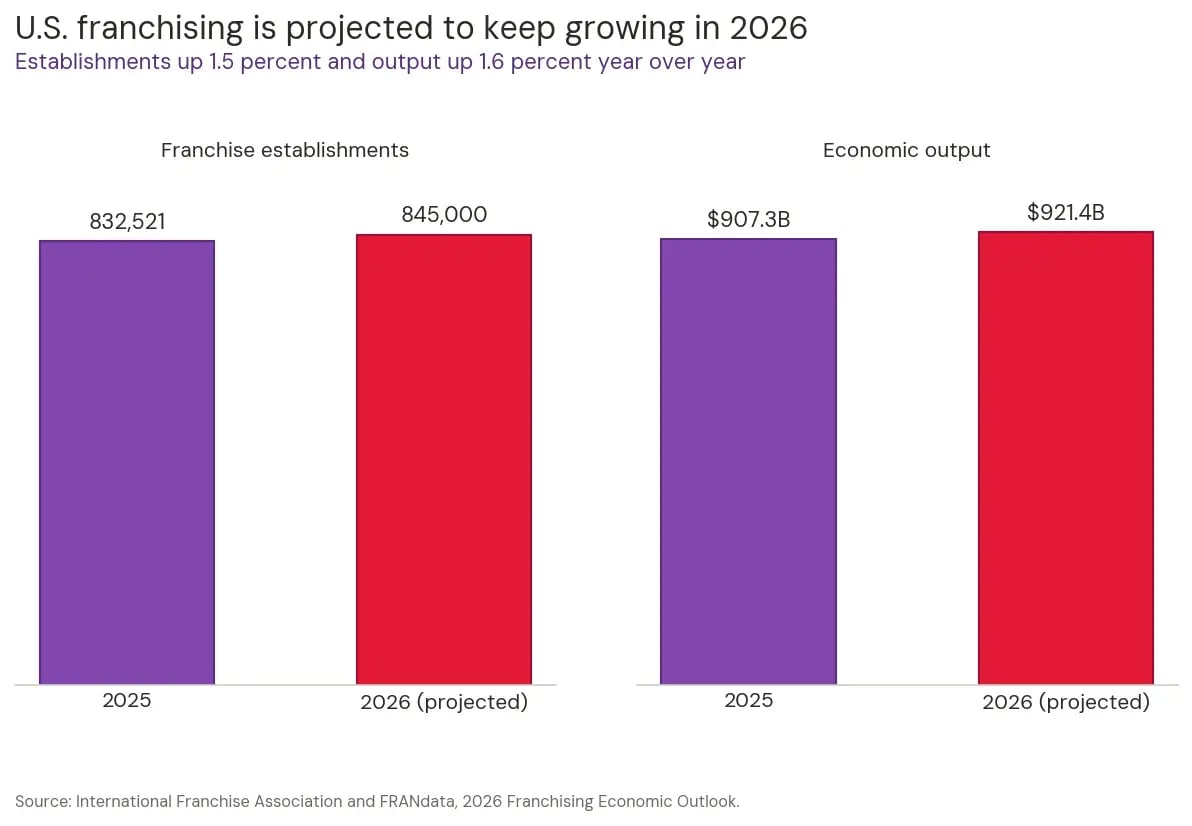
U.S. franchising is projected to keep expanding in 2026. Source: International Franchise Association and FRANdata, 2026 Franchising Economic Outlook.
None of that guarantees any single restaurant will do well. It tells you the model is widely used and still growing, which is a reasonable backdrop for the work you are about to take on.
Cost breaks into three buckets: the upfront franchise fee, the money to build and open the restaurant, and the ongoing fees you pay while you operate. Treat each one separately when you plan your cash.
Most brands charge a one-time fee for the right to use the name and system. Across the industry this commonly lands somewhere between $20,000 and $100,000. In the Jack in the Box FDD, the initial franchise fee is $50,000 per restaurant. Qualifying veterans receive a 25 percent reduction through our participation in the IFA VetFran program, which brings that first fee to $37,500.
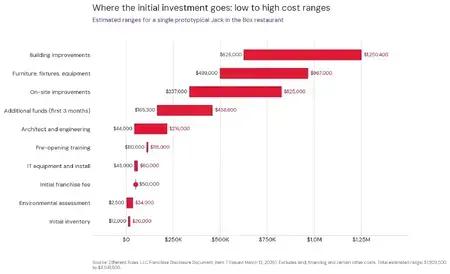
This is where most of the money goes, and it is the part people underestimate. You are paying for the building, the equipment, the sitework, and enough cash to run the first few months. The chart below shows the estimated low-to-high ranges for the largest cost categories in a single prototypical Jack in the Box restaurant, pulled straight from Item 7 of the FDD.
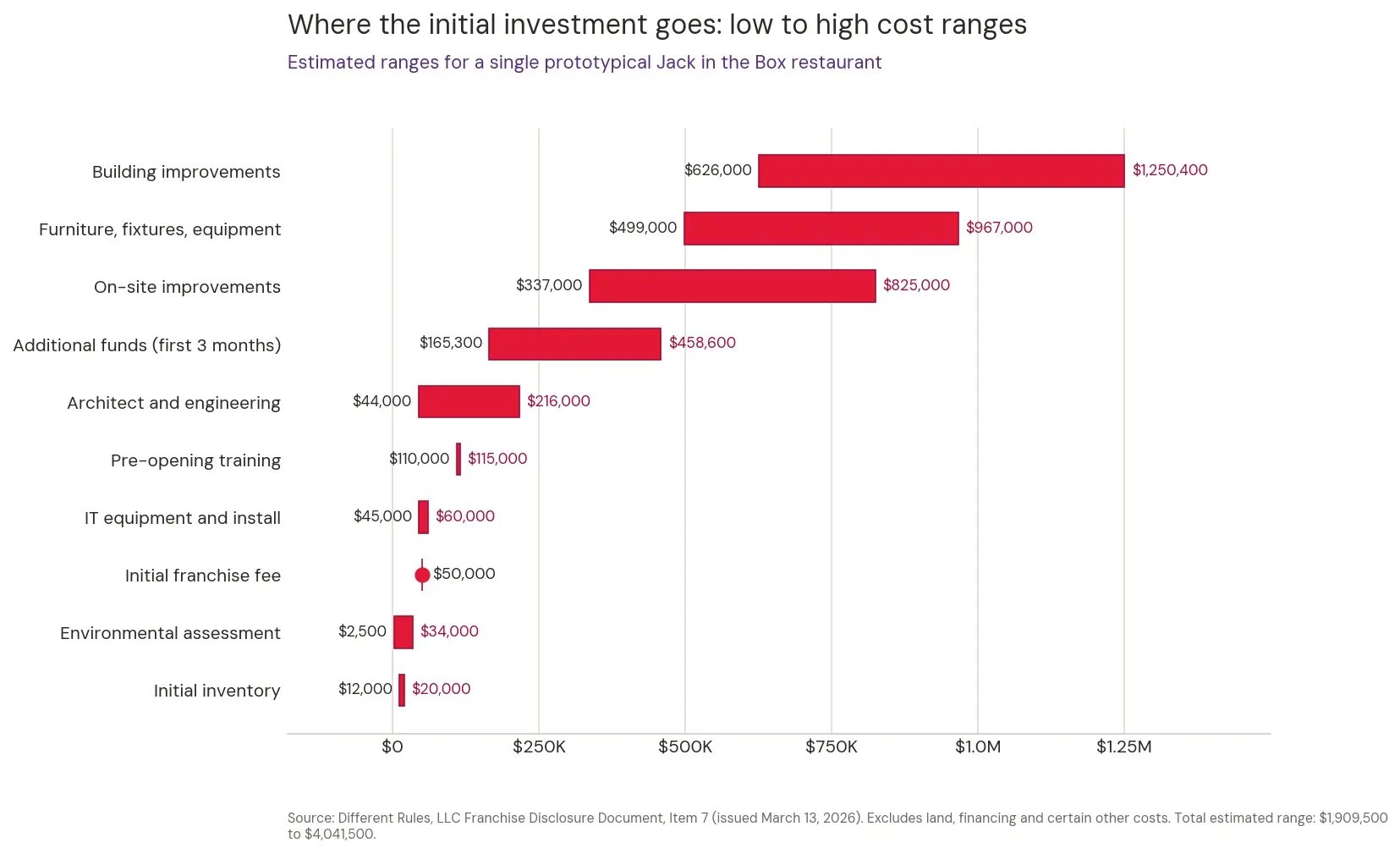
Estimated cost ranges for a single prototypical restaurant. Source: Different Rules, LLC Franchise Disclosure Document, Item 7, issued March 13, 2026. Excludes land, financing, and certain other costs.
Add it up and the FDD estimates a total of $1,909,500 to $4,041,500 for one prototypical restaurant, before land and financing. That is a wide range on purpose. Your site, your market, and your build all move the number. For a full walk-through of the line items, see our franchise costs and fees page.
Once you are open, you pay the franchisor a percentage of your sales every month. Industry royalties often run 4 to 8 percent, with a similar amount going to a marketing or advertising fund. At Jack in the Box, the standard royalty is 5 percent of gross sales and the marketing fee is another 5 percent of gross sales.
Think of the royalty as your ongoing payment for the brand, the systems, and the support. The marketing fee is your share of the advertising that drives customers to the brand and to your restaurant. Both are tied to sales, so they rise and fall with your top line. Build them into your monthly math from the start.
Some brands offer incentive programs that can change these numbers for a period of time. Two examples from our current FDD:
If you are weighing more than one location, our multi-unit development page explains how those agreements are structured.
The path is more predictable than most people expect. Here is the order it usually runs in, and what each step asks of you.
Start with your own numbers. Know your total investment capacity, how much risk you can carry, and how long you can wait before the business supports you. Then narrow to brands whose fees, build costs, and ongoing expenses fit that range. Look at how the menu fits local tastes, how strong the leadership is, and whether the brand is still opening restaurants. Our ideal candidate page is a useful gut check for fit.
This is the document that tells you the truth about the opportunity. It has 23 items. They cover the franchisor's history, its legal and bankruptcy record, every fee, your duties, territory rights, and the terms for renewal and exit. Under the FTC Franchise Rule, you must get the FDD at least 14 days before you sign or pay anything. The FTC spells this out in its Consumer's Guide to Buying a Franchise.
Pay close attention to Item 7 for the investment range and Item 19 for any financial performance representation. Not every brand includes Item 19, and when it does, read the fine print. In the Jack in the Box FDD I work from, Item 19 reports a fiscal 2025 system-wide average of $1,913,335 in gross sales. That number is gross sales, not profit and not take-home income. Results vary widely from the top third of restaurants to the bottom third. A brand-new restaurant has no track record to measure against. For a plain-language tour of the document, read our guide on understanding the FDD.
After early conversations, an FDD review, and a discovery day, you and the franchisor decide whether it is a fit. When both sides agree, you sign the development or franchise agreement and pay the initial fees. At that point you are in the system and can move to site selection and build-out. Our steps to ownership page shows how we run that sequence.
Few people write a check for the whole thing. Common sources include personal savings, an SBA loan, brand or third-party franchise financing, a conventional bank loan, or partners. The SBA 7(a) loan program is the one most restaurant buyers reach for, with loan amounts up to $5.5 million. One thing to check early: the brand needs to be listed in the SBA Franchise Directory for that financing to apply.
Site selection can make or break a restaurant. Look past raw traffic counts and ask who those people are, when they pass by, and how likely they are to stop. Study the local age, income, and household mix against the brand's typical guest. Check visibility, access, parking, and drive-thru potential. Then map the competitors and neighbors nearby to see whether the trade area is crowded or underserved. See where we are growing on our available markets page.
Before you open, you and your key managers go through the brand's training. That usually means classroom and in-store instruction, operations manuals, point-of-sale and technology training, and support from an operations team. You learn daily procedures, staffing, food safety, brand standards, and local marketing. Many brands add refreshers and conferences to keep operators current.
Use the marketing playbooks the brand has already tested instead of reinventing them. Then add your own local layer. Show up at community events, build relationships with nearby businesses, and stay active on social media so guests see your restaurant as part of the neighborhood, not just another sign on the road.
Every operator runs into the same handful of pressures. Knowing them ahead of time is half the battle.
After enough conversations with operators, a few habits show up again and again among the ones who stick around:
If you want to understand what draws people to this particular brand, our why Jack in the Box page lays it out.
It depends heavily on the brand and the site. Full-scale restaurant franchises with a building and a drive-thru sit in the seven-figure range once you include construction and equipment. For a single prototypical Jack in the Box restaurant, the FDD estimates $1,909,500 to $4,041,500, which excludes land and financing. Smaller or nontraditional formats can cost less.
Timelines vary by brand, site, and permitting. From signing an agreement to opening the doors, many restaurant projects run roughly a year or more once you account for site approval, construction, and training. Your franchisor's development team can give you a schedule for your market.
Not always. Many brands value business and leadership experience alongside, or instead of, direct restaurant experience, and they provide training to fill the gaps. What matters most is your ability to build a team, follow a system, and meet the financial requirements.
The Franchise Disclosure Document is a 23-item document that spells out the franchisor, the fees, your obligations, and more. Under the FTC Franchise Rule, you must receive it at least 14 days before you sign any contract or pay any money. You can request it once the franchisor has received and agreed to consider your application.
Often, yes. The SBA 7(a) program is the most common route for franchise buyers, but the brand must be listed in the SBA Franchise Directory for the financing to apply. Talk to an SBA-approved lender about your down payment and eligibility.
Dustin Thompson works in Franchise Marketing and Development at Jack in the Box, where he helps prospective operators understand the numbers, the process, and the commitment behind opening a restaurant. He reads Franchise Disclosure Documents daily and writes to make franchising clearer for the people considering it. Read more from Dustin on his author page.
The Jack in the Box figures in this article come from the Different Rules, LLC Franchise Disclosure Document issued March 13, 2026. They are provided for general information. This article does not make any financial performance representation. Any performance information appears only in Item 19 of the FDD.
Disclaimer: This article and the information on this site do not constitute an offer to sell a franchise. The offer of a franchise can only be made through the delivery of a Franchise Disclosure Document. Certain states regulate the offer and sale of franchises, and if you reside in one of them, we will not offer you a franchise unless and until we have complied with the applicable pre-sale registration and disclosure requirements in your jurisdiction.