
The 31 Best Franchises for Sale in 2026: An Insider's Breakdown
ByDustin Thompson, Franchise Marketing and Development, Jack in the Box · Last updated July 17, 2026
8 min read
By Dustin Thompson, Franchise Marketing & Development, Jack in the Box Last updated: June 18, 2026
The 10 best states for franchising in 2026 are Texas, Florida, Georgia, Arizona, North Carolina, Colorado, Michigan, Utah, Ohio, and Maryland. That ranking comes straight from the International Franchise Association's 2026 Franchising Economic Outlook, which is built by FRANdata using data from roughly 9,000 franchise brands. If you want the short version: the money and the new units are still flowing into the Southwest and Southeast, and a few Midwest states just crashed the party.
I'm Dustin Thompson. I work in Franchise Marketing and Development at Jack in the Box, which means I spend my days inside this exact question, which states have room for a 70-plus-year-old burger brand to grow, and which ones don't. When the IFA report dropped in February, I read all 50 state breakdowns and pulled the numbers that actually matter for someone deciding where to put their capital. This is what I found, plus where our brand fits into it.
Every February, the IFA releases its Franchising Economic Outlook. It's the report most of us in development treat as the baseline for the year. The 2026 edition calls for steady, measured growth after a bumpy 2025.
Here are the headline projections for U.S. franchising in 2026, according to the IFA:
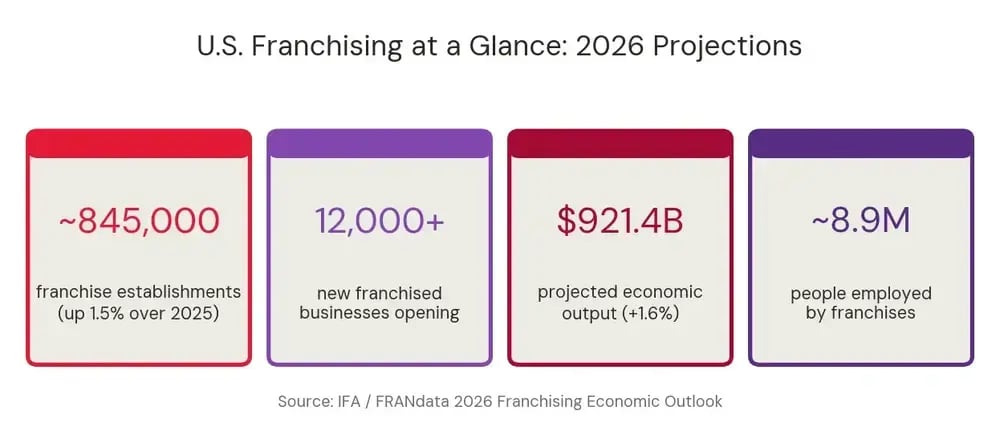
One word the report leans on is "recalibration." FRANdata's own write-up describes 2025 as a year of tighter credit and uneven consumer demand, with operators shifting toward disciplined execution over aggressive expansion. So 2026 isn't framed as a boom. It's framed as growth you can plan around. For someone evaluating a first restaurant or a multi-unit deal, that's a useful distinction, because it tells you to weight your decision toward location and operations, not hype.
Geography still drives most of the story. The report breaks growth down by region, and the gap between the top and the bottom is wide.
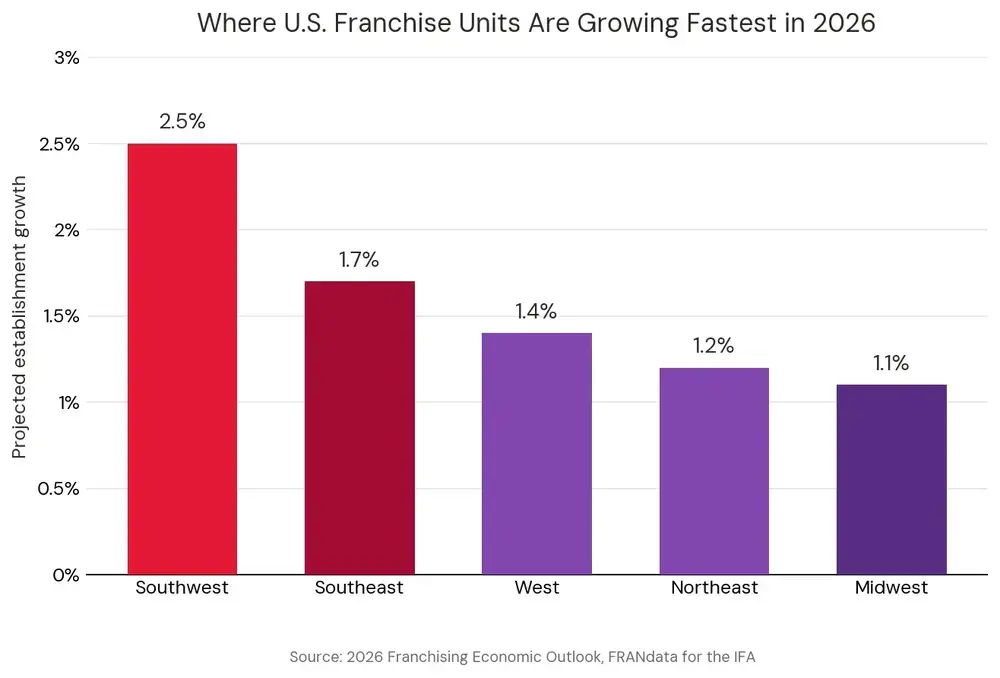
According to FRANdata, the Southwest is projected to lead the country with about 2.5% establishment growth, 2.8% employment growth, and 2.5% output growth. The Southeast, which already holds nearly 30% of all U.S. franchise establishments, is projected to grow units around 1.7%. The Midwest, Northeast, and West sit in a tighter band of roughly 1.1% to 1.4%.
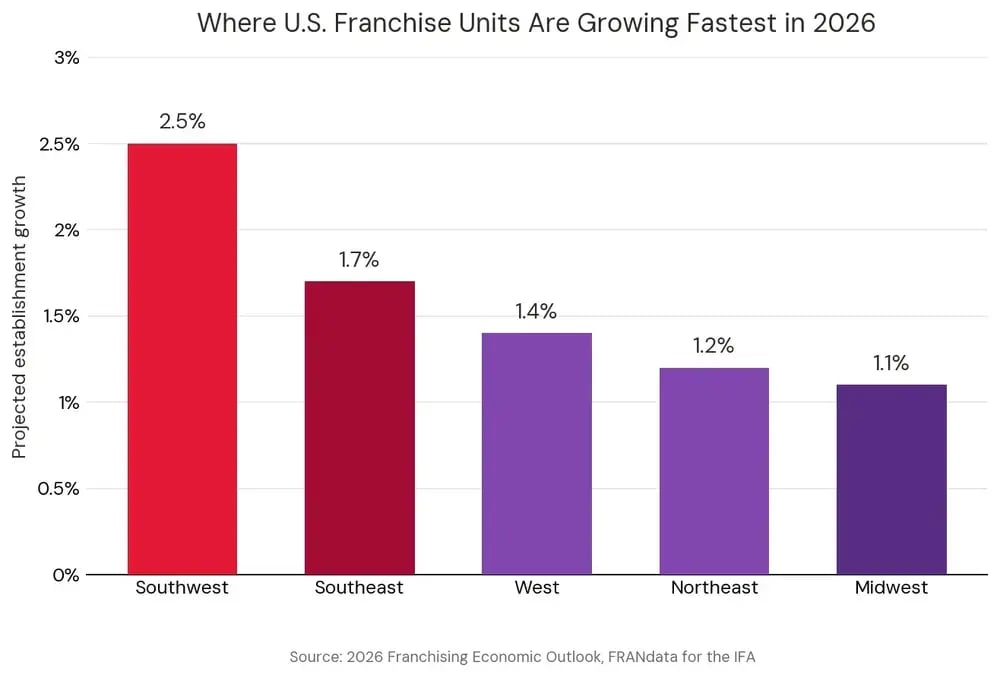
The report ties this pattern to three things it repeats across the document: business-friendly policy, lower cost of living, and population movement. Those are the same forces that have been reshaping where brands like ours look first, and they're the reason the top of the state list looks the way it does.
Here's the full ranking from the 2026 Franchising Economic Outlook, listed in descending order of projected growth:
The interesting part isn't just the list. It's the turnover. I pulled last year's top 10 and put it side by side with this year's so you can see exactly what moved.
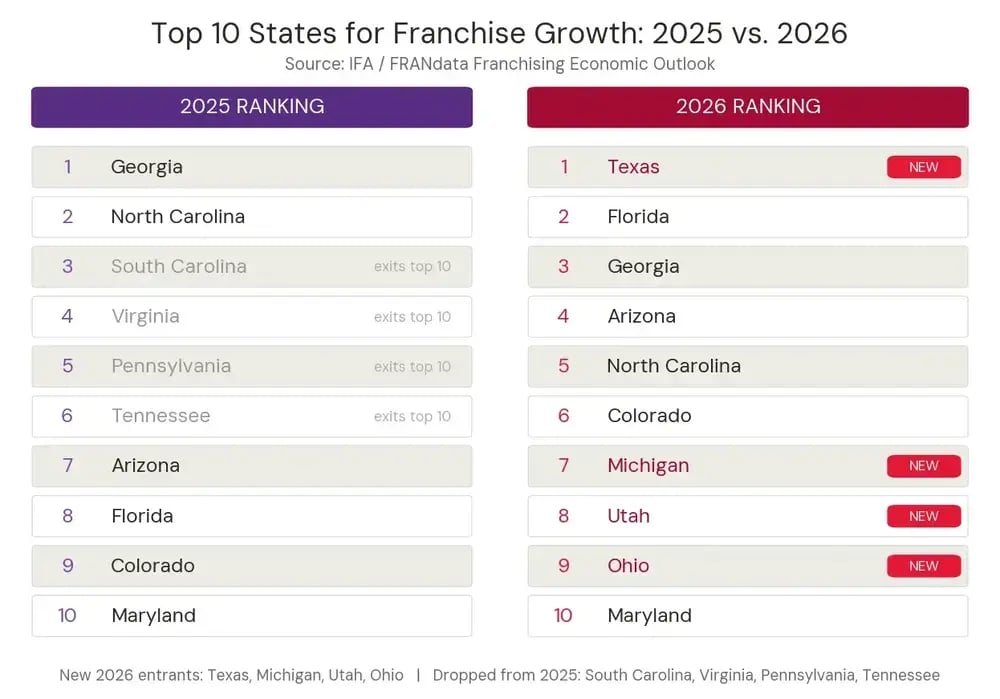
Four states are new to the 2026 list: Texas, Michigan, Utah, and Ohio. The report attributes Michigan, Ohio, and Utah's arrival largely to their affordability and expansion potential, per FranchiseWire's coverage. On the way out: South Carolina, Virginia, Pennsylvania, and Tennessee, which all appeared in the 2025 ranking but didn't make the cut this year.
Let me walk through the states one at a time, with the report's reasoning and, where it applies, where Jack in the Box stands.
Texas tops the list this year. The state combines a no-income-tax structure, sustained population growth, and a large Southwest base that the report flags as the fastest-growing region in the country. For us, Texas is home turf. It's one of our deepest markets, and we still have open development territory in several select western Texas cities like Lubbock and Amarillo, for operators who want to grow inside a brand customers already recognize.
Florida lands at number two, and it's a state I've watched closely this year for a specific reason: we just entered it. Jack in the Box opened its first Florida restaurant in Longwood on February 19, 2026 and in Tallahassee, FL on 03/29/2026 . Florida already carries one of the largest franchise establishment bases in the country, and the report still projects strong growth on top of that, driven by people moving in. We have open territory across the state and are actively talking with operators who want to help build the brand there from the ground floor.
Georgia held a top spot last year and stays in the top three for 2026. The report continues to point to population growth and a friendly operating climate. We have a presence and open development territory across central and southeastern Georgia, including markets like Augusta, Macon, and Savannah and opened our first store in Hinesville, GA in December 2025.
Arizona moves up the list and sits in the Southwest, the region projected to grow fastest. We already operate across Arizona, and there's limited room to add restaurants in edge and adjacent markets.
North Carolina remains a steady performer year over year. The report cites continued population growth in metros like Raleigh, Charlotte, and Greensboro. We operate in the state and have open territory beyond our current footprint.
Colorado holds its place in the top 10. It's a market where we already operate and where there's room to build more along the Front Range and surrounding metros.
Michigan is one of the four newcomers. The report ties its rise to affordability and runway for new development. It's also a state we recently entered, so the IFA's read and our own development plans point in the same direction.
Utah is another new entrant, and the same affordability-and-runway logic applies. We've been building in Utah, including the American Fork area, as part of our broader Western expansion.
Ohio rounds out the new arrivals. The report frames it as a value-and-opportunity story for franchisors looking at the Midwest. It's a state worth watching as more brands move capital toward affordable, high-population Midwest markets.
Maryland holds the tenth spot for a second straight year. The report projects continued, modest growth. Jack in the Box is not pursuing Maryland at this time, so I'm including it for completeness rather than as a development opportunity with our brand.
This is the question I get most from prospective operators, and it's where I can add something the IFA report can't, because I'm inside it.
Two moves define our 2026 footprint. The first is Florida, where our first restaurant opened in Longwood in February. The second is Chicagoland, where we've returned to the market for the first time in decades and now operate in communities including Lake in the Hills, Carol Stream, Naperville, La Grange, Cicero, Tinley Park, New Lenox, and Plainfield. We're still looking for operators to grow in the open territory across the Chicago area. I wrote a full breakdown of that market in Is Jack in the Box Opening in Chicago? if you want the detail.
Beyond those two, our recent multi-unit expansion has reached new markets including Utah, Kentucky, Arkansas, Montana, Wyoming, Michigan, Florida, and Georgia, plus international growth in Mexico. Several of those line up directly with the IFA's top 10, which is part of why this report matters to me beyond curiosity. When an independent source like FRANdata flags the same states our development team is already working, it's a useful outside check on where the demand is.
A quick note on how we think about territory, because it shapes every conversation I have. We grant franchises for specific restaurant locations and define larger development areas using market points, with protected development rights in a one-mile radius around each one. When we set those points, we look at competition, store characteristics, sales history, mobile customer data, demographics, and other inputs. The point is that "open territory" isn't a vague promise. It's a defined area you'd build inside.
If a top-10 state has you interested, the next practical question is whether you qualify. Here's where we set the bar, based on our current Franchise Disclosure Document dated March 13, 2026:
Those figures come from the FDD, the legal document every franchisor is required to provide. Before you sign anything, the Federal Trade Commission's guide to buying a franchise is worth reading, and you should review the FDD with your own attorney and accountant. None of the numbers above are a projection of what you'll earn. They're what it takes to get started.
If you're newer to the category, two of our other articles give helpful context: 5 Reasons to Buy a Burger Franchise and our breakdown of how burger franchises compare.
Here's my honest take, and I'll keep it to the things I can actually speak to. The IFA data and our own development pipeline are pointing at the same map. When I'm fielding questions from operators, the states that come up most, Texas, Florida, Georgia, the Carolinas, and now Michigan, are the same ones FRANdata ranked at the top. That overlap is the most useful thing in this report. It means a prospective franchisee doesn't have to choose between "where the industry is growing" and "where this specific brand has room." For a good chunk of the top 10, those are the same place.
The other thing I'd flag: the report's "recalibration" framing is real. 2025 made operators more disciplined. That's not a reason to wait. It's a reason to be deliberate about market selection, which is exactly what a ranked, data-backed list like this one is for.
What is the best state for franchising in 2026? Texas ranks first for projected franchise growth in 2026, according to the IFA's 2026 Franchising Economic Outlook, followed by Florida and Georgia.
What are the top 10 states for franchising in 2026? Texas, Florida, Georgia, Arizona, North Carolina, Colorado, Michigan, Utah, Ohio, and Maryland, ranked in descending order of projected growth.
Which states are new to the 2026 franchise growth list? Texas, Michigan, Utah, and Ohio are new to the top 10 in 2026. South Carolina, Virginia, Pennsylvania, and Tennessee dropped off the list.
Which U.S. region is growing fastest for franchising in 2026? The Southwest, with roughly 2.5% projected establishment growth, followed by the Southeast at about 1.7%, per FRANdata.
Where is Jack in the Box expanding in 2026? Jack in the Box opened its first Florida restaurant in Longwood in February 2026 and is operating across the Chicagoland market, with open development territory in both regions and in several other top-ranked states.
What does it cost to open a Jack in the Box franchise? Per the March 13, 2026 Franchise Disclosure Document, the total investment to build one restaurant ranges from $1,909,500 to $4,041,500. Candidates need a minimum of $750,000 in liquidity and $1,500,000 in net worth.
Several of the fastest-growing states in the country are also states where Jack in the Box has open development territory. If you want to see what's available near you, reach out to our franchise team and we'll walk you through it.
About the author: Dustin Thompson works in Franchise Marketing and Development at Jack in the Box, where he builds content for prospective franchisees using the brand's current Franchise Disclosure Document and firsthand knowledge of its development pipeline. He tracks franchise market data, including the IFA's annual Franchising Economic Outlook, to help operators understand where the brand has room to grow.
If you have any further questions, please don't hesitate to reach out to the Jack in the Box franchise team.