
How Much Does a Jack in the Box Franchise Cost in 2026?
A Jack in the Box franchise runs about $1,909,500 to $4,041,500 all in, including the $50,000 > franchise fee. Here's exactly where your money goes.
6 min read
By Dustin Thompson, Franchise Marketing and Development, Jack in the Box
If you are weighing a franchise, one of the first money questions is a fair one: do you pay the franchise fee once, or does it come back every year? I hear this almost every week from people looking at a Jack in the Box franchise.
I am Dustin Thompson, and I work in Franchise Marketing and Development for Jack in the Box. The franchisor entity is Different Rules, LLC. A big part of my day is helping prospects read the fine print before they sign anything. So here is the plain answer first, then the details pulled straight from our current Franchise Disclosure Document.
No. The Jack in the Box franchise fee is a one time payment. You pay it when you sign your Franchise Agreement, not every year you keep the doors open.
Key Takeaways
A franchise fee is the price of admission. It buys you a license to open and run a business under an established brand, along with the systems, training, and support that come with it. The Federal Trade Commission puts it plainly in its Consumer's Guide to Buying a Franchise: you pay a franchise fee and, in return, you get a proven format, the right to use the brand name for a set number of years, and help getting started.
I like to compare it to a driver's license. It opens a lot of doors. It also comes with rules, and the license can be pulled if you break them. A franchise agreement works the same way. Reasons a franchise agreement can be ended for cause include failure to pay fees, selling products that were never approved, and falling short of food safety standards.
You can read how renewal, termination, and transfer work in Item 17 of our Franchise Disclosure Document. That document is the source I point every prospect to, because it is the one place where the terms are spelled out in full.
Our initial franchise fee is $50,000 for each traditional franchised restaurant, plus any tax or other fee tied to collecting the payment. The fee is fully earned by the company on the day it is received, and it is not refundable. It is due when you sign your Franchise Agreement, which is a 20 year contract.
Two situations change the number. A nontraditional location, like a spot inside a travel center or a shared building, carries a $25,000 fee per unit. And if your term runs shorter than the standard 20 years, the fee is $2,500 for each year or partial year over six months. You can see how the fee fits into the full picture on our franchise costs page, and I break down the fee on its own in how much is a franchise fee.
No. It is a one time payment. You pay it once, at signing, and it gives you the license to run your restaurant for the length of your agreement. Where people get tripped up is the difference between a one time fee and the fees that run on a schedule. The FTC makes the same point in its breakdown of the Franchise Disclosure Document: the startup fees sit in one bucket, and ongoing costs like royalties and advertising fees sit in another.
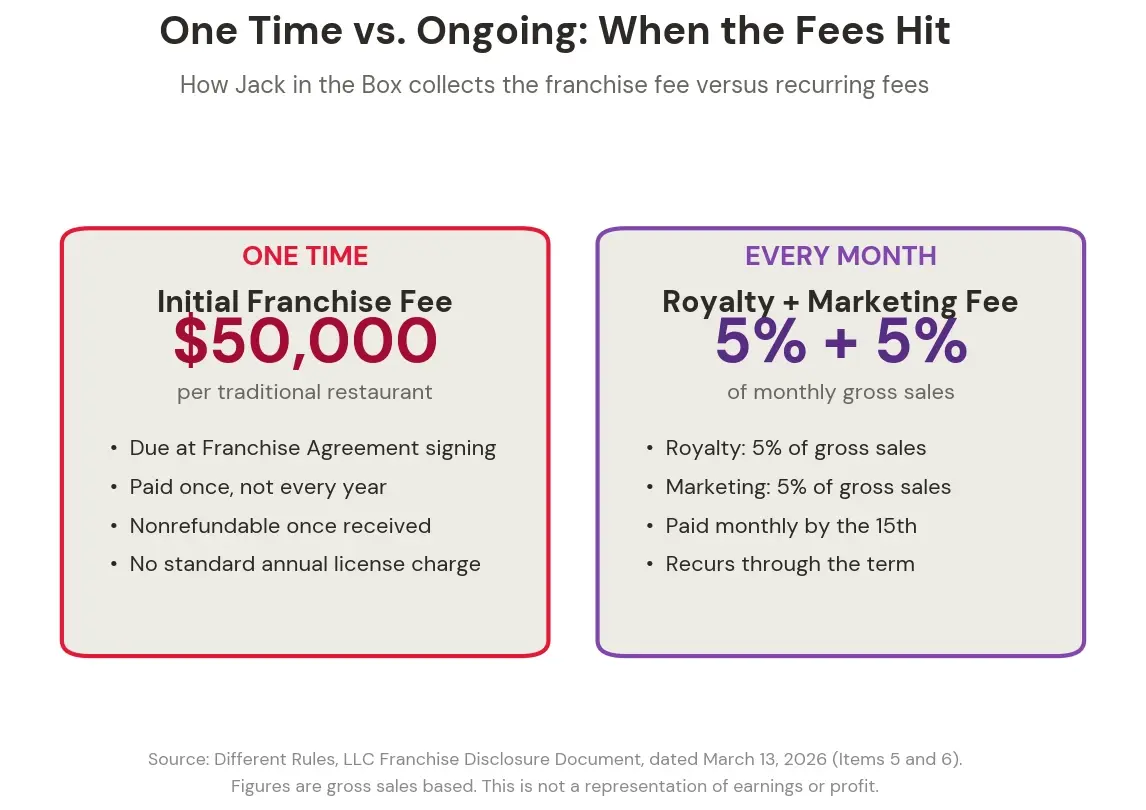
Here is how those two buckets look side by side for a Jack in the Box franchise.
One time versus ongoing fees. Source: Different Rules, LLC Franchise Disclosure Document, dated March 13, 2026, Items 5 and 6.
Two of them, and both are monthly, not annual. The royalty is 5% of gross sales. The marketing fee is another 5% of gross sales. Both are due by the fifteenth of the following month. These are the payments that keep coming as long as you operate, which is probably what most people are really asking about when they say "every year."
One note on wording: these are figures based on gross sales, not profit, and nothing here should be read as a claim about what any restaurant earns. Item 6 of the Franchise Disclosure Document lists the full fee schedule, including a handful of situations where the royalty rate can be negotiated up or down.
This is where the mechanics get a little more involved, so stay with me. When you sign a multi-unit development agreement, we grant you the right to build an agreed number of restaurants in a set area. The minimum under that agreement is two restaurants.
If you are new to our system, you pay a development fee when you sign the development agreement: $50,000 for the first new restaurant, plus $10,000 for each additional restaurant. If you are already a franchisee with us, the development fee is $10,000 for each new restaurant. That development fee is not refundable.
Here is the part that trips people up. As long as you stay in full compliance, the development fee you already paid gets credited toward the franchise fee for that same restaurant. So the franchise fee for each restaurant comes due when you sign that restaurant's Franchise Agreement, minus what you already put down. A worked example makes it clearer.
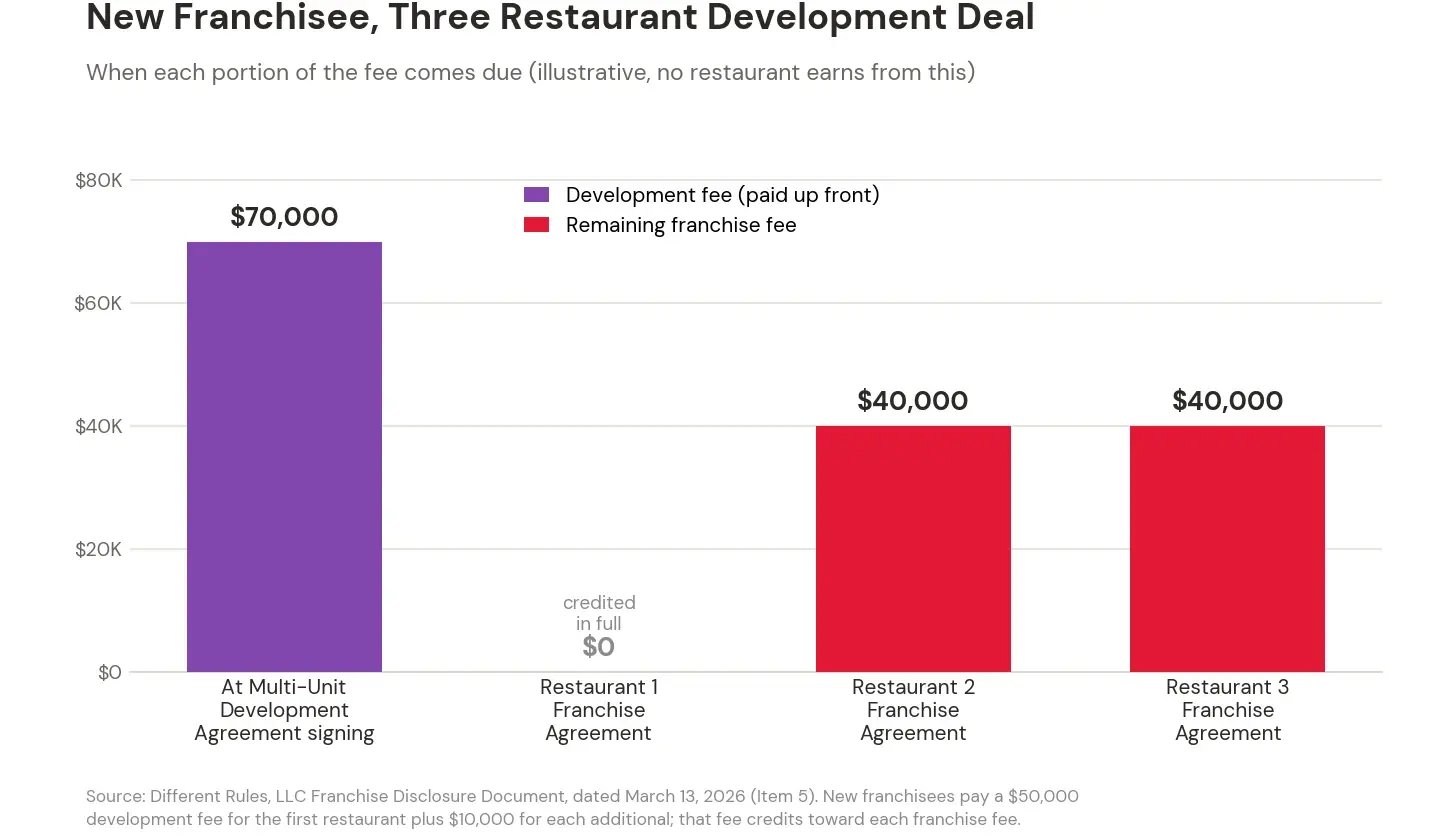
Illustrative timing of a three restaurant development deal for a new franchisee. This is a fee structure only and is not a representation of earnings. Source: Different Rules, LLC Franchise Disclosure Document, dated March 13, 2026, Item 5.
In that example, the up front development fee covers the first restaurant's franchise fee outright and leaves $40,000 of the franchise fee due for each additional restaurant at the time you sign its agreement. The total franchise fee obligation still works out to $50,000 per restaurant. You are just paying it in two moments instead of one.
This is the answer that has changed, and it is worth reading closely. The franchise term is 20 years. There is no right of renewal built into the agreement. At the end of the term, the company may, at its sole discretion, decide to grant you a new franchise, sometimes called a rewrite. That decision looks at things like your track record, how you represented the brand, your payment history and financial condition, the restaurant's location and operations, and the needs of the system as a whole.
If a rewrite is offered, it is not a simple extension. It means signing a new Franchise Agreement and paying a new franchise fee, bringing the building up to current design standards, and signing a general release. The new agreement can carry terms that are materially different from your original one. So the honest way to say it is this: you do not pay a franchise fee every year, but a fresh franchise fee can come into play if the company offers you a new franchise once your term runs out. The full language lives in Item 17 of the Franchise Disclosure Document.
Sometimes, and only in specific cases. We take part in the International Franchise Association's VetFran initiative. Under our Veterans Program, qualifying veterans get the initial franchise fee for the first new restaurant reduced by 25%, which is $12,500, bringing that fee to $37,500. Eligibility rules apply, and you can read them on our veterans page.
We also run development incentives from time to time for qualified operators. Those programs have their own eligibility requirements, they are offered at the company's discretion, and the company can change or discontinue them at any time. If you want to see what is active right now, start with our franchise incentives overview and then confirm the current terms with our team before you count on any of them.
No, and this matters if you are comparing brands. What I described is how Jack in the Box collects its fee. Another franchisor might structure a renewal fee differently, charge a different royalty, or run its development deals another way. The rules that govern all of this sit in the FTC's Franchise Rule, which requires every franchisor to hand you a disclosure document before you pay anything or sign anything. Read the one for each brand you are serious about, and put the fee sections side by side.
After years of walking people through this, my advice is to stop thinking about the franchise fee as the recurring cost. It is not. The fee is a one time entry point. The numbers that follow you month after month are the royalty and the marketing fee, both tied to gross sales. When you build your own projections, model those two, not a phantom annual license charge. If you want the wider view of what we bring to the table, our why Jack in the Box page and the franchise process page lay it out step by step.
Have a question I did not cover? Contact our franchise sales and support team.
About the author
Dustin Thompson works in Franchise Marketing and Development for Jack in the Box, the franchisor entity Different Rules, LLC. He works directly with prospective and current franchisees on the questions that come up before and after signing, and writes about franchise costs, fees, and the development process using the brand's current Franchise Disclosure Document as his source.
This content is informational only. It is not an offer to sell or the solicitation of an offer to buy a franchise, and it does not make any representation about the financial performance, earnings, or profit of any restaurant. An offer is made only through a Franchise Disclosure Document in states that require registration or otherwise permit the offer.