
10 Overlooked Costs: Restaurant Conversion vs. Raze & Rebuild
Article Summary: While converting an existing restaurant (second-generation space) often appears less expensive upfront, hidden conditions and...
5 min read
Dustin Thompson Updated on August 31, 2026
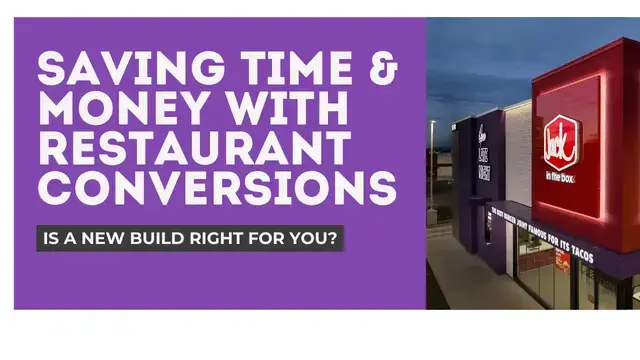
Article Summary: Converting an existing restaurant space (second-generation site) can offer a distinct speed and capital advantage over ground-up construction, primarily by leveraging existing utility infrastructure and entitlement approvals. Key savings can include the avoidance of steep municipal impact fees, reduced permitting timelines, and the utilization of existing assets like the walk-in cooler/freezer, grease trap, and HVAC units. For franchisees looking to scale quickly, conversions can provide a faster path to cash flow with lower initial risk.
In the race to get new cash registers ringing, time is the ultimate currency. Every day that a site is mired in permitting or construction is another day of potentially paying rent without revenue while your competitors are serving your guests. This is where the Second-Generation (2nd Gen Space) restaurant conversion projects can shine.
While "raze and rebuild" projects offer a blank canvas, they also come with a heavy price tag and typically longer development timelines. For savvy franchisees and independent operators, finding the right conversion opportunity is often the secret to rapid scaling and quicker Return on Investment (ROI).
In this article, we break down the ten most impactful reasons why breathing new life into an old space can be the smartest move on the board.
One of the more shocking costs that is levied on many new construction projects can be the "Impact Fees” levied by the utility service providers, state highway departments, or the municipalities to offset the strain they believe a new building puts on local infrastructure (utilities, roads, police, schools, etc).
Ground-up construction typically involves many design disciplines and approvals that might be reduced or avoided with a conversion project; for example zoning and architectural review boards can be a costly & time consuming process that must be completed in advance of building permit submittals, erosion control & temporary access design & approvals, mass site grading and drainage design & approvals, geotech investigations necessary for structural foundation & paving design & approvals, etc. in many cases might not be necessary in a conversion project.
The Speed: Depending on the existing condition of the property and extent of the site alterations needed, your conversion permit set of plans will likely focus primarily on the building. You may be avoiding the time-consuming site development plan reviews and approval process.
The Result: Depending on the municipality’s permitting process, you can often be "shovel ready" 6-12 weeks after making permit submittals for a conversion, compared to 6-12 months (or longer) for a new build.
Extending new water and sewer main lines from the street to a building can be incredibly expensive. "Tap fees" (the cost to connect to the city main) and associated impact fees are typically substantial.
The Asset: In a 2nd Gen space, the water, sewer, gas, and electrical services are usually already existing at the building – you’ll just need to modify them based on your conversion design.
The Saving: You avoid the costs of trenching the road, traffic control plans, roadway repairs, and the tap & impact fees themselves, thus saving $15,000 - $50,000 or significantly more depending on your municipality’s fee structures.
An expensive piece of equipment in a kitchen that is often overlooked is the exhaust hood and the associated "black iron" ductwork that runs to the roof.
The Asset: Even if you need to replace the exhaust fan and other components, the heavy lifting—the ductwork, shaft, and the hood itself can be reusable depending on its size and placement.
The Saving: A new exhaust hood system with its rooftop penetration, fire suppression, and installation can run more than $30,000+. If the existing one meets code and is positioned properly, you can just clean & update it and save a small fortune.
Walk-in boxes are durable assets. Unless the panels have rotted, they are prime candidates for refurbishment.
The Asset: A second-generation space often leaves the walk-in box behind.
The Fix: You might need to do a heavy-duty clean and replace the compressor or the evaporator coil ($5k-$7k), but you avoid having to purchase and install a new walk-in system by buying the box and paying for the installation labor $20k-$40k).
As noted in risks, grease traps can be tricky. However, if the existing trap is in operable condition and meets capacity and other code requirements (or was upgraded recently), you have struck gold.
The Asset: Installing a new underground grease interceptor can be a major site-work project itself involving excavation, sewer main, and concrete/paving work.
New builds must adhere to all applicable current local building codes including parking ratios (e.g., 10 spots per 1,000 sq. ft. of building area as an example). Older 2nd generation sites can often enjoy "legal non-conforming" status.
The Advantage: You may be allowed to operate with fewer parking spots than a new-build would require because the building & use is "grandfathered."
The Strategy: This allows you to reopen a 2nd generation space located in dense, high-traffic areas where there wouldn’t be enough space to develop a new building due to the parking or development ode requirements.
Civil work—moving dirt, pouring curbs, paving lots, and planting trees—can be a very unpredictable part of a restaurant construction project (weather delays, bad soil).
The Certainty: With a conversion, the parking lot is already paved, the curbs are already in place, and the landscaping is mature.
The Saving: Depending on the condition of the existing site improvements, you might just have to complete some refresh work to the landscaping and a sealcoat & restripe to the parking area thus saving yourself a significant amount of money when compared to developing a new parking area from scratch.
Landlords sitting on dark restaurant spaces are motivated to make deal. A vacant building is not only a liability but a cashflow loser.
The Deal: You can often negotiate significant Tenant Improvement (TI) allowances or free rent periods (abatement) because the landlord wants to start generating a revenue stream again.
The Cost: By the time you account for new building construction costs with the associated ground rent for a property large enough to meet all current development codes, renovation cost and rent for 2nd Gen space can be lower per square foot in a prime lifestyle center.
Property Taxes: Depending on the local municipality’s tax laws, conversion projects can sometimes be taxed at a more advantageous property tax rate than a new construction project. It is important that you investigate your planned project with your local taxing jurisdiction so you can avoid any surprises by planning appropriately.
The most critical metric.
The Timeline: A conversion can open in 12-16 weeks after construction begins versus a new building that could take 26-52 weeks.
The Win: Opening 4 months earlier means 4 months of revenue. If your restaurant does $100k/month, that is $400,000 in additional gross revenue in your first year compared to waiting for a new build.
While conversions carry risks, the financial upside of speed and infrastructure savings can be the difference between profitable and very profitable. For emerging brands or franchisees looking to maximize cash-on-cash return, a well-vetted second-generation space is often the most capital-efficient way to grow.
Choose Conversion When:
You need to open quickly.
The previous tenant had a similar kitchen layout.
New build development codes or municipal impact fees in the area are cost prohibitive.
You are entering a dense market with no vacant land.
Article Summary: While converting an existing restaurant (second-generation space) often appears less expensive upfront, hidden conditions and...
Are you searching for the most popular reasons to buy a drive-thru franchise?
Blog Summary: Converting an existing restaurant space ("second generation") typically offers faster speed-to-market and lower initial construction...