
9 min read
By Dustin Thompson, Franchise Marketing and Development, Jack in the Box
Last updated: June 30, 2026
If you are weighing burger franchise opportunities as a multi-unit operator or a fast food franchise investor, the first thing worth saying is this: the brand name is the least useful filter. What separates a fit from a mismatch is the combination of entry capital, ongoing fee load, operator involvement, and whether the brand is even awarding new agreements in your market right now.
I read Franchise Disclosure Documents for a living. My job at Jack in the Box is franchise development, so I spend my weeks inside Item 5, Item 6, and Item 7 of our own filing and reading the public franchise pages of the brands we compete with for operators. Below is how six well-known burger brands actually compare on the numbers that drive a decision, pulled from each brand's own disclosures rather than from secondhand aggregator sites that I have repeatedly found to be wrong.
Key takeaways
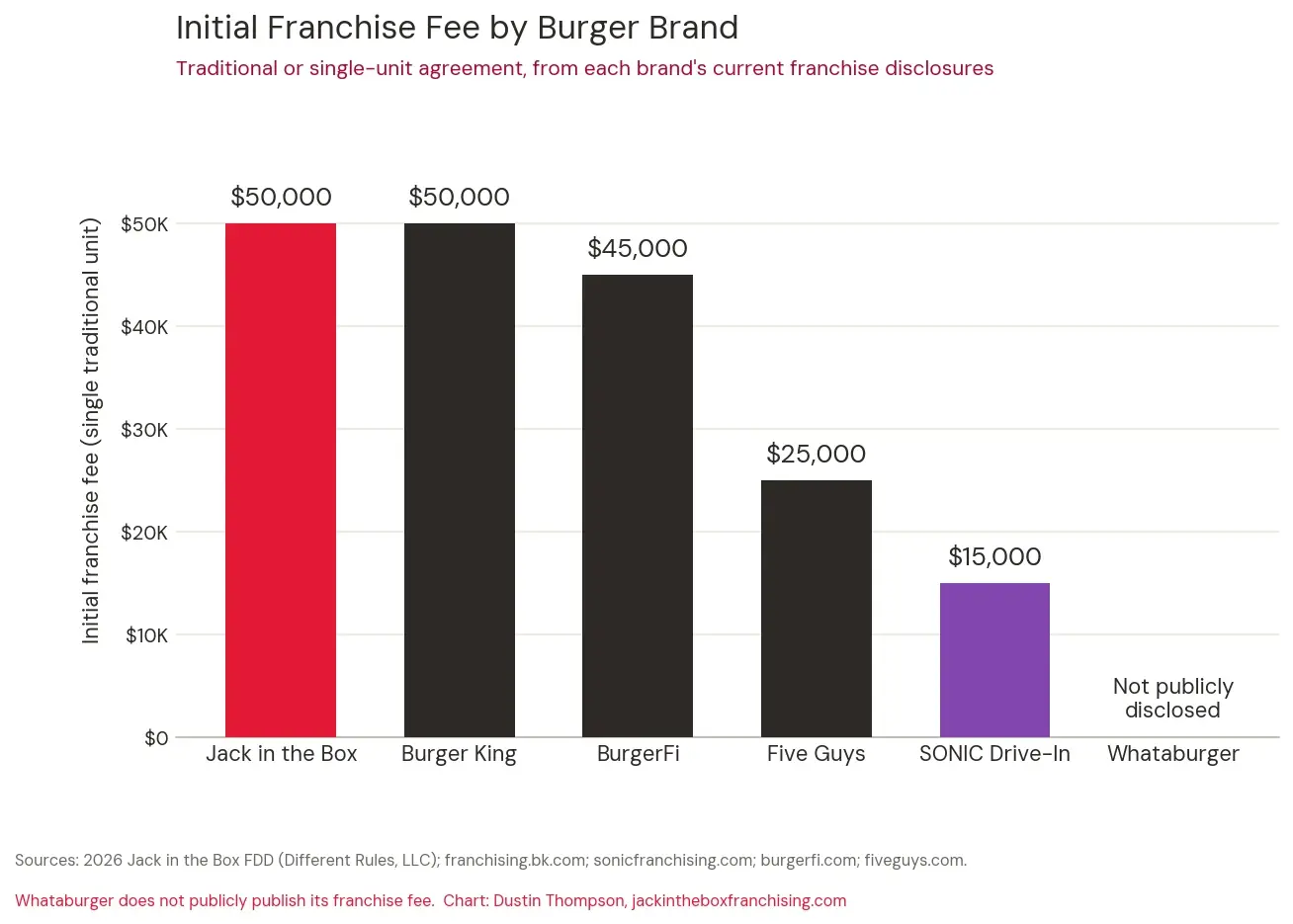
- Initial franchise fees across these six brands range from $15,000 (SONIC, traditional location) to $50,000 (Jack in the Box and Burger King). The fee is the smallest line in your total investment.
- Total estimated initial investment for Jack in the Box runs $1,909,500 to $4,041,500 per the 2026 Franchise Disclosure Document, in the same broad range as other freestanding burger and drive-in formats.
- Capital to qualify varies widely. Five Guys lists the highest published bar at $5,000,000 net worth and $2,500,000 liquid, while Burger King and BurgerFi publish $1,000,000 net worth and $500,000 liquid.
- Availability is the hidden disqualifier. Five Guys reports its US and Canada territories as sold out, and Whataburger franchises selectively and does not publish standard terms.
- For multi-unit operators, look past the sticker fee at royalty rate, marketing contribution, development incentives, and operator-involvement rules. Those decide your real cost and your day-to-day role.
- No figure here is an earnings claim. Sales numbers are gross sales, not profit, and past system performance does not predict any single location's results.
How does the burger franchise category look heading into 2026?
Franchising overall is projected to add more than 12,000 new units in 2026, with total output expected to exceed $921 billion, according to the International Franchise Association's 2026 Franchising Economic Outlook. That same report names Texas, Florida, Georgia, Arizona, and North Carolina among the fastest-growing states for franchising, with the Southeast and Southwest leading expansion.
That matters for burger investors because development activity tends to follow population and cost-of-living trends. Several of our own active development markets sit in those same growth regions, which is also where you will find the most open white space across competing brands.
Which burger franchise opportunities should investors compare?
Here are the six brands side by side, ordered by how open each one currently is to new US multi-unit operators rather than by any performance ranking. Every figure traces to the brand's own franchise disclosure or official franchise page.
| Brand | Initial franchise fee | Royalty | Marketing / ad | Min. net worth | Min. liquidity | US availability |
|---|---|---|---|---|---|---|
| Jack in the Box | $50,000 per traditional restaurant | 5% of gross sales | 5% of gross sales | $1,500,000 | $750,000 | Actively developing (FL, GA, IL, KY, TN) |
| Burger King | $50,000 | 4.5% of gross monthly sales | 4.5% of gross monthly sales | $1,000,000 | $500,000 | Open |
| SONIC Drive-In | $15,000 (traditional; plus $10,000 per restaurant development fee) | 5% of gross sales (1% promo, first 12 months) | 3.25% minimum | $1,000,000 (1 to 2 units) | $500,000 (1 to 2 units) | Open |
| BurgerFi | $45,000 | 5.5% of revenues | 2.0% brand fund + 1.5% local | $1,000,000 per restaurant | $500,000 per restaurant | Open (system reorganized 2024 to 2025) |
| Whataburger | Not publicly disclosed | Not publicly disclosed | Not publicly disclosed | Not publicly disclosed | Not publicly disclosed | Selective; mostly company-owned |
| Five Guys | $25,000 (plus $50,000 development fee) | 6% | Not listed on franchise page | $5,000,000 | $2,500,000 | US and Canada sold out |
Sources: 2026 Jack in the Box Franchise Disclosure Document (Different Rules, LLC); franchising.bk.com; https://www.franchising.inspirebrands.com/sonic; burgerfi.com; whataburger.com; fiveguys.com. Figures are costs and qualification thresholds only and are not earnings claims.
What does the initial franchise fee actually look like across brands?
The franchise fee is the number people fixate on, and it might be the one that matters least to your total outlay. Across these brands it spans a $35,000 range, while the full build-out, equipment, and working capital sit in the seven-figure range. Here is the fee comparison from each brand's own disclosures.
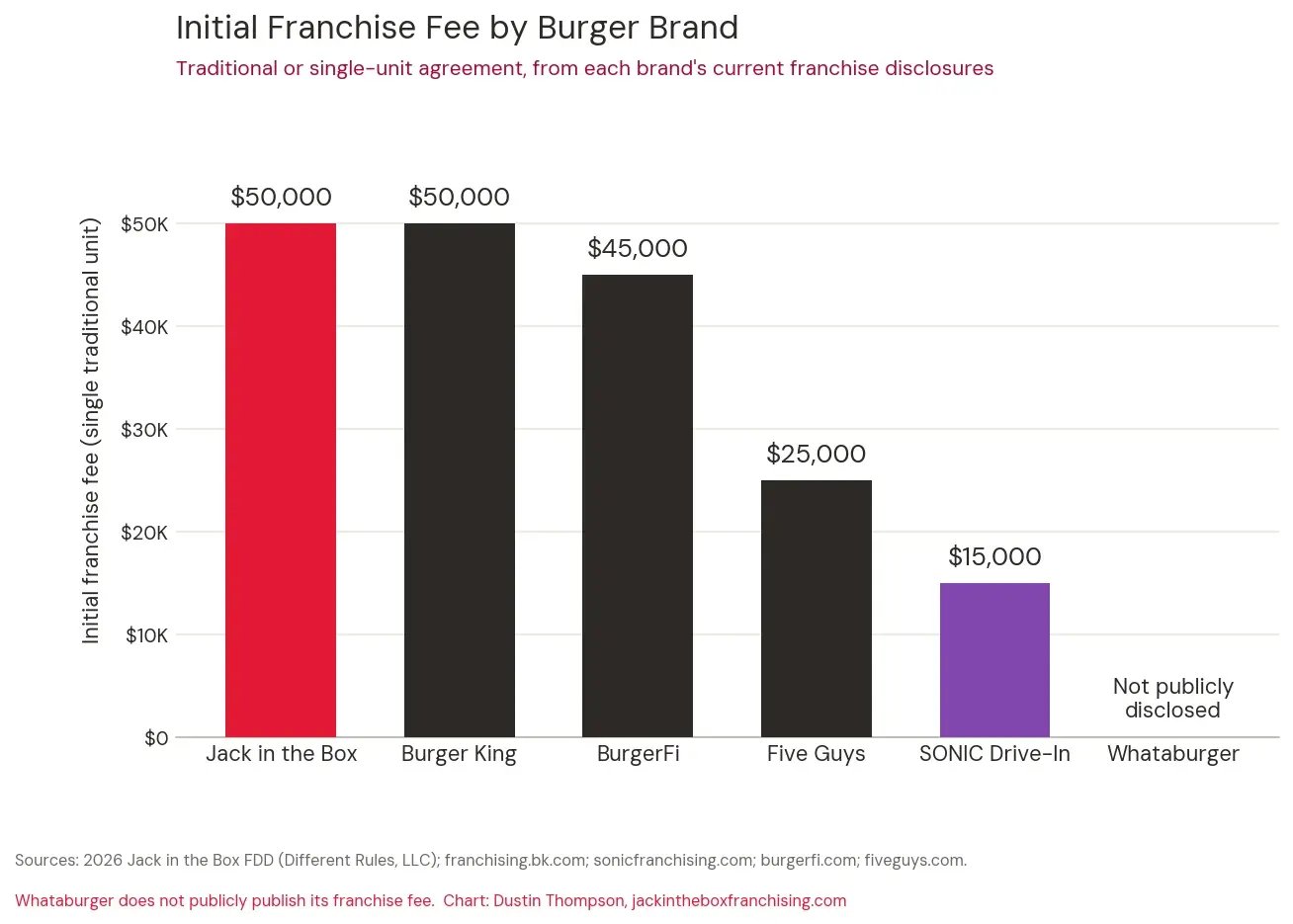
Original chart by Dustin Thompson. Initial franchise fee by brand, per traditional or single-unit agreement.
The FTC's Consumer's Guide to Buying a Franchise makes the same point in plainer terms: your initial franchise fee usually runs from tens of thousands to several hundred thousand dollars, but the costs to rent, build, equip, and stock the outlet are where most of your capital goes. Read Item 7 of any brand's FDD before you anchor on the fee.
How much capital do you need just to qualify?
Before a franchisor will hand you an agreement, you have to clear their financial gate. This is where the brands separate sharply, and where I see prospective operators get surprised. The published minimums below are the floor to be considered, not a forecast of returns.
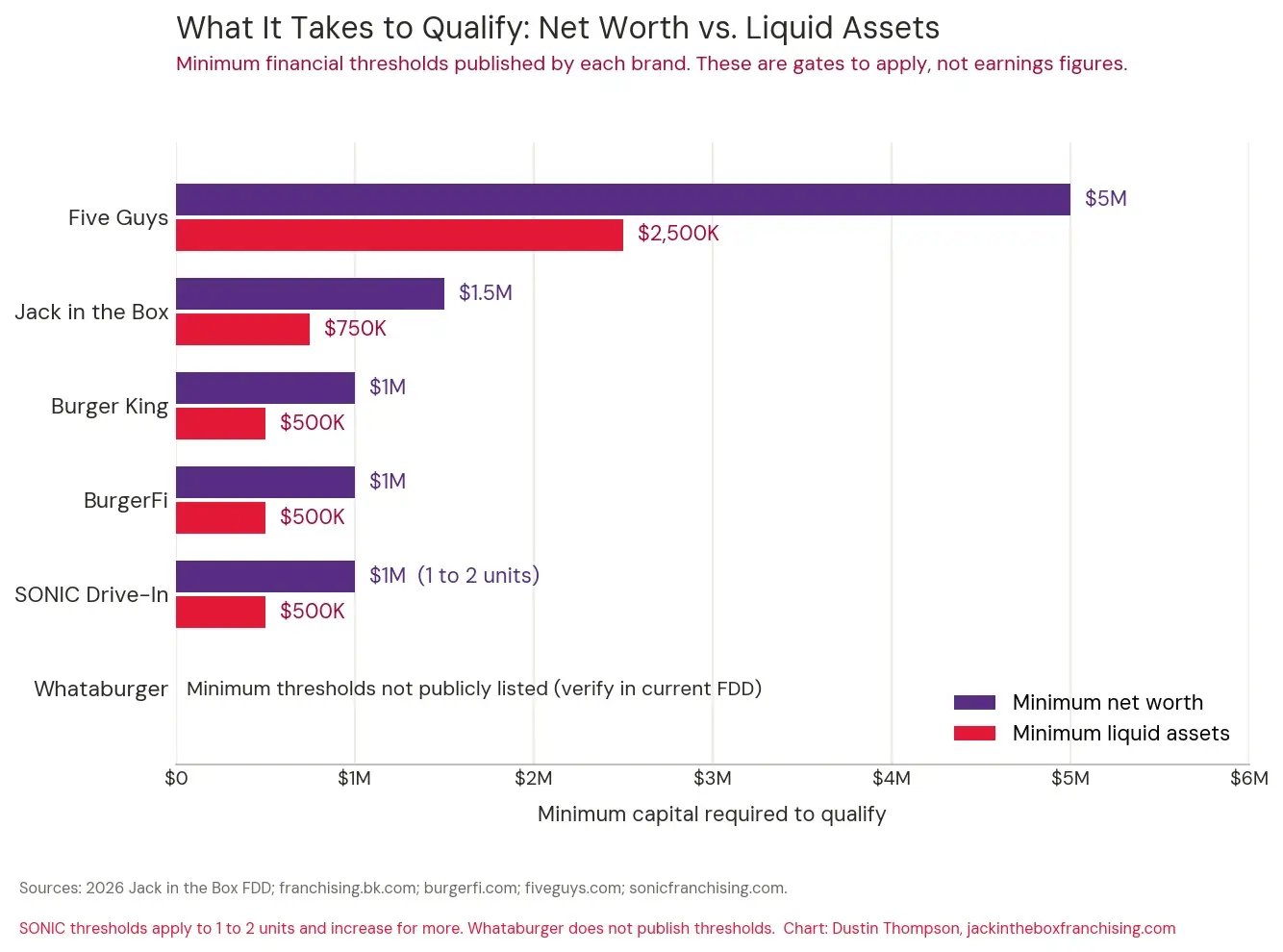 Original chart by Dustin Thompson. Minimum financial thresholds published by each brand. These are gates to apply, not earnings figures.
Five Guys sits in its own tier. Its official franchise page lists a $5,000,000 net worth and $2,500,000 liquid requirement, which lines up with its development-only, multi-unit model. Jack in the Box publishes $1,500,000 net worth and $750,000 liquid. Burger King, BurgerFi, and SONIC publish $1,000,000 net worth and $500,000 liquid, though SONIC's threshold covers one to two units and rises for additional units. Whataburger does not post standard thresholds, so those are verified only inside the current FDD or through direct conversation.
Jack in the Box: what are the terms and who is the fit?
I will start with my own brand because I can speak to it line by line from the source document. Per the 2026 Franchise Disclosure Document issued by Different Rules, LLC, the total estimated initial investment is $1,909,500 to $4,041,500 (Item 7), the initial franchise fee is $50,000 for a traditional restaurant, and the royalty and marketing fees are each 5% of gross sales. You can see the full breakdown on our franchise costs page.
Where it gets interesting for multi-unit operators is the incentive structure. In a qualifying Select Market, the royalty drops to 2% of gross sales for the first five years. Operators who commit to three or more units can access a $150,000 interest-free development loan. We also run a veterans program under VetFran that reduces the first restaurant's franchise fee by 25%, lowering it to $37,500 for qualifying veterans. Those programs are detailed on our multi-unit development and veterans pages.
On performance, our Item 19 reports a system average gross sales figure of $1,913,335 for fiscal year 2025, compared with $1,986,186 for fiscal year 2024. I want to be direct about what that is and is not. It is a historical, system-wide gross sales average. It is not profit, it is not a projection, and it does not predict what any individual restaurant will do. Read the full Item 19 and talk to current operators before you draw conclusions.
Operator fit: experienced operators and multi-unit groups who want development pathways and a defined support model. We are actively developing in Florida, Georgia, Illinois, Kentucky, and Tennessee, and you can see current availability on our available markets page.
Burger King: what does a legacy QSR brand require?
Burger King's official franchise page lists a $50,000 initial franchise fee, a 4.5% royalty on gross monthly sales, and a 4.5% advertising contribution, plus a minimum net worth of $1,000,000 with at least $500,000 in liquid assets. The brand is owned by Restaurant Brands International.
Operator fit: capital-ready operators who want a globally recognized brand and an open development pipeline. The lower published net-worth bar makes it one of the more accessible legacy brands on this list to qualify for, though your build-out costs still land in the seven figures.
SONIC Drive-In: what makes the drive-in model different?
SONIC, part of Inspire Brands, has refreshed its franchise terms. Per its current franchising materials tied to the Franchise Disclosure Document issued March 26, 2026, the initial franchise fee is $15,000 for a traditional location ($11,250 for non-traditional), with a $10,000 per restaurant development fee, a 5% royalty, and a 3.25% minimum advertising contribution. SONIC is currently running a limited-time offer of royalties as low as 1% for the first 12 months. Its franchising site publishes these figures, and the estimated initial investment is detailed in Item 7.
Operator fit: operators comfortable with a vehicle-first, real-estate-heavy format. The drive-in layout makes site selection unusually important. SONIC publishes a $1,000,000 net worth and $500,000 liquid requirement for one to two units on its franchise website, and notes those minimums increase for additional units, since it is run primarily as a multi-unit opportunity.
BurgerFi: what should investors know about the fast-casual option?
BurgerFi is the fast-casual entry here. Its franchising FAQ lists a total initial investment of $629,900 to $1,011,750 including a $45,000 franchise fee, royalties of 5.5% of revenues, a 2.0% national brand fund contribution, and 1.5% local marketing. Minimums are $1,000,000 net worth and $500,000 liquid per restaurant, and the brand requires an owner-operator or an operating partner with equity who lives within about a 60-minute drive of the restaurant.
One material fact to verify directly: the BurgerFi system was reorganized through a 2024 Chapter 11 process, and a new franchisor entity began issuing disclosure documents in 2025. The $45,000 fee and the investment range above come from BurgerFi's published franchising FAQ, but its post-reorganization 2025 FDD has been reported with a lower franchise fee near $35,000 and a different investment range. Treat the latest FDD as the controlling source and confirm the current numbers before relying on them.
Operator fit: hands-on owner-operators who want a lower entry point than the freestanding brands and are comfortable doing diligence on a recently restructured system.
Whataburger: why are the terms hard to pin down?
Whataburger is the brand I get asked about frequently and can confirm the least. It franchises selectively, most locations are company-owned, and it does not consistently publish standard franchise fees, royalty rates, or qualification thresholds. The brand took on BDT Capital Partners as a majority owner in 2019 and has been expanding beyond Texas since.
You will find wildly inconsistent numbers for Whataburger on third-party listing sites. I do not repeat them, because they do not trace to a primary source. The only reliable terms come from the FDD you receive directly through the brand's franchising process.
Operator fit: experienced, well-capitalized multi-unit operators who can be patient with a selective, application-driven process.
Five Guys: a strong brand that may not be available
Five Guys publishes clear terms on its franchise page: a $25,000 franchise fee, a $50,000 development fee, a 6% royalty, a $5,000,000 net worth requirement, and $2,500,000 in liquid capital, with a $10,000 veteran discount on the franchise fee. Prior restaurant or business ownership is required, and an operating partner must hold equity.
The decisive detail is availability. Five Guys states that franchise opportunities are sold out in the United States and Canada, and it is currently accepting inquiries only in select international markets. For a US-based investor, that moves Five Guys from a candidate to a reference point.
Operator fit: high-net-worth international developers. US operators should treat it as a model to compare against rather than an open door.
How should a multi-unit operator actually choose?
After the disclosures are on the table, I tell operators to weigh five criteria in this order:
- Availability in your market. A brand that is sold out or highly selective is not an option no matter how strong it looks on paper.
- Capital to qualify. Match the published net worth and liquidity gate to your real position before you fall for a brand.
- Total investment and fee load. Add royalty and marketing percentages together. A 10% combined load behaves very differently from a 9% load over a unit's life.
- Development incentives. Reduced royalties, interest-free development loans, and veteran programs change the math for committed multi-unit operators.
- Operator involvement. Some brands require an owner-operator or an equity partner on site. Decide whether you want a hands-on or a portfolio role.
Then do the diligence the FTC spells out: read all of the FDD, have an attorney and an accountant review it, and speak with current and former franchisees. When you are ready to map a development plan, our franchise process and training and support pages lay out what working with us looks like step by step.
Frequently asked questions
What is the cheapest burger franchise to start among these brands?
On franchise fee alone, SONIC is lowest at $15,000 for a traditional location, followed by Five Guys at $25,000, then BurgerFi at $45,000. BurgerFi reports the lowest total initial investment range of the group at $629,900 to $1,011,750. Keep in mind the fee is a small part of the total, and a low fee does not make a brand accessible. Five Guys requires the highest net worth on this list and is sold out in the United States.
How much does it cost to open a Jack in the Box franchise?
The 2026 Franchise Disclosure Document estimates a total initial investment of $1,909,500 to $4,041,500, including a $50,000 franchise fee per traditional restaurant. Royalty and marketing fees are each 5% of gross sales. Qualifying markets and multi-unit commitments can carry incentives that lower the effective cost.
Do these burger franchises disclose how much money owners make?
Franchisors are not required to make earnings claims. When they do, the FTC Franchise Rule requires written substantiation in Item 19. Any sales figure you see, including ours, is gross sales, not profit, and it does not predict an individual location's results. Always review Item 19 and speak with current operators.
Which burger franchises are actually accepting new US operators?
Jack in the Box, Burger King, SONIC, and BurgerFi are actively franchising in the United States. Whataburger franchises selectively with most locations company-owned. Five Guys reports its US and Canada territories as sold out.
Why should I avoid third-party franchise listing sites for cost data?
Because the numbers drift. In my own checks, aggregator pages have carried outdated fees, wrong investment ranges, and figures that do not match the current FDD. Every number in this article comes from a primary FDD filing or an official brand franchise page for that reason.
Comparing burger franchise opportunities for your market?
I work directly with operators evaluating development in Florida, Georgia, Illinois, Michigan, Ohio, Indiana, Kentucky, Tennessee and more! If you want to compare the numbers above against a real Jack in the Box development plan, let's talk.
About the author. Dustin Thompson leads franchise marketing and development for Jack in the Box (franchisor entity: Different Rules, LLC). He works hands-on with prospective and multi-unit operators and builds his brand comparisons directly from Franchise Disclosure Documents and official franchise pages rather than third-party aggregators.